


A rental fleet lives a harder life than almost any other audio equipment. A DJ booth that sits in one venue for years is a different purchase from one that gets folded, loaded, driven, unfolded and reassembled three times a week. For rental companies, the buying decision is less about how a booth photographs on a product page and more about how it behaves after its two-hundredth setup. This checklist walks through the questions a rental buyer should ask before adding DJ booths and facade tables to inventory, using the structural details that separate a fleet-friendly unit from one that will spend more time in the repair corner than on stage.
All structural details below are drawn from the current LESOUND stand catalogue, which covers the full-steel foldable DJ table series (FS013, FS014, FS015), the two-in-one facade tables (FS002, FS003), the adjustable-feet facade tables (FS004, FS006, FS007) and the adjustable-height folding-leg table DJT001. Yinyu-branded stands and tables are produced in the same LESOUND factory line for stands and stage hardware.
1. Transport Reality: Folded Size, Weight and the Carry Bag
The first filter for a rental buyer is not appearance — it is whether the unit fits the van. A booth that folds flat changes the logistics maths entirely: flat panels stack, while bulky assembled frames do not.
The full-steel foldable DJ tables in the FS013/FS014/FS015 series fold down to a package of roughly 119 x 107 x 15 cm, which means a stack of five booths occupies about the same van depth as a single flight case of comparable footprint. Unit weight sits between 21.5 kg and 27.5 kg depending on the version — a two-person lift, but not a four-person one. Each table ships with a carrying bag, and for fleet use that bag is not an accessory: it is what keeps scuffs off the scrim panels between gigs.
Ask the supplier for the folded package dimensions and the weight including the bag, not just the assembled dimensions. A booth that looks compact assembled but folds into an awkward 130 cm-long shape will quietly eat storage rack space for years.
2. Setup Speed: Folding Legs, Pin Locks and One-Person Workflow
Rental margins are made and lost in setup minutes. Two structural features matter here.
First, the leg system. The DJT001 table uses strong steel legs that fold into the desk body, height-adjustable from 66 cm to 100 cm, held by a pin-locking mechanism with a pull ring — the crew pulls the ring to release, swings the leg, and the pin re-engages. No loose hardware, no tools, no parts to lose in the truck. For a rental fleet, any design that eliminates loose bolts and separate brace bars removes the single most common reason a booth comes back incomplete.
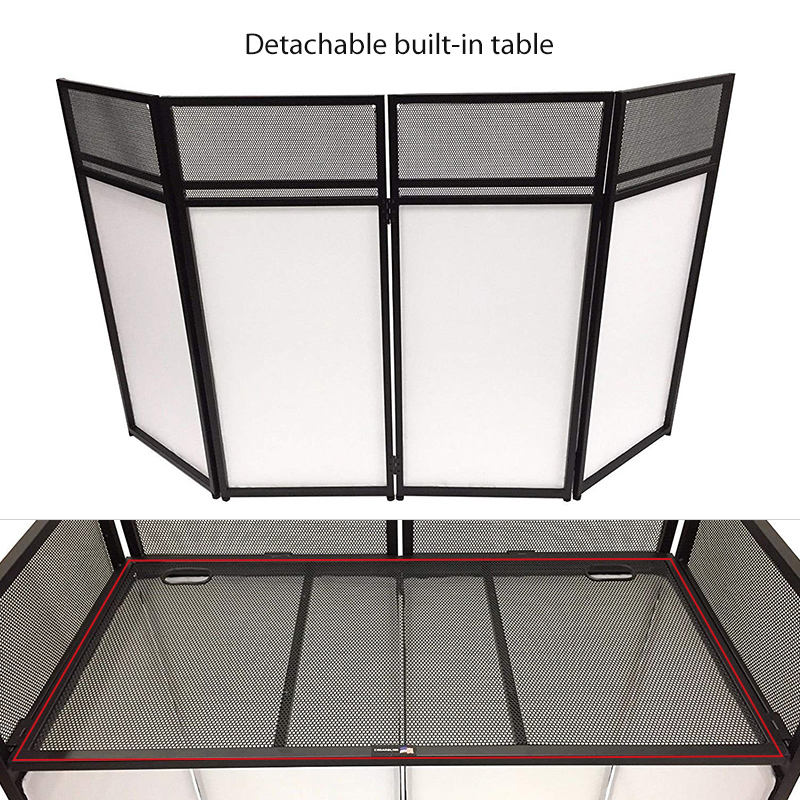
Second, the panel system on facade tables. The FS002 and FS003 two-in-one facade tables use four panels joined by hinges that fold completely flat, and the same panels serve as either a traditional DJ facade or — with the mesh tabletop attached — as a full facade table. A crew member can build or break down the whole structure in a few minutes without a second pair of hands, which matters when a Friday-night changeover runs two acts back to back.
When you evaluate any booth for rental use, ask to see the setup sequence on video or in person, and count the loose parts. A design with zero loose parts scores higher for rental duty than a marginally lighter one that ships with a bag of clips.
3. The Work Surface: Plywood vs Mesh Tabletops and Gear Protection
The tabletop is where mixers, controllers and laptops actually live, and rental gear gets set down hard. The catalogue offers two approaches.
The DJT001 uses a 20 mm plywood desk, 50 x 150 cm at full size, with a carpet finish on the working surface. Carpet finish matters for rental fleets: it resists the scratches that come from hard-edged controller cases sliding across the surface, and it keeps gear from sliding when a table is set up slightly off-level. The desk folds in half and includes a strong carry handle moulded into the structure.
The FS-series tables take a different route: a flat steel mesh removable tabletop with two grommet holes for cable pass-through. The mesh surface is rigid and ventilated, and because it is removable, a damaged top can be swapped without retiring the whole frame — a meaningful advantage when a fleet unit takes a hit mid-season.
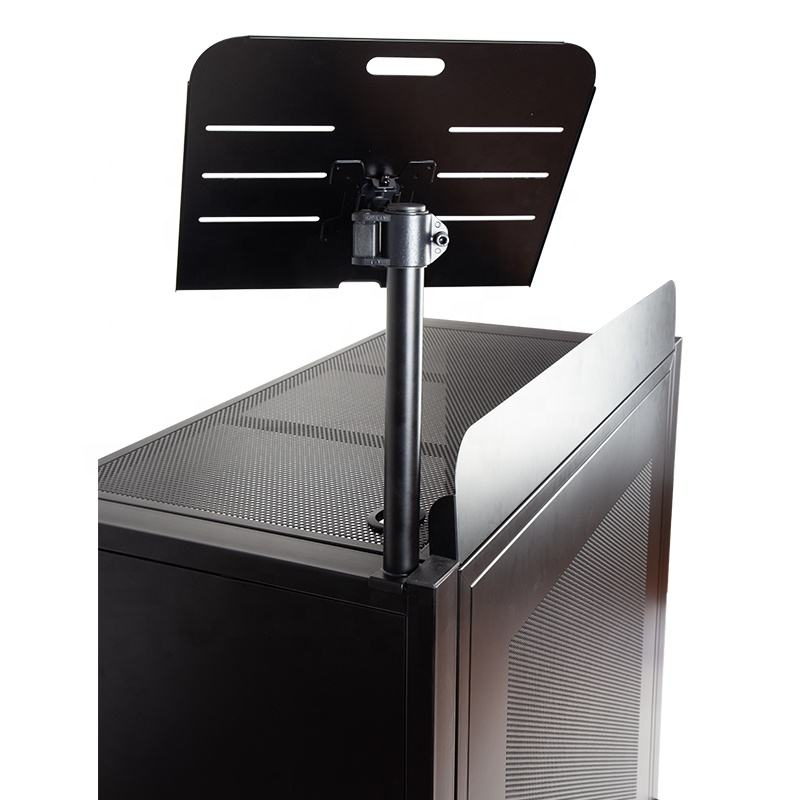
On the FS015 version, the working area extends beyond the bare table: the catalogue lists a strong desk with back stop, plus a cup holder, a headphone holder and a laptop mount as part of the package. Back stops and raised edges are worth specific attention for rental use, because they are what stops a mixer sliding off the back when a guest DJ leans on the booth.
4. Cable Access: Grommet Holes and Cable Management Ports
A rental booth gets re-cabled at every event, by a different crew each time, often in a hurry. Cable routing provisions are therefore not a detail — they determine whether the booth comes back with its panels intact.
The FS-series tables carry two grommet holes in the removable mesh top, so signal and power lines drop straight through the work surface instead of over the front scrim. The DJT001 adds a dedicated cable management port in the desk structure, which keeps the run from mixer to amp rack or floor box out of sight without drilling or zip-tying to the frame.
For fleet buyers, the checklist question is simple: can a crew member with no knowledge of this specific booth route power, XLR and controller lines cleanly in under two minutes? If the answer requires improvisation, panels will end up taped, velcroed and eventually torn. Pairing the booth with the right stock of lines is its own topic — the company’s audio cables range covers the XLR, speakon and multi-core lines that a booth build-out typically consumes.
5. Front Panel Options: Cloth Scrim, Steel Mesh and Two Colours
The front panels do two jobs at once: they hide the cable nest from the audience, and they take the abuse of transport. The catalogue splits the FS013/FS014/FS015 series exactly on this line — FS013 and FS015 carry a cloth front scrim, while FS014 uses a metal front mesh in place of the fabric. Steel mesh survives the rough handling typical of cross-rental and sub-hire traffic; cloth gives the classic smooth look that wedding and corporate clients tend to ask for. Many rental operators deliberately stock both.
Colour is the second decision. Each version is available in white (suffix W) or black (suffix B), and on the adjustable-feet facade tables FS004, FS006 and FS007, both a white and a black scrim are included in the box, attached with 3M velcro so the crew can flip the colour per event without carrying a second set of panels. For a rental fleet, white scrims photograph well for event planners, but black hides scuffs between washes — the included-both-scrims format is worth prioritising for that reason alone.
Note that the FS004/FS006/FS007 variants also add adjustable feet for uneven floors, plus either a TV bracket (FS004), a light bar (FS006), or both (FS007). If your events regularly include LED walls or uplighting, the light-bar version removes one more item from the truck, though dedicated fixtures still belong on lighting stands for larger rigs.
6. Height Range: One Booth, Two Different Clients
Standing height matters more at private events than most buyers expect. A table fixed at 94 cm — the FS-series standard height — suits a standard controller setup for a standing DJ. But seated sets, low stage risers and children’s equipment at family events all call for something lower.
This is the case for the DJT001′s 66 to 100 cm adjustable range: the same fleet unit serves a seated wedding set at 66-70 cm and a festival-style standing booth at the full 100 cm. The pin-locking mechanism makes the change a thirty-second job during soundcheck. Rental companies that cover both corporate and private-event markets tend to value this range more than any other single feature on the table, because it converts one stock unit into two product offerings.
Where the fixed-height FS tables win is rigidity and the integrated facade function — the two-in-one FS002/FS003 format means the booth and the table are the same object, with no separate facade to carry. A balanced fleet usually mixes both types, and the DJ booth and DJ table category pages break down the current formats side by side.
7. The Fleet Buyer’s One-Page Checklist
Condensing the above into the questions to put in front of any supplier before ordering:
- Folded package dimensions and weight including bag — will five units stack in the van you actually own?
- Loose-part count per setup — zero is the target; every separate clip is a future missing item.
- Locking mechanism — integrated pin locks with pull rings beat separate braces and knobs for turnaround speed.
- Tabletop material and replaceability — plywood with carpet finish for scratch resistance, removable mesh tops for mid-season swap-out.
- Gear-retention details — back stops, raised edges, laptop mounts and cup holders all reduce damage claims.
- Cable pass-through — dedicated grommets and management ports, sized for both power and signal lines.
- Front panel system — cloth versus steel mesh to match your client mix; included white and black scrims for colour flips on site.
- Height adjustability — a 66-100 cm range covers seated and standing formats from the same unit.
- Spares availability — confirm replacement scrims, mesh tops and feet can be ordered separately from the factory.
8. Matching the Booth to the Rest of the Rig
Finally, a booth is never bought alone. It arrives in the same truck as the PA, the lighting and the cabling, and the smartest fleet buyers specify them together. Speaker placement around the booth should be planned with the same fold-flat logic — the speaker stands in the Yinyu range follow the same folding-leg and integrated-lock philosophy described above, so crews learn one workflow and apply it across the load-out. Signal lines that live inside the booth should match the venue-side stock, which is where the company’s audio cables catalogue and the microphone cables range slot in.
LESOUND manufactures the full stand and stage-hardware line — stands, DJ tables and facades — in a 7,000-square-metre factory in Ningbo, and supplies rental companies and distributors under the Yinyu brand alongside OEM programmes. For buyers building or refreshing a rental fleet, the practical next step is to shortlist the formats above against your van dimensions and client mix, then request the factory’s current specification sheets for the FS and DJT series to confirm the details that matter for your operation.
Post time: Oct-28-2026