


Walk down the back line of any stage and you will see two cable types that are almost impossible to tell apart at a glance. Both use the same latching XLR connectors, both wear a round black jacket, and both coil up into the same road trunk. One carries the audio from a mixing console to the amplifiers; the other carries the lighting control data that tells every fixture on the truss when to change colour. They are not interchangeable, and the difference is worth a few minutes of understanding — because plugging the wrong one into a lighting rig is one of the most common and most frustrating wiring mistakes in live production.
This guide comes from the cable factory rather than the forum. LESOUND builds both lines in the same plant: analog audio cable in the Yinyu range, and a dedicated DMX cable family — bulk constructions such as DMX512 and DMX1024, plus finished assemblies DMX001 through DMX009. Below is how we explain the difference to distributors and installation contractors who stock both.
The Connector Is the Same. The Cable Inside Is Not.
The confusion starts with the connector. XLR is a connector standard, not a cable standard — it describes the shell, the pin layout and the latch. What travels down the three pins is a completely different question. An audio XLR cable carries a balanced analog signal, a continuously varying voltage that represents sound. A DMX cable carries digital control data: rapid voltage transitions between two fixed levels, clocked at a quarter of a million bits per second in the DMX512 protocol.
Analog audio is forgiving. If a cable is slightly imperfect, the signal degrades gracefully — a little more hum, a little less top end, usually nothing an audience would notice. Digital data is not forgiving. A data receiver does not hear “slightly degraded”; it either reads the transitions cleanly or it errors out, and errors on a lighting line look like fixtures that flicker, drop out mid-show, or freeze on their last scene.
Because the failure modes differ so much, the two cables are engineered differently from the conductor outward — even though the finished products look identical on a shelf.
What XLR Audio Cable Is Built to Do
A microphone or line-level XLR cable has one job: move a tiny analog voltage from A to B while picking up as little interference as possible. Its design priorities are:
- Shielding first. A braided or spiral copper shield surrounds the twisted pair, intercepting hum from mains wiring and radio-frequency noise from dimmers, LED drivers and switch-mode supplies.
- Flexibility and toughness. Audio cable gets coiled, stomped, and yanked nightly. A soft PVC jacket and fine-stranded conductors keep it workable at low temperatures and resistant to kinking.
- Low handling noise. The pair is twisted so that interference induces equal voltages in both conductors, which the balanced input at the far end cancels out.
What audio cable does not carefully control is its characteristic impedance — the electrical property that decides how fast signal edges propagate and reflect. For analog audio in the audible band, impedance matching simply is not part of the problem, so mic cable manufacturers optimise elsewhere: shield coverage, capacitance, mechanical strength.
What DMX Cable Is Built to Do
DMX data is a different electrical animal. The DMX512 protocol runs over an RS-485 style differential link, and that link behaves like a transmission line: every transition down the pair meets the cable’s characteristic impedance, and any mismatch sends part of the signal bouncing back toward the transmitter. Those reflections corrupt the timing of the data edges — which is exactly what a lighting receiver cannot tolerate.
That is why purpose-built DMX cable is designed around a controlled 120-ohm characteristic impedance, with precision-tuned conductor spacing, insulation and twist geometry. Our own DMX constructions in the cable catalogue illustrate the approach:
- Twisted OFC conductors with a cotton filler. The filler keeps the pair geometry stable when the cable is bent, which keeps the impedance stable too.
- Double shielding. A braided OFC shield plus an aluminium foil layer. The braid handles low-frequency interference and mechanical abuse; the foil closes the gaps against the high-frequency noise that dimmer racks and LED supplies radiate. The catalogue describes the family as particularly designed for lighting control with better anti-interference ability.
- Two- and four-conductor versions. The DMX512 construction carries the primary data pair, while the DMX1024 four-conductor build supports extended and multi-universe wiring schemes.

Factory photo: a 5-pin DMX cable assembly from the LESOUND cable plant. The connector is familiar; the cable geometry behind it is not mic cable.
Why Impedance Matters for Data but Not for Vocals
A useful way to picture it: analog audio is like water flowing steadily through a hose — small kinks barely matter. Data is like a series of sharp pulses fired down the hose; every kink sends a splash backwards. Mic cable is full of small electrical kinks, and at 250 kbps each one throws a small echo down the line. Over a short run of a few metres, a lighting receiver may still sort the signal out. Stretch the run to thirty metres past a dimmer beach, and the errors start arriving in the middle of the encore.
What Happens When You Use the Wrong One
Mic cable on a lighting rig is the mistake that causes the trouble. The symptoms are maddening precisely because the system seems to work: the rig tests fine in the afternoon, then fixtures start flickering or dropping scenes once the room fills, the LED wall powers up, and the cable runs warm under the stage. Swap the mic cable out for proper DMX cable and the gremlins usually disappear — because the reflections and noise immunity problems went with them.
DMX cable on an audio line is the reverse case, and here is the honest answer: electrically, it works. A 120-ohm balanced cable passes analog audio without any practical problem, and its shielding is usually excellent. The reasons audio crews still keep the two apart are practical — data cable is often slightly stiffer, and mixing stock makes inventory confusing. There is also nothing wrong with an install contractor standardising on DMX cable where both uses exist; it is simply a stock-keeping decision rather than a sonic one.
The direction that matters, then, is one-way. DMX cable can back up an audio line in a pinch. Mic cable should never be speced for a lighting run, especially a long one or one sharing a route with dimmer and LED power.
The 5-Pin Question: Why DMX Prefers XLR-5
Look closely at lighting-grade XLR connectors and you will notice many of them have five pins rather than three. The DMX512 specification favours the 5-pin connector for two sensible reasons: the second pair is reserved for future and optional uses, and the extra pin count physically prevents a lighting cable from being plugged into an audio line — or a vocal mic being jabbed into a lighting port mid-changeover.
In practice, most professional fixtures accept 5-pin while a great deal of installed legacy kit and budget gear still uses 3-pin, so wholesalers need both formats and the adapters between them. The LESOUND DMX assembly range covers the full matrix:
- DMX001 / DMX002 — 3-pin and 5-pin XLR male-to-female assemblies for standard fixture links.
- DMX003 – DMX006 — additional 3-pin and 5-pin combinations so mixed fleets can be cabled without re-terminating anything.
- DMX007 / DMX008 — 3-pin to 5-pin adapter assemblies, and DMX009 in the reverse direction.
- DMX001 in its splitter configuration — one 5-pin female input feeding two 3-pin male outputs, handy for dividing a console output toward two short fixture chains.
For buyers assembling a lighting accessories programme, stocking bulk DMX512 cable plus a small matrix of finished assemblies and adapters covers nearly every combination a rental house or installation contractor will ask for.
A Quick Checklist Before You Ship a Mixed Container
Because the two cable types look alike, warehouse and shipping mistakes are the real-world failure point. A few habits keep them apart:
- Print or label the jacket. A cable marked DMX on the jacket cannot quietly end up in the audio bin.
- Count the pins when receiving. It takes two seconds and settles most stock questions.
- Separate the reels in storage. Bulk DMX512 cable and bulk mic cable should never share a rack position.
- Route data away from power. Even the best-shielded data cable prefers not to run parallel to dimmer feeders for thirty metres.
- Keep terminators on hand. A data terminator at the last fixture is the cheapest insurance a lighting rig can carry.
How LESOUND Supports Both Lines
LESOUND produces analog audio and lighting control cable side by side in Ningbo: braided instrument and patch assemblies, XLR microphone and line cable, audio snake and multi-core builds under the Yinyu range, plus the dedicated DMX constructions described above — all exported through OEM programmes and wholesale supply to more than sixty countries. Because both families come off the same production floor, mixed-container buyers deal with one factory, one QC process and one consolidation point rather than coordinating two suppliers.
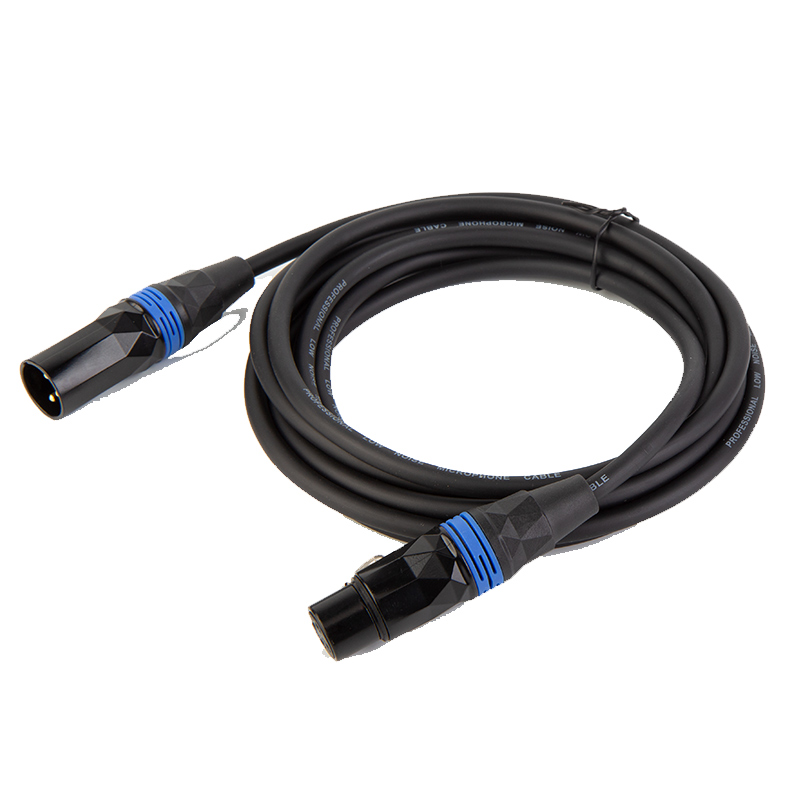
Factory photo: an XLR audio cable from the same plant. Different internals, same connector family — which is why labelling and stock discipline matter.
If you are planning a range around live production, these guides go deeper on the neighbouring products: our overview of professional audio cables, the microphone cable selection, multi-pair audio snake cables for stage looms, and the stage-side hardware that consumes all of this cable — DJ booths and lighting stands.
And when the next mixed cable order is being quoted, ask the supplier one question first: which of these SKUs are data-rated and which are audio-only? A factory that answers instantly — with the constructions to prove it — is a factory that builds both properly.
Post time: Oct-20-2026