


Somebody mixes a track on a desk, plays it in a car, and the low end has vanished. They blame the room, then the monitors, then themselves. Nine times out of ten the problem started at the desk surface, because a wooden top under a pair of speakers doesn’t sit still. It moves with the cabinets, and it radiates.
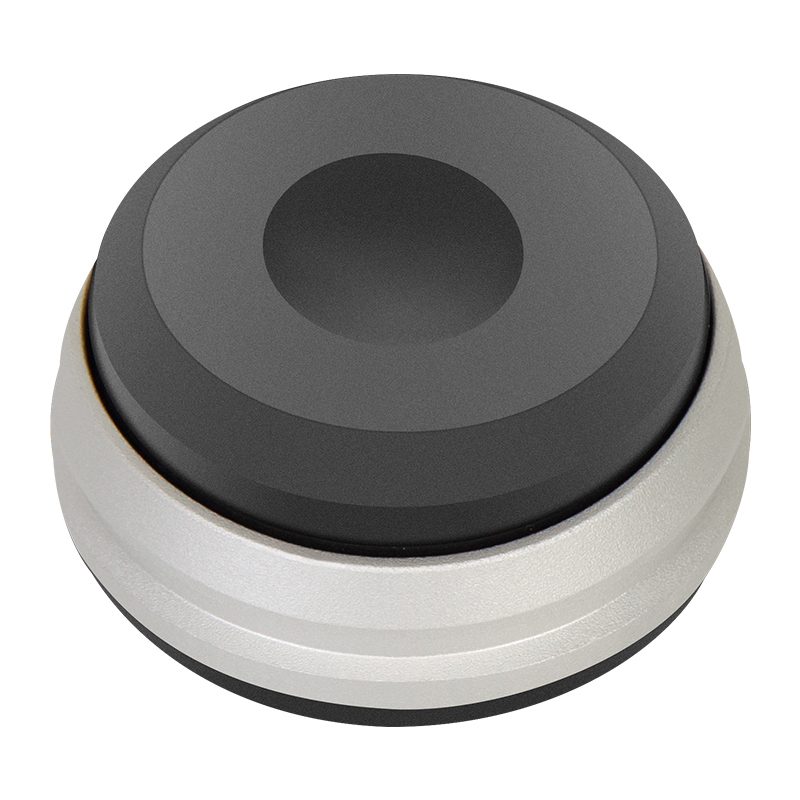
A speaker isolation platform is a small piece of hardware that breaks that path. Ours are built for nearfield and desktop setups, and they’re the sort of part a dealer sells alongside the monitor rather than instead of it. If you’re assembling a range for studio customers, the detail that matters is in the contact page on our site.

A desk is a second diaphragm, and nobody budgets for it
Put a monitor cabinet straight onto a desk and the driver’s motion has somewhere to go. The cabinet vibrates, the desk picks it up through four small contact patches, and a flat panel roughly a metre across starts behaving like a large, badly damped radiator. It’s not adding bass in any useful sense. It’s adding a delayed, smeared copy of the bass, arriving a fraction late and from the wrong place.
What a mixer hears is a low end that seems full until they check it somewhere else, plus a midrange that feels slightly hollow. Neither symptom points at the desk, which is why the diagnosis takes so long. The giveaway is usually physical. Put a hand flat on the desk while something with a strong bass line plays, and you’ll feel it humming.
That hand test is worth teaching to anyone who sells this category. It costs nothing and settles the argument in four seconds, which matters when the customer is in a shop and doesn’t want a lecture.

Foam compresses, and that changes where the tweeter points
The obvious way to decouple a cabinet is to sit it on something soft. The problem with soft is that it keeps being soft. A pad that’s comfortable under a light monitor will flatten under a heavy one, and the cabinet settles at an angle rather than sitting level. A couple of degrees of tilt at the base turns into a visible change in where the tweeter axis lands at the listening position.
This is why density matters more than thickness on a spec sheet, and why a supplier who quotes one figure without the other hasn’t told you much. A dense enough foam holds its shape under load, and a foam that’s too dense transmits vibration almost as well as the desk did. There’s a middle band where the material compresses a little and stops there.
Ask what weight range the platform is intended for and how much compression is expected at the top of it. We’d rather confirm that against your actual cabinet weight than quote a number that only holds for one model, so send the monitor model and we’ll answer for it.
Weight against density, tested with the heel of your hand
On a sample, the check doesn’t need instruments. Set the platform on a hard floor, put the monitor on it, and press a corner of the cabinet with the heel of your hand, the way you’d test a mattress. What you’re watching for is whether the material bottoms out. If it goes solid, it’s too soft for that cabinet.
Then look at the gap. The platform should still be visibly thicker at the unloaded edges than under the cabinet’s feet. Once the whole pad is flat against the desk, it’s stopped doing the job and started being a shim.
- Press one corner, watch the opposite corner lift, and note whether the material recovers when you let go.
- Check that the cabinet sits level by eye from the side, because a tilt you can see is a tilt you can hear.
- Slide a sheet of paper under each corner and see whether it pulls out evenly, which finds a rocking cabinet faster than a spirit level.
Contact area decides whether the platform walks
A platform smaller than the cabinet base concentrates the load on a narrow band and gives the monitor a lever to rock on. One much larger than the cabinet puts most of its surface to no use and looks wrong on a desk. The useful rule is that the pad should meet the cabinet footprint closely, with a small margin rather than a large overhang.
There’s a second effect worth knowing about. Soft materials creep. A monitor that sits in the same place for two years will leave a permanent depression, and the cabinet will end up resting on the compressed rim rather than the centre. That’s one reason a platform with a firm base layer and a softer top layer holds up better than a single slab.

Angle first, then decoupling, then everything else
Here’s the order we’d put the work in, and it isn’t the order most buyers expect. Before any isolation hardware, get the tweeter pointing at the ears. A nearfield monitor is designed to be listened to slightly off axis, and a cabinet sitting low on a desk aims the high frequencies at the listener’s chest. That alone produces a dull top end that people try to fix with EQ.
Once the angle is right, deal with the surface. Only after both of those does it make sense to think about wall treatment or room correction, because those two are working on a signal path that’s already been compromised. A desktop monitor speaker stand is the tool for step two, and it isn’t a substitute for step one.
For a customer who can’t raise the monitor, a tilt built into the platform does the same job in one move. That’s why we treat angle adjustment as a feature of the platform rather than an accessory to it.

Where the nearfield triangle sits before you buy hardware
The other thing worth settling early is geometry. An equilateral triangle with the listener’s head at one corner and the two tweeters at the others is the usual starting point, and the distance from the front wall matters as much as the distance between the cabinets. Push monitors back against a wall and the boundary reinforces the low end in a way no platform will undo.
So the honest advice to a studio customer is a sequence. Move the desk, set the triangle, set the height, then isolate. Selling someone a platform to fix a placement problem is a return waiting to happen, and it’s the reason we ask what the desk looks like before recommending a size. A 6.5 inch active studio monitor is the usual starting point in a small room, and it’s worth knowing its footprint before you pick a platform to sit under it.
What a shop shelf needs from the packing
Isolation platforms are an easy add-on sale and a hard thing to merchandise, because they’re flat, light and look like nothing in a bag. The packing has to do the selling. A printed face that shows a monitor sitting on the product does more work than a paragraph of copy, and a hang hole turns a shelf item into a pegboard item.
For ecommerce the flat shape helps in freight and hurts in a mailer, since a thin carton that flexes will crease the foam corners. Ask for a carton that holds its shape under a stack, and confirm whether the pair ships banded or loose.
- Ask for the packed dimensions and weight per pair before you cost the freight.
- Confirm whether the retail carton carries a printed image or a plain label.
- Check whether the pair is banded together or packed loose, since loose pairs arrive separated.
Where these sit in a mixed order
Studio customers rarely buy one thing. A typical container from us carries Yinyu stands for the monitor positions, Yinyu cables for the runs behind the desk, and Audfine headphones for the second reference, all on one set of documents. It’s the same reason a college music department orders Yinyu stands and platforms together, since the room gets fitted out in one go and nobody wants a second delivery window.
That mix is also why we can be useful on the packaging side. A dealer building a studio range wants the boxes to look like they belong to each other, and Yinyu stands already ship in a house style. Ningbo Lesound Electronics builds the platforms on the same line, so matching the print across the range is a conversation rather than a project.

Three checks we’d run on any isolation platform
We aren’t going to name other factories and rank them. What we can do is give you the three checks that separate a platform that works from a block of foam with a logo on it. Use them on us as readily as on anyone else.
1. Load it and look at the gap. Put the intended cabinet on the sample and check whether the material still has thickness at the edges. A platform that flattens completely has become a spacer, and a spacer transmits.
2. Ask for the weight band in writing. A supplier who can state which cabinet weights the platform suits, and what happens above that, has tested it. One who says it suits all monitors hasn’t.
3. Check the base layer. A firm layer under a softer top stops the material creeping and keeps the cabinet level over years. Ask what the underside is, because that’s the part nobody photographs.
Questions buyers send about isolation platforms
Will a platform fix a room that sounds boomy?
Partly, and less than people hope. It removes the desk or shelf from the vibration path, which cleans up the low end at the listening position. It doesn’t change room modes, and it won’t fix a monitor pushed into a corner. Treat it as one step rather than the answer.
Should I use a full platform or just the feet?
If the cabinet has a flat base and the desk is the problem, isolation feet rather than a full platform are usually enough and cheaper to ship. If you also need to change the angle, a platform does both jobs. We build both, and the choice usually comes down to whether height adjustment is part of the brief.
Do these work under a subwoofer?
They can, and the load is the thing to check first, because a subwoofer cabinet weighs considerably more than a nearfield monitor. Send the cabinet weight and we’ll tell you whether the standard platform suits or whether you need a different build.
How thick should the platform be?
Thickness alone doesn’t answer it. What matters is whether the material holds its shape under your cabinet, which is a function of density as much as depth. A thick soft pad can bottom out where a thinner firm one won’t.
Can the platform be branded for our shop?
Yes. OEM and ODM are available, and the usual requests are a printed carton, a moulded or printed mark, and a colour matched to the rest of your range. Send artwork and the quantity band and we’ll confirm what’s practical.
What’s the best way to check a sample when it arrives?
Put your heaviest monitor on it, leave it for a day, then look at the gap at the edges and check the cabinet is still level. Foam that’s wrong for the load shows up within a day, and it’s better to find out on a sample than in a customer’s studio.
If you’re building a studio range and want the platforms to match the rest of the catalogue, send us the monitor models you sell and we’ll confirm which builds suit them. The quickest route is the contact page on our site, where you can tell us the cabinet weights and the packing you have in mind.
Post time: Nov-04-2026