


A guitar stand looks like the simplest piece of gear in a studio or on a stage, and that is exactly why it is so often chosen badly. A stand that suits a touring electric player may be awkward in a teaching studio. A rack built for a retail wall is overkill for a bedroom practice corner. At LESOUND we manufacture guitar stands under our Yinyu brand alongside microphone stands, keyboard stands and other instrument hardware, and the questions buyers ask us most are not about any single model — they are about which type of stand fits which working environment. This guide walks through the main categories, what each one is designed to do, and the situations where it is the sensible choice.
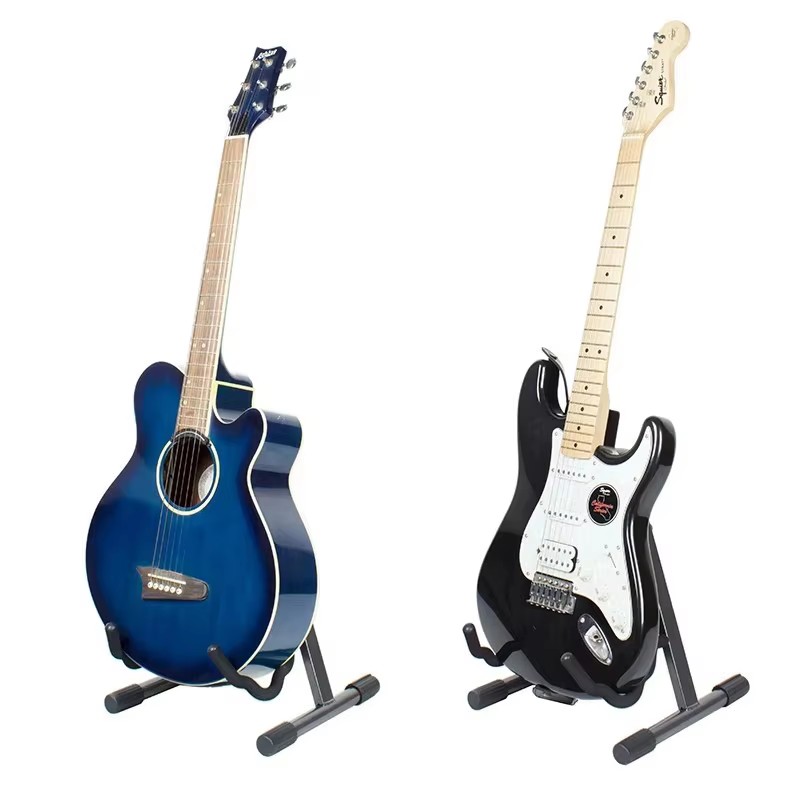
Factory photo: acoustic and electric guitars resting on floor stands from the Yinyu range.
Why the Type of Stand Matters More Than Any Single Feature
Guitars vary enormously in shape and balance. A dreadnought acoustic leans back heavily on its lower bout; a Strat-style electric sits forward and light; a classical guitar has a wider body and a polished finish that shows every scuff. The stand’s job is to hold those very different silhouettes without stressing the neck, the finish or the tuning machines. That is why manufacturers divide stands into A-frames, auto-locking stands, folding portable stands, multi-guitar racks and wall hangers rather than offering one universal product — and why a buyer who matches the type to the setting rarely has to compromise.
A-Frame Stands: The Classic Floor Choice
The A-frame is the stand most people picture first: two legs spreading from a horizontal base bar, with a padded yoke in the middle that cradles the body of the guitar. It is simple, stable and quick to use — step the guitar in, lean it back, done.
A-frames suit settings where the guitar is set down and picked up constantly: rehearsal rooms, backstage corners, lesson rooms. When specifying an A-frame, check two details. First, the yoke padding: a soft EVA coat protects both the body finish and the top of the lower bout. Second, whether the model adds a neck hook. Our GS720 and GS820, for example, pair the padded holder (25 cm wide) with an upper hook for the guitar neck, and the hook height adjusts from 50 to 78 cm so the neck is supported rather than left to pull against the body. For heavier instruments or busy rooms, that second contact point is worth having.
Auto-Locking Stands: For Stage and Backline Use
A more recent category is the auto-locking stand. In our GS030 to GS034 series, the hook locks automatically when the guitar is placed onto the stand and releases when the guitar is lifted out. There is no latch to operate one-handed while the other hand holds the instrument, and no chance of a neck simply tipping out of a passive yoke when someone brushes past.
Where does this matter most? Anywhere people move around guitars. Backline techs love them because the guitar stays put during a set change. Rental houses and teaching studios like them because students handle them without instruction. The series covers floor stands with working heights from 77 to 120 cm, EVA padding at every contact point, and variants for acoustic, classical, electric, bass and even ukulele headstocks. If the stand will live in a public or high-traffic space, auto-locking is the type to shortlist.
Folding and Portable Stands: Built for the Gig Bag Lifestyle
Some players never leave home without a stand. For them, the question is not how impressive the stand looks in a room but how little space it occupies on the way there. A dedicated portable model such as the GS033 folds down to just 34 cm in height, with a 21 cm holder — small enough to slide into a guitar bag pocket or the accessory compartment of a case.
Portable stands trade some mass for packability, so evaluate them on the three things that keep a light stand honest: the spread of the feet (a wider footprint compensates for lower weight), the quality of the rubber feet on hard stages, and the hinge hardware — metal joints and firm detents rather than loose friction. For buskers, session players commuting between studios, and teachers who bring a guitar to several schools in a day, this category is the practical answer.
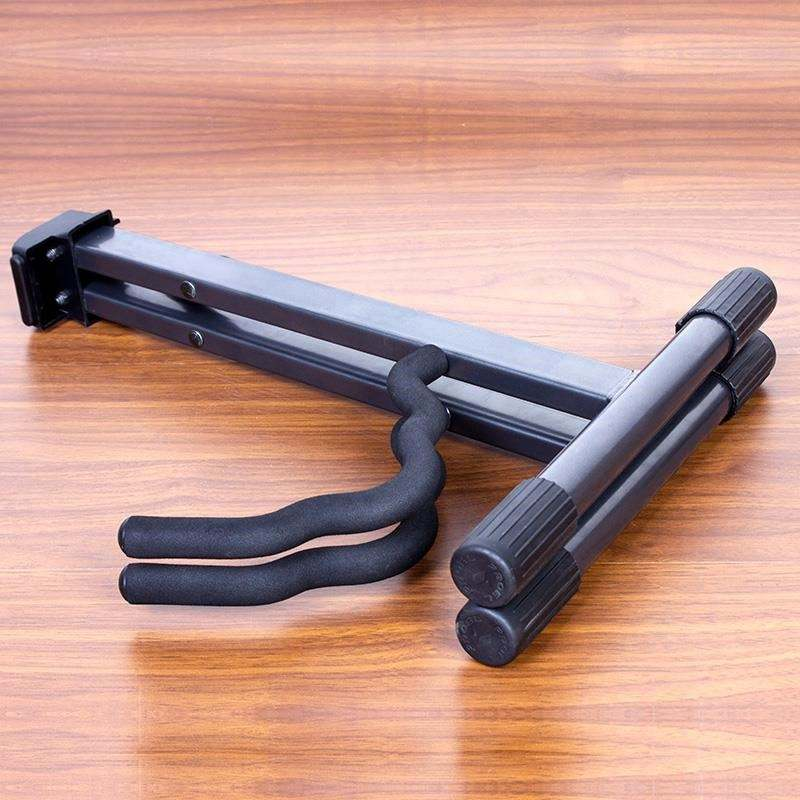
Factory photo: a folding guitar stand packed flat — the format that fits inside a guitar bag.
Multi-Guitar Racks: Studios, Teaching Rooms and Retail Display
When the collection outgrows single stands, a rack consolidates it. Multi-guitar racks are floor-standing frames with individual padded slots, and they are the standard choice in three settings: project studios that cycle instruments during tracking, schools where a class set needs a home between lessons, and showrooms where customers need to browse.
Our GS020, GS021 and GS022 foldable racks hold three, five and seven guitars respectively, each slot with a soft EVA-coated holder, and the folding design matters more than buyers expect — a seven-instrument rack that collapses flat can be stored or moved by one person. Several models also include a pick slot on the holder hook, the kind of small detail teachers end up using daily. For retail, the rack does double duty as display and storage, keeping the floor clear between lessons or appointments.
Wall Hangers and Clamp-On Options: Getting Instruments Off the Floor
Wall storage changes the relationship between the guitar and the room. Instruments become visible, accessible and out of the path of vacuum cleaners, pets and chair backs — which is why wall hangers dominate in home studios and living-room practice spaces.
The category has more variety than most buyers realise:
- Fixed wall hooks — the simple hanger series such as our GS017 and GS019: a solid base plate and a strong padded hook, suited to electric, classical-acoustic and bass headstocks.
- Adjustable-angle wall mounts — the GS216 installs at different angles, useful for angled headstocks or for displaying the instrument at a deliberate tilt.
- Solid-wood shelf systems — the GS039 pairs two guitar hangers with four belt hooks, a display shelf and a pick groove in mahogany, ebony or acacia finishes, turning instrument storage into furniture.
- Clamp-on hangers — the GS625 clamps onto a desk, shelf or tabletop, adding hanging storage without drilling anything into a wall, popular in rented rooms and small apartments.
The same logic extends to the wider instrument family: dedicated wall hangers and stands exist for violin, cello and bass, with hook heights and holder widths scaled to each body — worth remembering when a studio or school also stores orchestral instruments.
Ukulele and Small-Bodied Instrument Stands
Ukuleles expose a common mistake: putting a small, light instrument on a stand designed for a full-size guitar. The headstock may never make contact with the hook, or the body may sit too deep in the holder. A purpose-scaled stand such as the GS620 — hook height adjusting from 34 to 57 cm with a 19 cm holder — positions a ukulele securely instead of letting it dangle. Teaching studios with mixed instrument programmes should treat this as its own line item rather than assuming the guitar stand covers it.
Matching the Stand Type to the Setting
Condensing the above into a practical selection matrix:
- Rehearsal rooms and lesson studios — A-frames or auto-locking floor stands; one per player, plus a multi-guitar rack for the loaner collection.
- Stage and backline — auto-locking stands for set-change safety, portable folding stands in the gig bag as backup.
- Home practice — wall hangers or a solid-wood shelf system to keep the floor clear; a folding stand that travels with the player.
- Retail and showrooms — multi-guitar racks for browsing, wall systems for display density.
- Schools — racks sized to class sets, plus dedicated ukulele and small-instrument stands.
Construction Details Worth Checking Before You Order
Across all five categories, four details separate a stand that lasts from one that does not:
Contact-point padding
Every point where the instrument rests — yoke, neck hook, base bar — should carry a soft EVA or rubber coat. Bare metal or hard plastic eventually marks lacquer, especially on polished classical bodies.
Headstock compatibility
Radically angled headstocks, wide classical necks and narrow ukulele necks each need different hook geometry. Ask how the holder accommodates different head shapes, and whether the arms adjust independently — our auto-lock series lets each arm be set and locked to match the instrument’s silhouette.
Hinge and joint hardware
On folding models, joints are the failure point. Steel hardware, positive detents and welded frame joints hold up under daily folding cycles; sloppy friction fittings do not.
Base design
Look at the footprint and the feet. Rubberised feet protect stage floors and keep the stand from walking on hard surfaces; a low, spread base handles accidental knocks more gracefully than a tall, narrow one — which is also why floor stands position the instrument low and back rather than high and forward.
Working With a Stand Manufacturer
For distributors and retail chains, guitar stands are a category where range architecture matters: one reliable A-frame, one auto-locking model, one portable folder, one rack and one wall system covers nearly every customer who walks in. As a manufacturer of stands under the Yinyu brand, LESOUND develops and produces the full family alongside microphone stands, keyboard stands, music stands and lighting stands, with EVA-coated contact points and adjustable fittings standard across the range — and with the OEM flexibility to match finishes, paddings and packaging to a partner’s market. Pairing the stands with our own instrument cables and accessories lets a buyer consolidate a whole musician-accessory programme with one supplier.
If you are planning a range for your market, browse the current guitar stands line, or see how the same engineering carries across our microphone stands, keyboard stands and music stands. For stage-focused setups, our guides to DJ booths cover the neighbouring live-performance category. Contact LESOUND to discuss models, samples and OEM programme details.
Post time: Oct-14-2026