


A dual head microphone stand looks like one product in a catalogue photo, and that’s where the first mistake usually happens. Two microphones on a single column is a balance problem before it’s anything else, and a factory that treats it as one stand with an extra arm will sell you something that behaves badly the first time a customer loads both sides.
We build this range ourselves in Zhejiang, so the answers below come from stands we’ve assembled and loaded, not from a datasheet. Where a number depends on how your market uses the product, we’ll say so rather than invent an average.
Two microphones, one column, and the balance that decides the rest
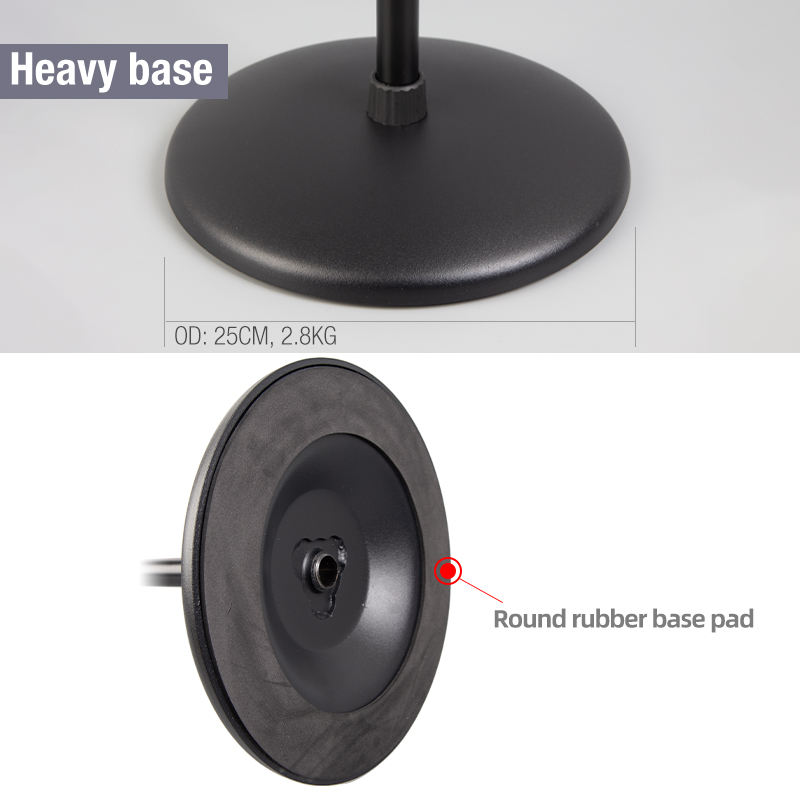
Put one microphone on a stand and the weight sits roughly over the base. Put two on it and the load moves sideways every time somebody adjusts an arm, which means the base has to be chosen for the worst case rather than the typical one. Buyers ordering a dual head microphone stand for the first time often spec that base from a single head model, and the sample is where they’ll find out.
The practical question is what the customer does with the two ends. A podcast pair that sits across a table gets adjusted twice a session and needs a stable, low base. A pair of drum overheads gets set once and left, but those arms reach further, and reach is what tips a light base over.
Where a two head stand actually gets used
The orders we see fall into four groups, and they don’t want the same product. Interview and podcast rooms want the two heads close together at desk height, usually with short arms. Small studios want one voice and one instrument, which means two different heights on one column. Houses of worship want a lectern pair that gets moved between services. Schools want something that survives being taken down every week.
Ask the factory which of those it builds most often, because the answer tells you what its jigs are set up for. A workshop that mostly makes desk positions will have short arms and heavy round bases on the shelf. Ask it for a long reach version and it’s effectively building a new product for your order.
The base and the footprint before anyone discusses the heads
Three base types turn up here, and none of them is a substitute for another. A round cast base puts all of its weight into one disc that sits under the desk position. A tripod spreads the load but sticks out where feet go. A clamp base takes no floor space at all and instead puts its load into the desk edge.
Ask what the base weighs and what it’s rated to hold at full reach, not at the shortest setting. A stand is at its least steady with both arms extended, and that’s the setting a customer will use the moment two people have to share it.
How the two booms share the column
This is the part that separates a real dual head stand from a single head stand with a second arm bolted on. Each arm needs its own clutch and its own height collar, otherwise adjusting one side moves the other. Ask to see a unit with both arms loaded while one of them is loosened, and watch whether the second arm holds.
Ask how the boom collar is made, and ask what happens after a year of use. A collar with no adjustment left is one that’s headed for the bin. That one question separates a product with a two year life from one with a two month life, and the difference rarely shows in a photo.
Threads, clips and what arrives in the box
Both arms and the column end in a thread, so all three take wear. Ask whether the threads are cut straight into the tube or sit on their own insert. An insert that unscrews can be renewed. A thread cut into soft metal cannot. Ask what the inserts are made of as well. A steel insert survives years of service that a soft metal thread surrenders inside one season.
Then ask which adapters ship in the box. Markets differ on the default, and a two head stand that lands without the expected adapter ends up wearing whatever clip the customer finds lying around. If your buyers mix a large capsule with a small clip on, say so early, because that’s a two-adapter order rather than a one-adapter order.
Height ranges that read fine on paper
The working height of a two microphone position is usually decided by the taller of the two, and buyers regularly order a range that only reaches it at the very top of its travel. Ask which part of the range buyers really work in, because the highest setting leaves the least tube inside the collar.
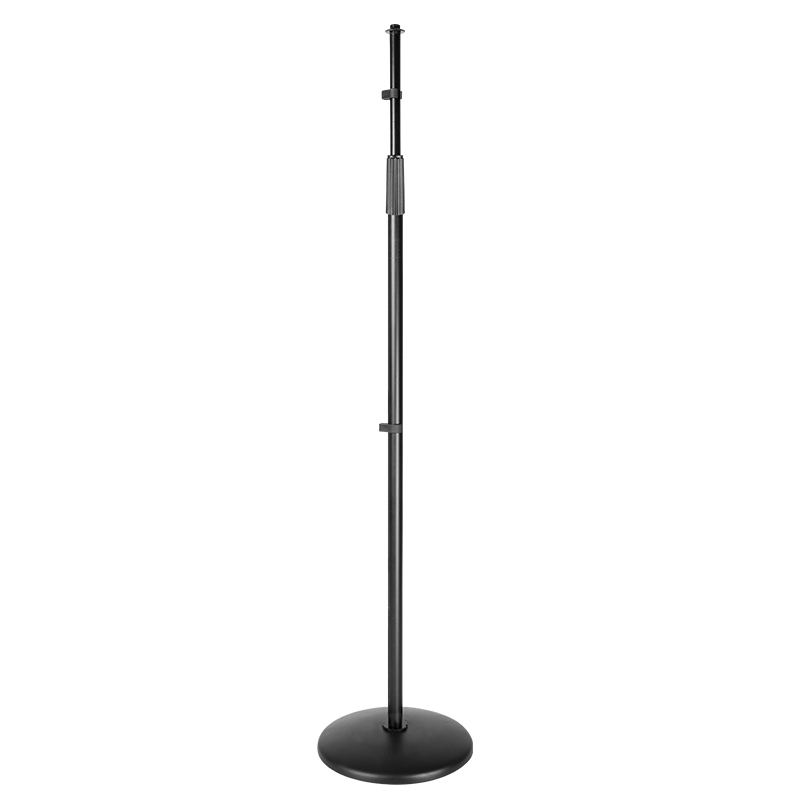
If the two microphones sit at very different heights, ask whether that’s a job for one column with two arms or for two stands. Some positions are cheaper and steadier as two separate stands, and a supplier who tells you that is worth keeping.
Cable dressing on a two microphone position
Two microphones means two cables, and loose cables are what pull a stand out of position. Ask whether the arms have clips or ties to hold the cable along the boom. A stand with no cable management ends up with the cable hanging off the clutch, which is the part that then wears out early.
The cable choice matters as much. A thin, stiff cable tugs. A soft one with a strain relief at the connector trails better. The same workshop builds the balanced leads we ship with these stands, so ask for the pair to be matched rather than buying the stand and the cable from two places.
What we look at on a sample before a trial order
A sample answers almost everything on this list, and a two head stand deserves more of your attention than a single head one because there are more adjustments to go wrong. Ask for it built around your market, with the base your buyers ask for rather than the base the workshop finds easiest to produce.
Then work it the way a customer would. Fit your heaviest microphones to both arms, run each collar through its full travel without taking them off, and leave the stand loaded overnight in the exact setting it’ll live in. Half an hour of that says more about a supplier than any brochure.
- Both arms loaded, then loosen one collar and check the other arm stays put
- Threads checked against the clips and mounts the customer already owns
- Height run through its full travel with the microphones still mounted
- Cable clips present on both arms, not just the main column
- Master carton count and the loaded carton weight written down
- Spare collars and thread inserts available to order on their own
Cartons, inner packs and the master quantity
Get the master carton count and the inner pack size before any unit price comes up. Together they settle what a piece really costs you landed, because freight is billed on volume and weight rather than on the goods. This version is longer in the box than a single head one, so fewer pieces fit and the cost per unit shifts.

Ask whether the arms travel assembled or laid along the column. Laying them down adds a little packing work, and it’s what stops an arm arriving bent. Any dealer who has opened one crooked carton asks for that layout from then on.
How a first order usually runs
Almost nobody opens with a container on this product. The sequence is usually one sample, then a small trial run of a few cartons, then a full order once the market has answered. That’s the sequence we plan for, which makes the sample the most important shipment we send rather than the smallest.
If your first order mixes stands and other items, ask for it consolidated. One workshop means one consolidated shipment and one set of documents instead of two, and the second freight bill is what usually makes a mixed order look expensive.
Questions importers ask before a trial order
Is a dual head stand one stand or two stands bolted together?
It has to be a single column carrying two independent arms. If both heads ride on one arm, you’ve bought something that only holds two microphones when they sit side by side, and that’s rarely the position a customer has in mind.
What decides whether the two microphones stay where we put them?
The clutch on each arm, plus the weight sitting in the base. Have the factory fit your heaviest capsules to both sides, set the arms where they’d normally work, and walk away for a night. A stand that sags while nobody touches it will sag on a customer’s desk as well.
Can the two heads take different threads?
Yes, and it’s worth asking for. Interview rooms often pair a large diaphragm capsule with a small clip on one, and those two don’t share a fitting. Name both and we’ll match them, instead of sending one adapter and leaving you to hope.
Do we have to buy the microphones from you as well?
No. Most dealers take the stand alone and pair it with whatever capsule their market already moves. We only ask which one so the threads and the clip line up.
How do the cartons compare with a single head stand?
This version is longer and heavier per piece, so fewer units go into a master carton. Get the loaded carton weight before you set the two freight figures side by side, because that comparison is where a first quote usually slips.
What do you need from us to quote one?
The base type, the working height, the two microphones going on it and your destination port. Give us those four and the reply will be built around your setup instead of around a catalogue page.
Send us the desk and the two microphones
Tell us the base your buyers want, the height the position works at, and which two microphones go on it. Those three lines are enough for us to answer, and the reply will be built around your setup. A dual head microphone stand is the one item in a range where the customer’s own desk decides the answer.
If you’d rather open with a single head position first, the OEM desk microphone stand for mic and the OEM desktop microphone stand for podcast are the two models most dealers start with, and both come off the same line as the two head version.
Most rooms buying a two microphone position also order monitoring. Audfine headphones leave with nearly every order of this kind, because the person setting up the stand is the person who then sits behind it, and the Audfine studio monitor headphones are the pair that goes out with them most often.
Ask for the sample to be set up the way your customer will actually use it. Base weight and clutch feel are the two things no photograph can carry.
The one check that saves a container
If only one check survives from this page, make it the loaded clutch test on both arms. It asks for nothing beyond the microphones you already stock, and it won’t take more than half a day. Run it on our sample and on every other quote you’re holding, then weigh the results rather than the unit prices.
The Yinyu name sits on this range, and the pieces are built and tested in Zhejiang by Ningbo Lesound Electronics before any of them is boxed.
Post time: Oct-14-2026