


Ask five guitarists what makes a pedalboard quiet and tidy, and four of them will talk about the pedals. The fifth — the one whose board never buzzes and whose cables never tug loose mid-set — will talk about the patch cables. On a pedalboard, the cable is not an accessory; it is the plumbing that holds the whole signal chain together. And the single decision that shapes everything about how a board assembles, fits in a case and survives the road is the one printed right on the end of each cable: flat plug or straight plug.
This guide comes from the factory floor rather than the forum. LESOUND manufactures instrument and patch cable under the Yinyu range, including the GTC series of braided patch assemblies, and we build both straight and right-angle versions of nearly every model. Below is how we think about the choice, and how professional buyers usually spec their boards.
If you are new to the wider range, our instrument cables overview covers conductor and shielding construction in detail; this article stays focused on the plugs themselves.
Why Plug Shape Matters More on a Pedalboard
On a guitar lead running from a pedalboard to an amplifier, plug orientation is almost irrelevant — there is space, the cable hangs free, and either plug lands wherever it lands. A patch cable is the opposite. It lives in a gap measured in millimetres between two metal enclosures, often with a second row of pedals directly above it, and often inside a flight case lid that closes with barely any clearance.
Three mechanical problems decide whether a patch cable works on a real board:
- Spacing. Two adjacent jacks may be 40 mm apart centre-to-centre, or less. A straight plug barrel is typically 45–55 mm long, so two straight plugs facing each other across a short patch will collide or lever against each other.
- Clearance above. A straight plug stands proud of the pedal, adding its full barrel length to the height of the row. Boards with riser plates and top-jack pedals can absorb that; flat layouts cannot.
- Side leverage. A straight plug hanging off a side-mounted jack turns the cable’s weight into a bending force on the jack’s solder tag and nut. Over months of transport vibration, that is the joint that works loose.
Plug shape does not change the signal. An electrically sound plug in any orientation passes the same audio; the differences are mechanical. That is worth stating plainly, because a lot of forum space is spent on the wrong question. The right question is not which plug sounds different — it is which shape lets your board close its lid and keep its joints tight for a year of gigs.
Straight Plugs: The Underrated Default
Straight plugs get dismissed as the shape you use when you cannot fit anything else, but on many boards they are the correct first choice. Their advantages are structural:
- Shortest body depth behind the jack. A right-angle plug changes direction immediately, but its moulded elbow still sits beside the pedal. On pedals with side-mounted jacks that are already close to the board edge, a straight plug exiting rearward often uses less total space.
- Gentler on the solder joint. With the cable exiting in line with the plug and dropping naturally, there is no fixed 90° bend concentrating stress at the jack. Combined with a proper strain relief, this is the most forgiving geometry for the cable itself.
- Easier to service and re-terminate. A straight barrel gives a soldering iron straightforward access. Anyone who has re-terminated a patch cable in a hotel room appreciates this.
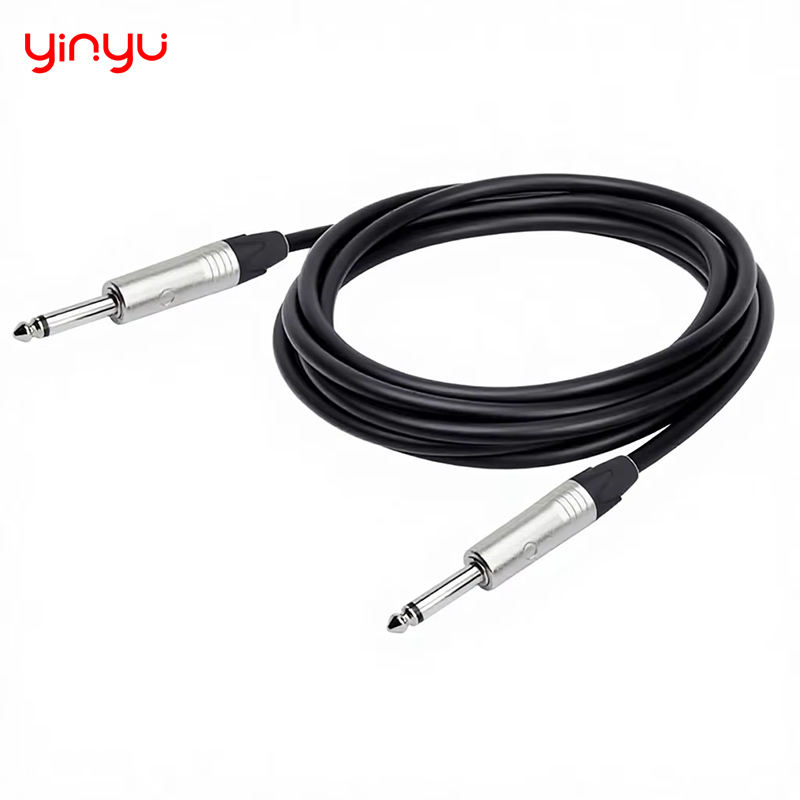
Factory photo: a straight-to-straight patch assembly from the Yinyu GTC range, with nickel-plated 6.35 mm plugs on braided cable.
Straight plugs suit: the first and last cables on the board (guitar in, output to amp), any patch where the cable exits over the back edge of the board, top-jack pedals on a riser, and side-jack pedals spaced widely. Models such as the GTC006 (dual straight, nickel) and GTC042 (straight plugs on a woven-jacket cable) exist precisely for these positions.
Right-Angle and Flat Plugs: Engineering for Tight Rows
Right-angle plugs solve the spacing problem by turning the cable 90° immediately, so the patch occupies depth beside the pedal instead of length behind it. But “right-angle” actually describes two different constructions, and the difference matters:
- Barrel-type right-angle plugs keep a full-size barrel and elbow the cable sideways. They are robust and easy to grip, but the elbow still adds 20–25 mm of width beside each jack. On very tight jack fields, two of these facing each other can still touch.
- Flat (low-profile) plugs flatten the whole body into a thin paddle, often under 15 mm of protrusion. The GTC008 in our range is this construction: a flat plug patch cable made for switcher loops and riser-style boards where every millimetre of width is allocated.
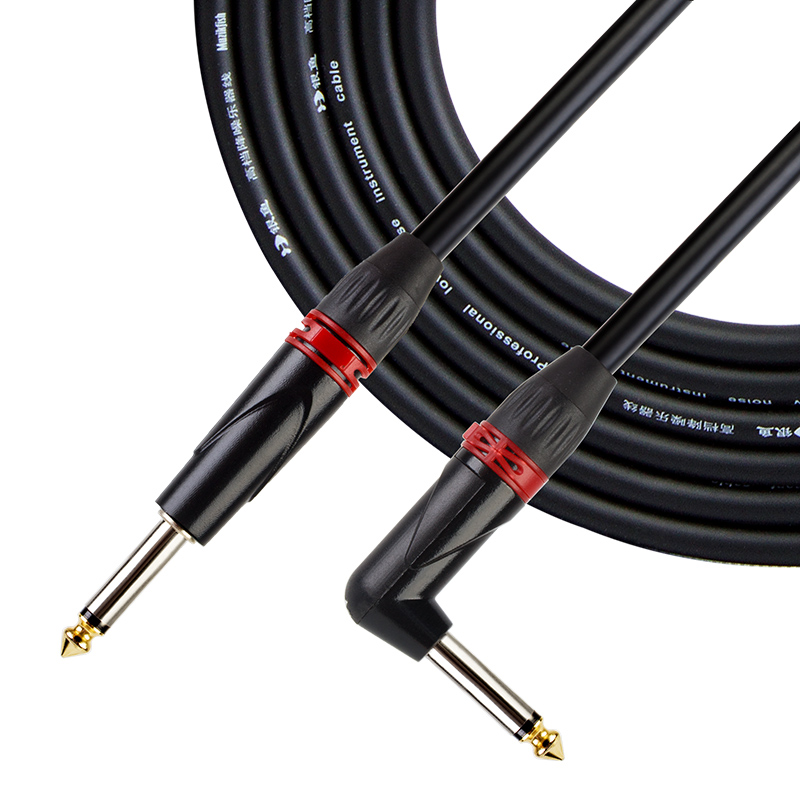
Factory photo: a mixed straight-and-right-angle assembly, the most common layout for pedalboard patch runs.
Right-angle and flat plugs suit: patches between adjacent pedals in the same row, side-jack pedals placed close together, boards with a second row above (where a straight plug’s barrel would foul the pedals behind), and effects-loop patches on switchers, where jacks sit edge to edge in a dense field.
Matching Plug Shape to Jack Orientation
The fastest way to plan a board is to sort your pedals by jack position before buying any cable:
| Jack position | Typical pedals | Recommended patch |
|---|---|---|
| Top-mounted | Tuner, drive, most compact pedals on risers | Straight or barrel right-angle, patching forward |
| Side-mounted, same row | Compact analog pedals in a tight row | Flat or barrel right-angle, alternating orientation |
| Side-mounted, spaced | Large digital units, power supplies | Straight, with slack routed under the board |
| Dense jack field (switcher/looper) | Loop switchers, MIDI controllers | Flat plugs exclusively — barrel elbows will not fit |
A common professional pattern is the mixed assembly: straight plug at the input end, right-angle at the crowded end. Our GTC007 (straight plus right-angle) and GTC016GL (gold-plated, straight plus right-angle) are built as mixed assemblies for exactly this reason, and GTC043 pairs a straight plug with a slim flat-angle plug.
What Is Inside the Plug Matters as Much as the Shape
Shape decides fit; construction decides whether the cable is still silent in two years. The failure points on a patch cable are nearly always at the plug: the solder joint, the strain relief, and the contact the plug tip makes with the jack. When we build the GTC series, the specification that matters is written on the same page as the models:
- OFC conductor with a conductive-PE layer and braided OFC shield — the low-noise shield construction that keeps RF and handling noise out of a high-impedance instrument signal, which matters even over a 300 mm patch.
- Metal connector shells with professional soldering — a soldered joint inside a metal shell survives board packing and case transport far more reliably than a crimped or glued assembly.
- Durable plug hardware — the plug a pedalboard sees most is the one being pushed and pulled weekly at load-in.
For buyers assembling boards for rental stock or backline, we would rather see ten well-soldered flat plugs than twenty cheap moulded ones. A patch cable’s job is to disappear electrically and survive mechanically, and both halves of that job are decided at the plug.
Colour Coding: The Underrated Third Option
Both straight and flat plugs in the GTC patch range are available with woven jackets in several colours — the GTC042, for example, uses a blue woven jacket, and the flat-plug GTC008 ships in a multi-colour set. On a private board this is cosmetic. On a rental or backline board it is operational: colour-coding patches by signal path (guitar chain, effects loop, MIDI) turns a 15-minute fault-finding session into a 2-minute one, and makes inventory counts visible at a glance.
A Practical Ordering Checklist
- Map the jack fields. Sort pedals by jack position and measure the tightest gaps. Every gap under 50 mm means a right-angle or flat plug on at least one end.
- Choose straight for the board’s edges. Guitar-in and output-to-amp cables rarely need an angle plug, and straight barrels are the most serviceable.
- Use flat plugs on switcher loops. If the board has a loop switcher, flat is not a preference; it is the only shape that fits.
- Spec one cable construction throughout. Mixing shield constructions across a board invites inconsistent noise floors. Pick one braided OFC series and stay on it.
- Order a few spares in mixed orientations. Failures on the road are mechanical, and a spare mixed assembly covers most of them.
Where Patch Cables Fit in the Wider Cable Plan
A pedalboard is usually one node in a larger signal plan. The same Yinyu cable programme that supplies patch assemblies also covers full-length instrument cables, microphone cables and the audio cables used around the rest of a rig, all listed on our cables overview. Keeping one construction standard across patch and long runs means a fault on stage can be diagnosed by swapping cables, not by guessing which assembly behaves differently.
And if the board travels with a backline, the stands and supports that hold the rest of the rig — from guitar stands to the pedestals and risers under an amp — come from the same factory programme, which keeps freight, documentation and spares consolidated under one supplier.
The Short Answer
Straight plugs where there is room and the cable exits naturally: board edges, top-jack risers, spaced side jacks. Right-angle plugs where pedals sit close in a row. Flat plugs where jacks are edge-to-edge, especially on switcher loops. None of these change your tone; all of them change whether the board closes, whether the joints survive the van, and how quickly a fault gets found. That is the whole decision.
LESOUND builds the GTC patch cable range in straight, right-angle and flat plug formats, with soldered metal connectors and braided OFC shielding as standard across the series. For wholesale and OEM enquiries on patch cable programmes — including custom lengths, colour coding and private-label packaging — contact the factory team via the instrument cables page.
Post time: Oct-19-2026