


A church in Guadalajara sent us a drawing in June. Not of a speaker. Of a room. Thirty metres long, a wooden floor, a balcony at the back, and a line array they’d already bought hanging over the front. What they wanted to know was how many double 18 cabinets they needed underneath it, and whether those were supposed to hang too. That’s a good question, and it’s the one that goes on to decide everything else in the order. The cabinet we build for that job is the DS218A, and you can read the whole sheet on the double 18 subwoofer speaker page. It’s 2000 W RMS with 4000 W peak, 131 dB at a metre, and it runs 35 Hz to 120 Hz. Here’s what those numbers do and what they don’t do.

Two cones in one box, and why it isn’t two boxes
Putting two 18 inch drivers in one cabinet gets you something you can’t get from two singles, and convenience is the least of it. Two cones sharing one air volume load each other. Move one and the air in the box pushes the other, and that coupling is why a double 18 reaches lower for its size than a single one does. It’s also why the box has to be stiff enough not to flex while both cones are working. A cabinet that panels out is making its own sound, and it isn’t a sound you asked for. There’s a trade sitting in it. One double 18 takes less room in a truck than two singles and needs one fewer stand. But it’s one heavy thing that takes two people, where a single can be carried by one.
Where a double 18 sits under a line array hang
Most arrays you see have their subs on the floor, and the reasons go past rigging points. A cabinet on the floor gets half space loading from the floor itself, which is free output you don’t get from something in the air. The usual layout is three or four across the front in an arc, or a cardioid block of them either side of the stage. Flown subs do happen, and they get used where the floor is taken by cameras or where the balcony coverage is falling apart. You give up output for the same number of cabinets. If you’re buying for rental, buy for the ground stack and treat flying as something you can do when a job genuinely needs it. The tops above them need their own support. If the array is a compact one like a dual 10 inch powered line array speaker, those poles are a separate line on the same order.
131 dB at one metre, and the distance it is really heard at
One hundred and thirty one decibels is the max SPL figure at a metre, and it’s the number that turns up in enquiries. It’s a real measurement, and it’s also a condition rather than a promise about your room. Sound falls away as it travels, so what you have at a metre is a good deal less at twenty, and less again at the back of a hall. The useful way to read it is as a comparison between cabinets measured the same way, not as a prediction. If you want to know what you’ll have in the last row, that’s a prediction job with the room in it. We’d rather talk it through than have you find out on the night.
35 to 120 Hz leaves a gap somebody else fills
The response runs 35 Hz to 120 Hz, and the top of that is the number that matters for planning. Above 120 Hz something else takes over, and that something is the tops in your array. Where you hand over between them is a processor decision, and it isn’t just the two numbers on the sheets. Cross too high and the array starts working on material it isn’t good at, and the low end sounds slow. Cross too low and you lose the hit in a kick drum. The 35 Hz end is more forgiving. Not much lives down there, and most of what does is things you didn’t want reproduced loudly anyway. It’s worth knowing what you’re comparing against, too. A rig built from an 18 inch subwoofer in a single box will not give you the same bottom end for the same cabinet count. The reason is that coupling we started with rather than anything on the sheet.
A 4 inch voice coil and 125 oz of ferrite
Each driver is an 18 inch with a 4 inch voice coil on a 125 oz ferrite motor. The coil is the number to read. Four inches is a lot of surface to get heat out of, and heat is what kills a driver that’s been asked for more than it has. Ferrite rather than neodymium is a weight decision. A neo motor gives you the same motor strength for a good deal less mass. The reason you’d still pick ferrite is that it’s cheaper per cabinet and easier to keep consistent across a production run. If weight is the thing that decides your sale, say so and we’ll price the other motor. One more thing that gets missed in these enquiries. A cabinet that heavy needs something under it, and when the subs are the base of the stack the whole thing rests on the floor rather than on Yinyu stands. Check that before you order the tops for it.
DSP, limiter, and the thermal protection saving the coil
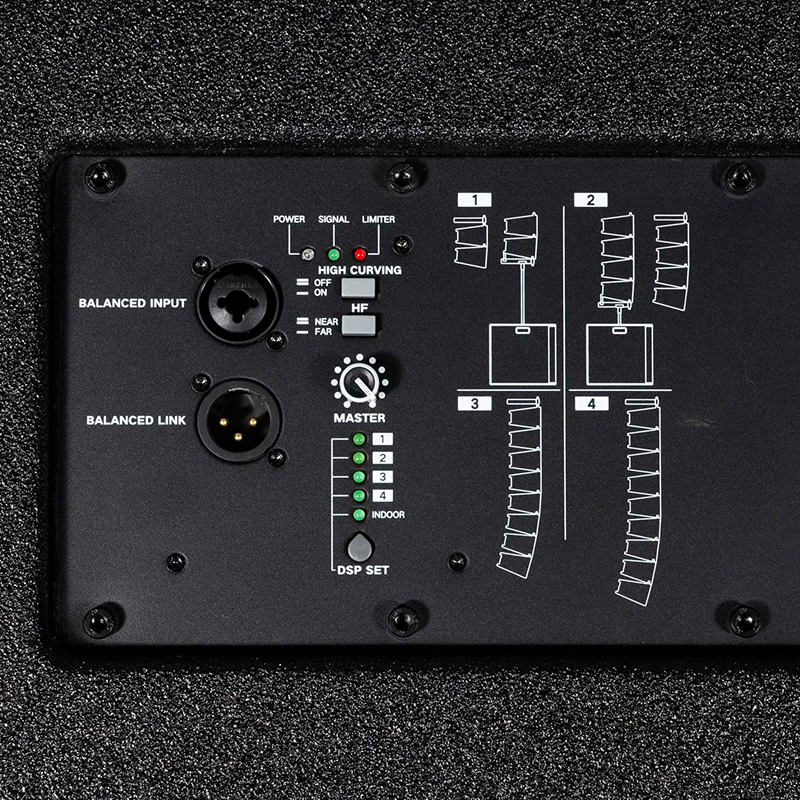
The cabinet is powered, so there’s processing inside doing three jobs. There’s the crossover and the alignment, which is work you’d otherwise do in a rack. There’s a limiter, which is there to stop you. And there’s thermal and RMS protection, which is the part that matters in the fourth hour of a loud night. A limiter working isn’t a fault. It’s the cabinet telling you it’s at the edge, and if it’s holding constantly you’re asking for more than it has, and the answer is more cabinets rather than more level. The controls on the back are DSP and volume. If you want a network port on it to sit inside a system you already run, that’s worth raising early.

Combo in, XLR out, at 110 or 220 volts
Three combo inputs on the back, three male XLR outputs, and a supply that takes 110 or 220 volts. The combos are the useful part, because one socket takes XLR or a quarter inch jack without an adapter, and on a rental job that saves the adapter that always goes missing. The XLR outputs feed the next cabinet or the tops, and they’re parallel with the input. The voltage range is what lets the same cabinet go to two markets without a second build. There’s a switch or an auto ranging supply depending on the run, and that’s worth confirming for the country you’re importing into before the container ships.
Four side handles and the crew that moves it
There are four handles on it, two a side, and that isn’t decoration. A loaded 18 inch cabinet is a two person lift at best, and where the handles sit decides whether it’s an awkward one. Handles let a crew get their hands under the weight instead of around it. What they don’t survive is being used as a pull. Cabinets get dragged across stages by a handle, and that’s how a handle comes off. The DS218A is birch plywood with a steel grille, and the grille is there because the cones are the most expensive part and they face outwards. A grille that’s taken a knock is doing its job. A cone that’s taken one is a re-cone. On the pallet they leave on, Yinyu stands usually take the space right beside them, because a rig that turns up without its stands is a rig nobody can put up yet.

Five things to settle before a DS218A order
- How many across the front, and whether you’re stacking them flat or in an arc
- Whether they ever need to fly, and what rigging your venues have
- What voltage and what sockets they’ll be plugged into
- Whether your processor does the crossover or you want it in the cabinet
- What you’ll carry them in, because that decides the dolly
What else shares the container
Nobody imports a container of subwoofers on their own. The same one usually has the tops, the stands they sit on and the cable that joins them, and there’s a real saving in those three things coming from one place. Yinyu stands go in with the array. Yinyu cables go in the same crate, and on a church install that’s usually a run of XLR microphone cable long enough to reach the mixing position at the back. Audfine headphones go in with them for the monitor position. Ningbo Lesound Electronics is the name on the paperwork out of Zhejiang, and the way we pack that mix is one container, one invoice and one forwarder. It isn’t clever. It just takes three emails a week off your desk.
Answers before a double 18 order
How many do we need for five hundred people?
Room size alone won’t tell you. Send the drawing, or the dimensions and what the walls are made of, and we’ll work it out with you. The number that usually moves the answer is how far the last row is from the stage.
Can we fly them?
You can, and we’d want to know what you’re hanging them from before we agree. Most of the output comes from leaving them on the floor, so unless the floor is spoken for, that’s where we’d put them.
Is it 110 or 220 volts?
Both. The supply handles 110 to 220 volts, and which end of that you get depends on the run. Tell us the country at quotation time and we’ll make sure it leaves here right.
Where does it cross over to the tops?
There’s DSP in the cabinet that will do it, and you can also do it in your own processor upstream. Which you want depends on what you’re already running, so it’s worth saying early because it changes the back panel.
Can we have our own brand on it?
Yes. The cabinet ships as OEM, and ODM is on the table if you want the grille or the box changed. Badges, cartons and manuals are separate jobs with their own minimums, so tell us how far you want to go.
What is the lead time?
It moves with the quantity and with what you’ve asked us to change, so ask rather than assume. Every cabinet gets inspected before it is crated, whichever date you pick. If a date can’t be held we’d rather say so when you’re still deciding.
If you’re planning a rig, the most useful thing we can help with is the arrangement. Send the room, or the drawing, or the array you’ve already got, and we’ll tell you how many. Put the words line array sub count in the subject so it comes to the right desk, or send the same note through our site contact page.
Post time: Nov-11-2026