


We get the same email about twice a week. Someone bought a stand that looked solid online, mounted a heavy condenser on the boom, and three weeks later the arm is sagging. They tighten the clutch, it holds for a day, then it slips again. By the time they write to us, they are convinced the whole category is junk.
It is not. But the failure is real, and it almost never happens where people think it does.
Where heavy duty mic stands actually fail
Stand on a factory floor for a week and you learn that poles rarely break. Clutches lose grip. Bases tip. Threads strip. Those three points decide whether a stand survives a year of real use.
The clutch takes the worst of it. On a boom model it holds the arm, the mic, and whatever angle the user has set — and it holds all of that every time someone adjusts height. Cheap clutches compress under that load. Once the contact surface deforms, no amount of tightening brings the grip back. The stand is not broken in any visible way, but it has stopped doing its job.
Then there is the base. A lot of buyers assume heavier equals steadier. Not quite. A heavy base with a small footprint still tips when a boom is fully extended and the mic is front-heavy. What matters is how the mass sits across the floor, not the number on the spec sheet. This is why round base microphone stand designs handle tight studio corners better than tripods — no leg is going to foul a desk, a wall, or a kick drum.
And the thread. A stripped 3/8" thread at the top of the pole ends the stand's usefulness faster than any clutch wear. It is a five-cent part on a stand that costs real money, and it is the first thing we inspect on a returned unit.
What the Yinyu MS044 does differently
The MS044 is the heaviest series we build for heavy microphones. We did not design it around a spec sheet. We designed it around the complaints above.
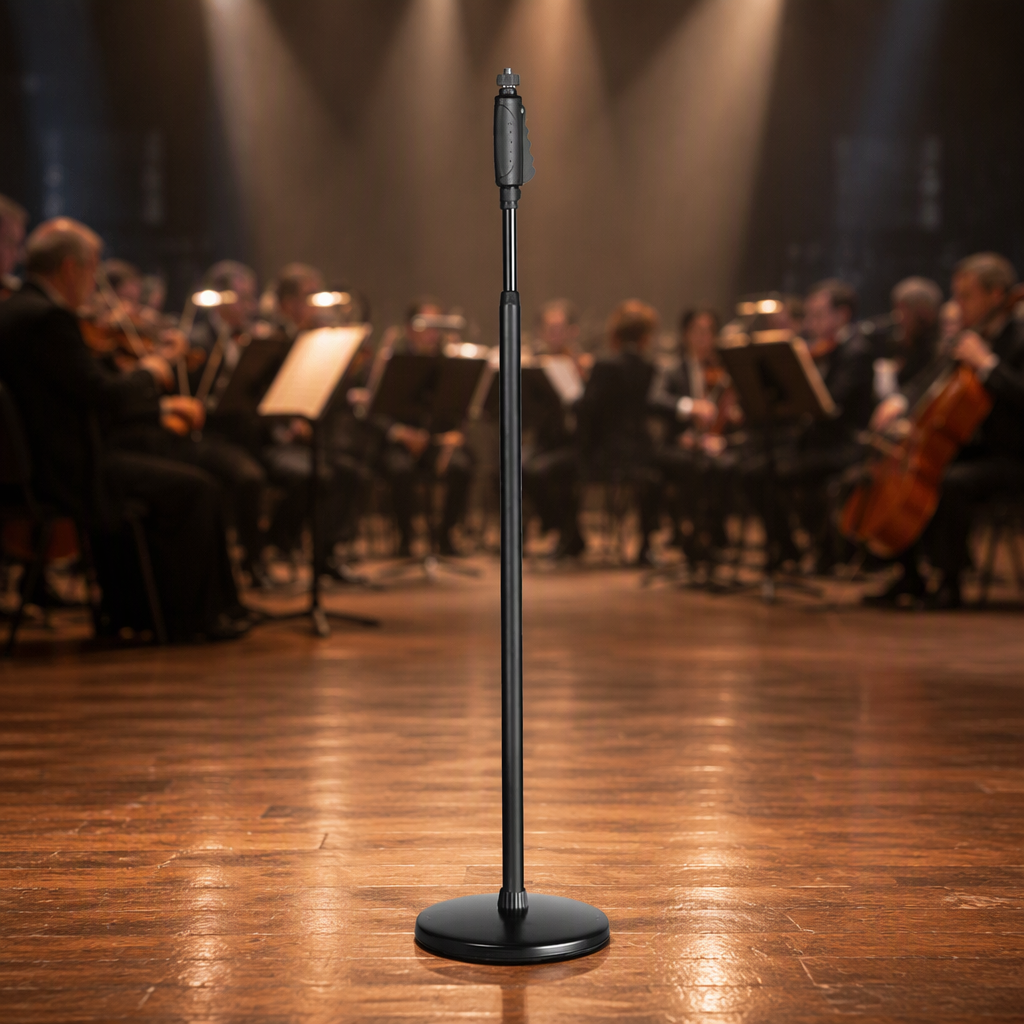
The clutch. It is a one-hand plastic clutch, assembled as a serviceable part rather than moulded into the pole. That detail matters more than the material. A clutch that can be adjusted and replaced when it wears is a clutch that does not turn the stand into a disposable item. Users change height with one hand and keep the other on the mic — no hex key, no two-handed wrestling.
The base. Solid metal, round, built to spread load rather than concentrate it. For a heavy duty mic stand for home studio use, that footprint slides under a desk without a tripod leg getting in the way. On stage, the same shape sits flush next to a drum riser or a monitor wedge.
The height. 1.1 to 1.72 metres. Seated desk work and standing vocal capture both fit inside that range. No compromise on mic placement.
The thread. Male 3/8" with a 5/8" adaptor included. Both major clip standards work out of the carton. No second order, no extra wait.
High quality parts are the reason the MS044 holds up longer and stays steadier than the cheap stands it competes with. That is not a slogan — it is the difference between a serviceable clutch and a sealed one, and buyers feel it six months in.
What buyers should ask before paying for any metal microphone stand for sale
Ask for the base diameter and thickness, not just the weight. Ask whether the clutch is replaceable. Ask what thread is on top and whether the adaptor is in the box. Ask whether the clip is included. These four questions separate the stands worth owning from the ones that end up in a returns bin.
And if you are buying for retail stock, ask whether the model is actually held in stock. Microphone stands ready to ship means the units exist, not that a production slot exists. For a dealer, that is the difference between a normal delivery window and a six-week wait.
The questions that actually land in our inbox
"Will it hold a [specific heavy condenser] on a fully extended boom?"
Send the mic model and the boom angle you plan to use. We will tell you straight whether the MS044 fits or whether a different base setup is the better match. We would rather lose a sale than manage a return.
"Is the plastic clutch going to fail like my last one?"
The clutch that fails is usually sealed and unserviceable. Ours is assembled to be adjusted and replaced. That is the practical difference.
"What does ready to ship mean for OEM orders?"
It means the MS044 is already in production. Finish, carton, and logo changes can be applied to an existing model, so customisation does not automatically add weeks. We handle OEM on in-stock models at LESOUND ELECTRONICS, alongside the Yinyu stand line and Audfine headphones.
One last thing before you order
Spec lines flatten everything. Two adjustable bar microphone stand models can list the same height and the same thread and still behave completely differently after a year, because clutch contact area, base thickness, and thread tolerance never make it onto the headline spec.
We build and assemble the Yinyu stand line in our own workshop. If you are weighing a round base mic stand for stage use or a heavy duty mic stand for home studio work, email us the mic you plan to mount and where the stand will live. We will send the base underside photo, the clutch assembly photo, and exact carton dimensions — and we will tell you honestly if the MS044 is not the right pick. That conversation is cheaper than a return.
Post time: Nov-11-2026