


Every boom arm solves the same problem — putting a microphone exactly where the speaker or singer wants it and keeping it there — but the two dominant designs go about it in completely different ways. Broadcast and podcast studios almost always use spring balance arms clamped to a desk. Live stages almost always use friction clutch booms mounted on tripod stands. Buyers who treat them as interchangeable usually end up with returns, because each mechanism is engineered for a different environment, a different microphone and a different style of repositioning.
This guide explains how each mechanism actually works, where each one performs best, and what importers and distributors should compare when adding boom arms to their microphone stand range. The examples come from our own stand programme at LESOUND, a professional audio accessories manufacturer in Ningbo, China, where both designs are produced side by side under our house brand Yinyu.
Two Ways to Hold a Boom in Position
A boom is an off-centre lever. The microphone sits at one end, the counterweight or pivot sits at the other, and the stand carries the turning moment created in between. The difference between the two families is how they resist that moment — and, just as importantly, how they let the user defeat it every time the microphone needs to move.
How a spring balance arm works
A spring balance arm carries the microphone on a pair of parallel links connected by pivot joints, with tension springs built into the arm structure. The springs are set so that they continuously offset the pull of the microphone on the far end of the arm. When the springs and the microphone are correctly matched, the arm floats: it stays exactly where you leave it, in any attitude, without the user turning a single knob.
That floating behaviour is the defining characteristic. Repositioning takes one hand and less than a second — pull the mic down to mouth height during a take, push it away when the talent wants to lean back — and the arm neither sags nor drifts. Because the springs do the holding, the joints themselves can stay light, which is why desktop arms look almost delicate compared with stage hardware.
How a friction clutch boom works
A friction clutch boom is a straight or telescopic tube attached to the top of the stand column through a pivoting joint with a knurled clutch. Tighten the clutch and friction locks the boom at the chosen angle; loosen it and the boom swings freely. Height changes happen on the column clutch, angle changes on the boom clutch, and length changes — on telescopic models — on a third clutch partway along the tube.
Nothing is balanced. The clutch holds by pure mechanical grip, so the design tolerates heavier combinations and rougher handling, but every adjustment is a deliberate two-handed operation: loosen, reposition, re-tighten. That trade — speed of adjustment exchanged for robustness — is essentially the whole story of the two families.
Spring Balance Arms: Built for the Desk
Spring balance arms were perfected in broadcast studios, where an announcer touches the microphone dozens of times per hour and a screw clamp would slow the programme down. The same logic carries into podcasting, streaming, voice-over and instrument recording at a desk.
Our Yinyu heavy-duty boom arm series — the MS077B and MS078B — is built around this mechanism. Both models use an integrated spring balance system, and both arms extend and fold vertically and horizontally in all directions, so the capsule can sit above, below or in front of the desk edge as the session demands. A male 3/8″ thread with a 5/8″ adaptor is fitted at the microphone end, which means standard broadcast and studio mic clips mount directly, and a cable clip on the arm keeps the mic cable routed along the link instead of dangling in front of the desk. Once the springs are set for the microphone in use, day-to-day operation is grab-and-move.
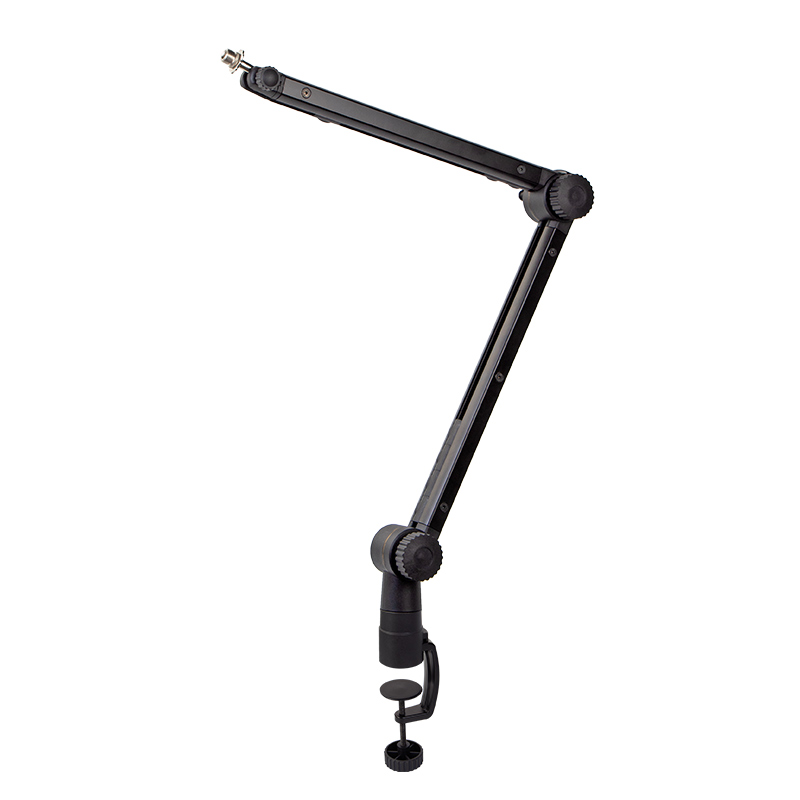
The MS075 extends the concept for compact setups. It folds completely flat for transport, and its multi-function desktop base can be installed either through a C-clamp on the desk edge or through a grommet hole — the flush fitting that most professional studio furniture already provides. The aluminium arm has a lock for the arm angle when a position needs to be fixed for a long run, and the same built-in spring arrangement as the larger models. For desk-based work, the choice between clamp and grommet is worth confirming with the supplier before ordering, because it decides which furniture the arm can serve.
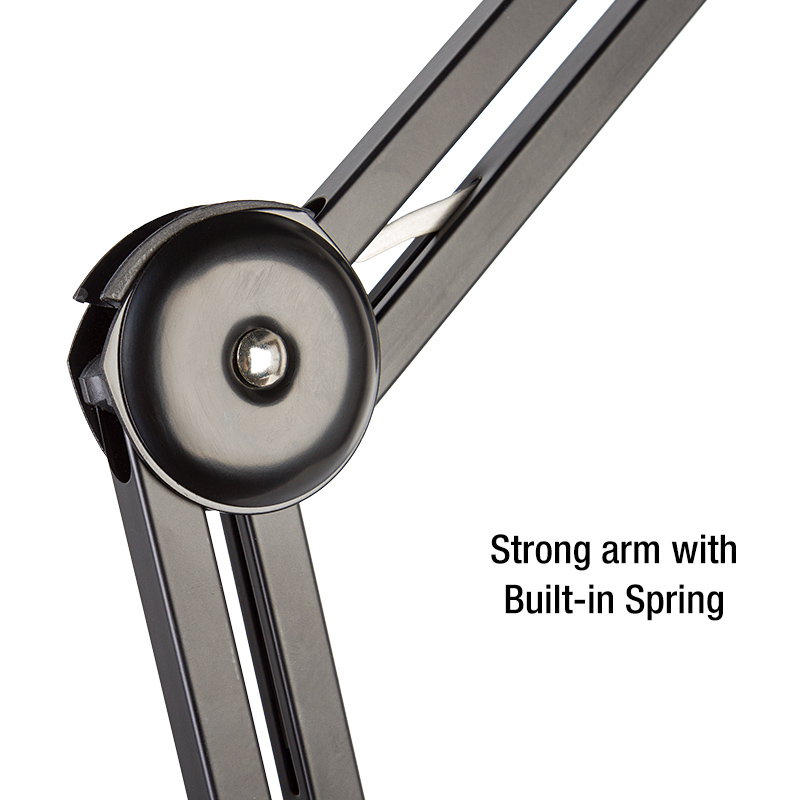
What spring balance does well — and what it asks in return
- One-hand, one-second repositioning. The reason broadcast chose this design.
- No visible hardware at working height. No knobs to fumble on camera; the arm reads as clean lines on a video feed.
- Quiet operation. No clutch handles knocking against the desk or the stand.
- Set-up discipline required. Springs must be matched to the microphone; a very light mic on an arm set for a heavy one will not stay down. Buyers should confirm how the spring tension is adjusted — tool-free or not — before listing the product.
- Desk mounting only. Clamp or grommet bases assume furniture. There is no way to stand one on a floor.
Friction Clutch Booms: Built for the Stage
On a live stage the priorities invert. Stands get knocked by performers, wheeled in road cases, set up on raked decks and re-aimed mid-soundcheck by someone holding a torch in their teeth. The friction clutch boom on a tripod — the arrangement used across the Yinyu microphone stand line, including the MS002 covered in our earlier comparison of tripod and round-base stands — survives that life because it has almost nothing to go wrong: a steel tube, a pivot and a grip pad.
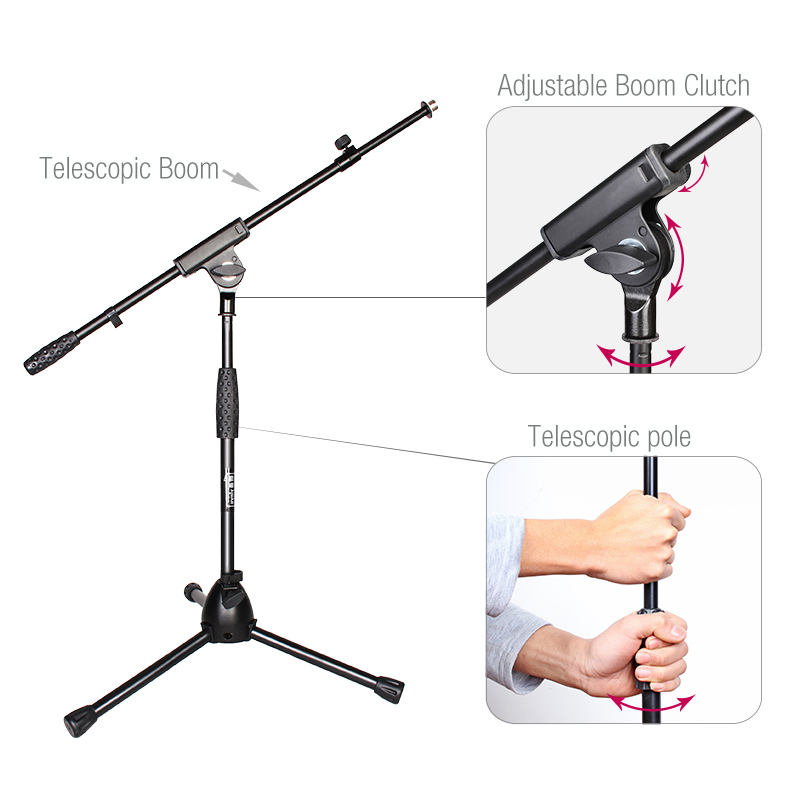
Three properties make the clutch boom the stage default. First, robustness: there are no springs to fatigue and no precision joints to gum up, so a clutch stand shrugs off the knocks that end a desktop arm’s life. Second, range: a telescopic boom such as the 48–87 cm tube on the MS002 lets the capsule hang over a drum kit or guitar amplifier from outside the performer’s working area. Third, versatility of mounting: the boom sits on a standard stand column, so the same head works on tripod bases, round bases, low-profile stands and even stand-mounted accessories, all of which share the same male 5/8″ or 3/8″ thread convention.
The compromise is adjustment speed and position memory. A clutch boom holds any angle you set, but only while the clutch stays tight; a hard knock can rotate a loosely set boom, and every deliberate move costs two hands and a re-tighten. On stage that is irrelevant — repositioning happens at soundcheck, not mid-song. At a podcast desk it would be intolerable, which is precisely why the two families do not compete for the same buyer.
What Buyers Should Compare Before Ordering
For importers building out a microphone stand category, the two designs are complementary rather than competing, and the useful diligence questions differ for each.
For spring balance arms
- Spring matching and adjustment. Can the arm be tuned for different microphone weights, and is adjustment tool-free? An arm that cannot be matched to the buyer’s mic mix generates avoidable returns.
- Mounting hardware. C-clamp, grommet fitting, or both supplied? Desk edge thickness range matters for office and home-studio furniture.
- Cable routing. Integrated clips along the links keep desks tidy; arms without them make the product look unfinished in use.
- Joint hardware. Metal pivot components at the elbow and the mic thread are the difference between an arm that stays tight after a year of daily grabs and one that develops slop. Our MS077B and MS078B use metal hardware at these points, and an innovative zinc clamp at the base.
For friction clutch booms
- Clutch grip material and thread pitch. The clutch is the product; a soft or worn pad lets the boom drift under a knock.
- Boom tube diameter and wall thickness. These decide how the boom behaves over long extensions — the relevant property is stiffness, not any published figure.
- Base pairing. Confirm which bases in the range the boom head pairs with — folding tripod, round base, low profile — so the catalogue presents coherent sets rather than loose parts. Our earlier guide to tripod versus round-base microphone stands covers that pairing in detail.
- Folding behaviour. Legs and boom should fold parallel for case packing; rental and installation buyers care about this more than any other feature.
Where Each Type Fits in a Product Range
Retailers and distributors rarely have to choose between the families — the question is proportion. A microphone stand range aimed at live sound, houses of worship and rental companies will be dominated by clutch-boom tripods, with maybe one spring arm for the recording corner. A range aimed at the creator market — podcasters, streamers, home studios — inverts the ratio, and the desktop arm becomes the hero SKU while a compact tripod covers occasional live use.
Cross-selling completes the picture. Desktop arms nearly always feed into a recording chain that also needs microphone cables in the right lengths, audio cables for the rest of the signal path and closed-back studio headphones, all of which sit in adjacent categories of the LESOUND catalogue. Stage clutch booms, on the other hand, sell alongside speaker stands and instrument cables, so presenting them as part of a stage package raises the average order rather than the unit count.
Bringing Both Families into One Sourcing Programme
Because spring balance arms and friction clutch booms share thread conventions, cable routing habits and packing logic, a single factory can serve both without the buyer splitting the order. At LESOUND, both the desktop spring balance series (MS077B, MS078B, MS075) and the tripod clutch-boom series (including the MS002) are produced in-house under the Yinyu brand, alongside the cable and headphone lines that complete a professional microphone package. That means one supplier conversation covers the desk and the stage, and buyers can phase the two families into their range as demand develops rather than choosing one at the expense of the other.
If you are planning a microphone stand programme and want to review spring balance arms and clutch booms side by side, our export team can walk you through the current range, sample options and the configurations that suit your market. Get in touch through the contact page and tell us which environments your customers buy for.
Post time: Oct-09-2026