


You've got a great laptop. You've got a top-notch mixing console. But they refuse to talk to each other. One has a tiny headphone jack. The other expects those big round XLR connectors. It's a classic problem. And honestly, it happens way more often than it should.
That's exactly where a 3.5mm to XLR cable comes into the picture. It's one of those simple tools that can save you from a whole lot of frustration. Whether you are setting up for a live show, recording in a studio, or just trying to play music from your phone through a proper PA system, this cable might be exactly what you have been looking for.
But here is the thing—not all these cables are the same. Some will give you clean signal. Others will add hum, noise, or just fall apart after a few uses. I have seen both. And in this article, I want to walk you through what actually matters when picking one.
So What Is a 3.5mm to XLR Cable Anyway?
Let's keep this simple.
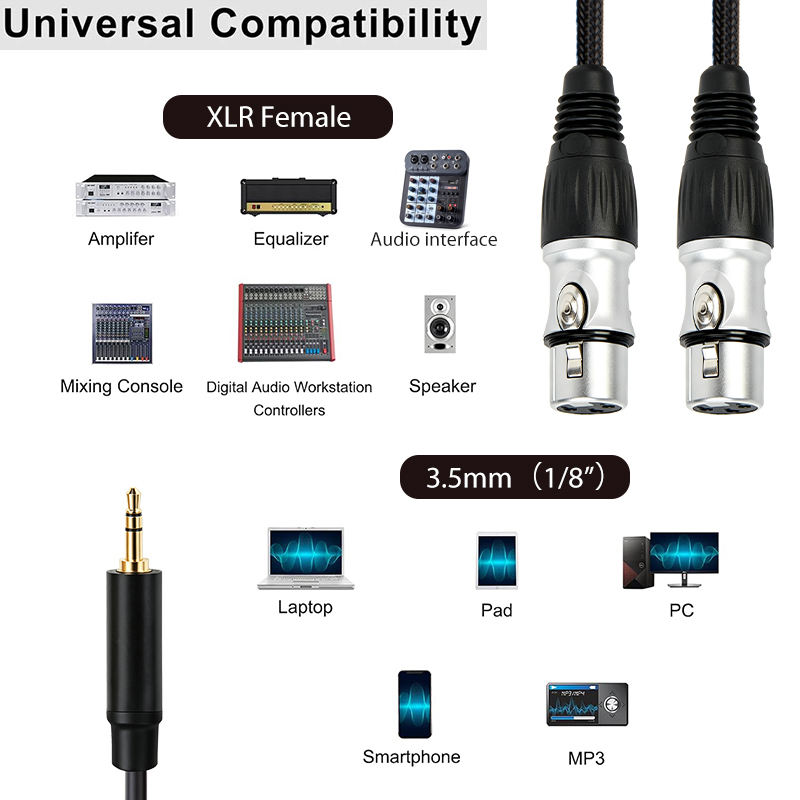
On one end, you have a 3.5mm TRS jack. That's the small plug you see on headphones, phones, laptops, and tablets. On the other end, you have one or two XLR connectors. Those are the big round ones with three pins that you see on professional microphones, mixers, and speakers.
The 3.5mm to dual XLR female version splits your stereo signal into two separate mono signals. Left goes to one XLR. Right goes to the other. This lets you plug your phone or laptop into two different channels on a mixer, or into two powered speakers.
Think of it as a translator. Your consumer device speaks one language. Your pro audio gear speaks another. This cable makes them understand each other.
When Would You Actually Need One of These?
I get asked this a lot. So let me give you some real-world examples.
Live Performances
You are a musician. You have backing tracks on your phone. You want to run them through the venue's sound system. Without a 3.5mm Y splitter XLR, you are stuck using the headphone out into a DI box—or worse, holding your phone up to a microphone. Not ideal.
Podcasting and Streaming
You want to bring a phone call into your podcast. Or play sound effects from your tablet. The aux to XLR splitter cable makes this clean and simple. No weird adapters. No signal degradation.
DJ Setups
DJs are using laptops and tablets alongside traditional gear. The 3.5mm to dual XLR female lets you route audio from your computer directly into the main mixer. It's reliable. It's quick. And it saves you from carrying extra equipment.
Home Studios
Maybe you have studio monitors with XLR inputs. Maybe your audio interface only has a headphone output. This cable bridges that gap. It's a small investment that opens up a lot of possibilities.
Conference Rooms and Events
You are running audio for a corporate event. Someone hands you their laptop and says "play this video." You have a 3.5mm to XLR cable in your kit. Problem solved in seconds.
What Actually Matters When Buying One of These Cables?
Not every cable is built the same. Here is what I look for, and what you should look for too.
The Conductor
Inside the cable, you have copper wires. The quality of that copper makes a big difference.
Cheap cables use low-grade copper or even copper-clad aluminum. They have higher resistance. That means signal loss over distance. It also means more noise.
Better cables use Oxygen-Free Copper. OFC has lower resistance and better conductivity. Our cables use 2x22AWG OFC conductors. Thicker wire. Better signal. Plain and simple.
The Shielding
This is probably the most overlooked part of any cable.
Your cable is basically an antenna. It picks up electromagnetic interference from power cables, lighting rigs, Wi-Fi routers, and a hundred other things. Without good shielding, all that noise gets into your audio.
Good shielding uses a braided copper layer. Better cables use a braided shield plus foil. Our cables use a dense braided shield with 96 strands of 0.10mm copper. It's not just marketing. It actually works.
The Jacket
PVC is standard. It's cheap. It works. But it's also stiff and prone to tangling.
Our cables use a braided nylon jacket. It's more flexible. It resists tangling. It looks better. And it holds up better to repeated use.
If you are gigging regularly, or you're constantly plugging and unplugging, the jacket matters more than you think.
The Connectors
Gold plating is more than just a marketing gimmick. Gold doesn't corrode. A clean connection means a clean signal.
Strain relief is also important. The point where the cable meets the connector is the most common failure point. Good strain relief—molded or reinforced—makes the cable last significantly longer.
Length Options and Why They Matter
We offer this cable in five lengths. Each one fits a different use case.
1.5M is good for desktop connections. Laptop to nearby interface. Tablet to small mixer on the same table.
3M is the most popular. It gives you enough slack to route cables neatly without excess coil.
5M is versatile. Stage use. Studio use. Conference rooms. It's long enough for most situations.
10M is for when you need to cross a room or a moderate-sized stage. With quality OFC conductors, signal loss is minimal.
15M is for larger venues or installations. This length assumes you are using quality cable with proper shielding and low resistance.
And here is a practical tip: many customers buy both a 3M and a 5M. Keep the 3M in your gig bag. Use the 5M for bigger setups. It's a simple way to cover most scenarios.
The FAQ Section—Real Questions from Real Customers
I've been in this industry long enough to know what people actually worry about. Here are the questions I get asked most often.
Can I use this cable with a microphone?
No. And I want to be very clear about this. This cable is for line-level signals from consumer devices. Microphones need microphone-level inputs with preamps and phantom power. If you plug a mic into this cable, it won't work properly.
Will this work with my iPhone?
Yes, but with a caveat. Newer iPhones don't have headphone jacks. You'll need a Lightning to 3.5mm adapter. Same for Android phones with USB-C. Once you have that, the cable works perfectly.
Is there signal loss over longer lengths?
With quality OFC conductors, loss is minimal even at 15M. The thicker 22AWG wire has less resistance than thinner cable. That's one reason we use 22AWG instead of the more common 24AWG or 26AWG.
Why does my cable sometimes pick up noise?
This is almost always a ground loop issue. Your devices are plugged into different power outlets with different ground potentials. The cable is just carrying what it's given. Using a ground lift adapter at the mixer end can fix this. Also, keeping the cable away from power cords helps.
Can I get different colors?
For stock items, we carry standard colors. For custom orders, yes. OEM customers can request specific jacket colors, connector finishes, and packaging.
What is DDP shipping and why should I care?
DDP means we handle customs clearance and import duties. You get the cable delivered to your door with no surprises. No extra fees. No customs hassles. It's a big deal if you are buying from overseas.
Ready to Ship—and Customizable
One thing I hear from customers all the time is frustration with long lead times. You need cables now. Not in two months.
That's why we keep our most popular products in stock. The 3.5mm to XLR cable is available in all five lengths. Orders ship within 24 to 48 hours. Simple as that.
But maybe you need something different. Maybe you want your own brand on the cable. Maybe you need a specific length or a custom color. We do that too.
We are a 3.5mm to XLR cable China supplier with full manufacturing capabilities. We don't just resell. We make. We can customize cables with your logo on the connector, your packaging design, and specific lengths to match your requirements.
For Amazon sellers, we are a custom XLR cable manufacturer Amazon-friendly. We understand the platform. We understand the packaging requirements. We've helped many sellers launch their own branded cable lines.
Why Work with a Chinese Factory Direct?
I want to be honest about this. There are a lot of suppliers out there. So why would you choose a 3.5mm to XLR cable factory direct supplier?
Cost
No middlemen. No distributors. You pay the factory price. That means you get better quality for your budget. Or you can buy more for the same money.
Control
When you work direct, you control the specs. You can ask for thicker wire. Different jacketing. Custom packaging. You get exactly what you need.
Quality
We test every batch. Continuity. Resistance. Visual inspection. Signal quality. We don't send out cables that don't pass.
Flexibility
Need a small sample order? No problem. Need a large production run? Also no problem. That's the advantage of working with an actual factory.
Fast Response
Our team is on the same timezone as our production floor. Questions get answered quickly. Problems get resolved quickly.
What Does "In Stock, Ready to Ship" Actually Mean?
It means we have the cables on our shelves. Not in someone else's warehouse. Not on a container ship somewhere. Physically here, in our facility.
When you place an order:
- We pick it from inventory within hours.
- We inspect it one more time.
- We pack it for shipping.
- It leaves our dock within one to two business days.
For international buyers, we offer DDP shipping to the US and Europe. You get tracking information. You know exactly where your order is. And it arrives with no customs fees or unexpected charges.
The Technical Details (For Those Who Want Them)
I know some of you like the numbers. Here's what our AC030MB model delivers:
- Connector A: 3.5mm TRS Stereo Jack
- Connector B: Dual XLR Female
- Conductor: 2 x 22AWG Oxygen-Free Copper
- Shielding: 96 strands of 0.10mm braided copper shield
- Jacket: Braided Nylon, 6.0mm outer diameter
- Lengths: 1.5M, 3M, 5M, 10M, 15M
This cable is designed to split a stereo signal into two mono signals. Left and right go separately to their own XLR outputs. It's clean. It's simple. And it works.
Some Quick Advice on Using This Cable
Here are a few things I wish I had known earlier.
Check your levels
Consumer devices often output a hotter signal than professional gear expects. Start with the volume low and gradually increase. You'll avoid distortion and protect your equipment.
Don't run it next to power cables
Even with good shielding, running audio cables parallel to power cables invites noise. Cross them at 90 degrees if you must. But keep them separated.
Coil it properly
Over-under coiling is the standard for audio cables. It prevents kinks and extends cable life. If you don't know what that is, look it up. It takes two minutes to learn and it makes a difference.
Label your cables
If you have multiple cables, label them. You'd be surprised how often someone grabs the wrong cable in a dark venue.
What Makes Lesound Different?
We've been making audio products for over seventeen years. Our facility spans over 7,000 square meters. We have complete production lines—from raw copper to finished cables. Everything under one roof.
We are not a trading company. We are a factory. Our quality control team checks every batch. Our R&D department is constantly improving designs. Our production team has years of experience.
We also manufacture our own brands. Audfine for headphones and speakers. Yinyu for stands. These brands are sold in over sixty countries. We put our own name on products. That tells you something about our confidence in quality.
When you work with us, you get that same quality. Our cables, like our headphones and stands, are built to perform.
A Note on Why I Wrote This Article
Honestly, I see too many people buying poor-quality cables. They don't know what to look for. They get something cheap. It buzzes or breaks. They waste time and money.
I wanted to put together a guide that explains what matters. Not just marketing talk. Real, practical information.
If you are just buying a cable for your home setup, I hope this helps you choose better.
If you are a business looking for a supplier, I hope this gives you confidence in what to look for.
And if you have questions—about this cable, about other cables, about anything audio—please ask. I answer emails personally.
So, Does This Cable Really Improve Audio Quality?
Here is the short answer: it can.
The cable itself doesn't make your audio better. It preserves it. A good cable keeps the signal clean. It doesn't add noise. It doesn't lose high frequencies. It doesn't break after a few uses.
A bad cable ruins your audio. It adds hum. It cuts out. It falls apart.
So yes, choosing the right 3.5mm to XLR cable makes a big difference. It's the difference between sounding professional and sounding amateur. Between a reliable setup and one that fails at the worst possible moment.
Ready to Order or Just Want to Ask a Question?
We keep this cable in stock. Lengths from 1.5M to 15M. Ready to ship. DDP available for US and Europe.
If you need custom lengths, custom packaging, or your own branding, send us a message. We handle OEM orders daily.
If you are not sure which length you need or which configuration works for your setup, I'm happy to help. Sometimes it's easier to just describe what you're trying to do and let us make a recommendation.
Drop us an email or send an inquiry through the site. Our sales team speaks fluent English and understands technical questions. We respond quickly. And we won't push you to buy something you don't need.
We've been in this business a long time. We know audio. We know manufacturing. And we know how to get you the cable that actually works for your application.
LESOUND ELECTRONICS CO., LTD.
Over 17 Years of Professional Audio Manufacturing Experience
We make cables. We make headphones. We make stands. We make them right.
Post time: Sep-08-2026