


Put a screen on a totem and the project changes shape. The tower stops being signage and starts being a mount, which means weight, cabling and viewing angle all arrive at once. Buyers who plan for a printed panel and then add a screen halfway through are the ones who end up with a tower that leans.
Screen towers come out of the Yinyu booth line, so the notes below are about the mount and the load path rather than about the tower’s paint.
A screen changes the tower, not the panel
This is the first thing that gets missed. A printed panel is light and soft, and it puts no load worth talking about on the tower. A screen is a rigid mass held out in front of the upright, and it behaves like a small sail that also wants to be looked at. If you’re specifying a tower that might carry a display later, say so now, because the difference is in the frame and the base rather than in the panel.
The other change is height. A printed panel is read from across a room, so it wants to sit high. A screen is looked at from close, so it usually wants to sit lower than the print would. If you’re asked for both, you’re building two towers, not one.
The bracket decides more than the tower
Ask whether the mount is a standard pattern or a custom one. A standard pattern lets a client fit a display they already own, which is what most venues want, and it keeps the tower useful when the screen is replaced. A custom mount ties the client to a single display model, and when that model goes end of life the tower goes with it.
- Standard pattern: the client can swap the display without touching the tower.
- Custom mount: a tighter fit for one model, and a dead end when that model retires.
- Tilt or fixed: tilt helps avoid ceiling glare, and it also adds a joint that can loosen.
- Portrait or landscape: changing orientation changes the bracket, not just the way it’s fitted.
Weight, and why height is the real number
A display high on a tower is a mass at the end of a lever, and the lever is the height. The same screen that behaves on a low tower will rock a tall one, because the same weight has further to swing. When a supplier quotes a weight limit, ask at what height it applies and whether it’s per tower or per pair. A limit that quietly assumes a low mount isn’t a limit at all.
Don’t forget the display’s own bracket. A tilt joint adds weight above the mount point, which is the worst place for it. If you’re building for retail, ask buyers to name the heaviest display they expect to hang, not the average one.
Getting power and signal to the screen
A screen needs power, and often a signal cable, and both want to travel inside the tower rather than down the outside. Ask where the cables enter, how they’re kept from being seen, and whether there’s a route that a venue can re-dress without tools. A tower with visible cables looks unfinished even when the display is working perfectly.
- Decide where the display socket sits before the frame is drawn, not after.
- Run power and signal together so a venue isn’t chasing two routes.
- Leave enough slack at the mount to re-fit a replacement display without re-cabling the tower.
- Keep the connection point above floor level, out of the way of mops and feet.
Sightlines, and the room the tower stands in
A screen tower is planned around where people stand and how far away they’re. If the room has a raised area, the screen may need to tilt down. If it’s meant for people walking past, it wants to be closer to eye height. Neither of those is a tower problem, they’re a brief problem, and they’re worth settling before the frame is cut.
Transport with a screen fitted, which you shouldn’t do
A screen should travel off the tower, in its own case, every time. A tower that goes in a van with the display attached is a tower that arrives with a cracked panel and a bent bracket. If you’re building for a rental market, ask for a mount that a single person can fit and remove quickly, because the speed of that step decides whether the crew takes the screen off or risks it.
How to check a screen tower before a bulk order
- Fit the heaviest display the market uses and push the top of the tower sideways.
- Check the mount height against a seated and a standing viewer.
- Run a power lead through the tower and see whether it stays hidden with the screen fitted.
- Fit and remove the display the way a crew would, and time it.
- Fold the tower with the mount still attached and check nothing fouls.
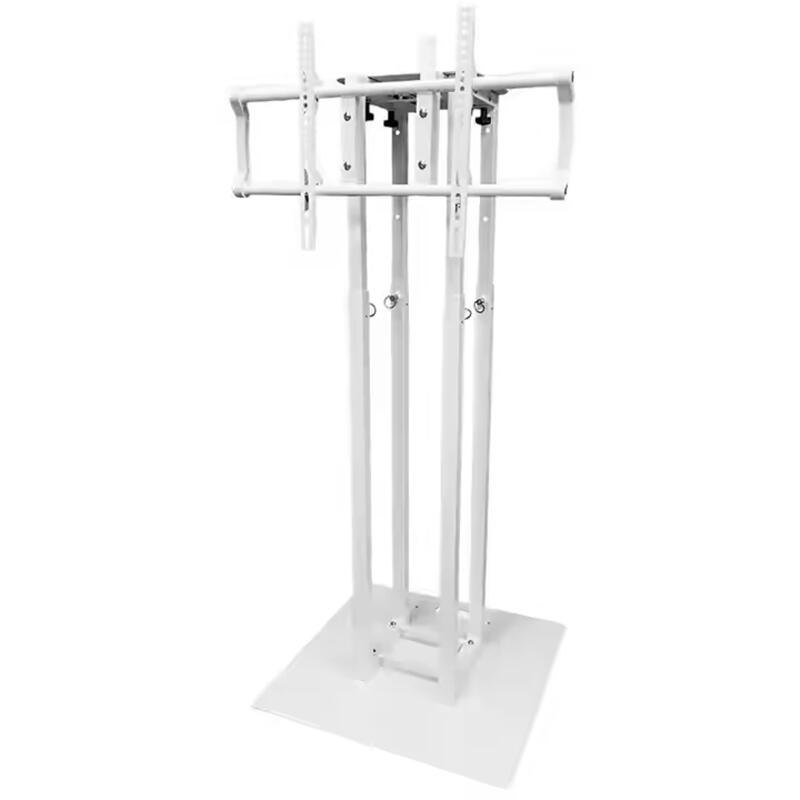
Broken down, base, mount and the parts to hold
The parts that wear on a screen tower are the mount, the joint that takes the tilt, and the folding joints. If a distributor can hold the mount as a spare, a damaged tower stays in service, which matters for a market that runs the same tower every weekend.
Packing a tower with a display mount
The mount is the part that gets bent in transit, so it travels in its own bag or in a protected pocket rather than bolted to the bare frame. If the screen ships separately, the two cartons want consecutive labels so a venue doesn’t fit the tower and then wait a week for the display.
For retail, a tower that ships with a clearly marked mount kit sells better than one that arrives as a frame with a loose bag of bolts.
What goes out with a screen tower
A screen tower rarely ships alone. Whoever fits a branded corner adds the Yinyu dj stand and the OEM Yinyu foldable dj facade table to the tower, then the OEM adjustable dj table, so the install lands in one delivery.
Crews running events tend to add Audfine headphones on the same order, which keeps the delivery count down on a day that’s already busy.
Questions before a screen tower goes on the order
Can we add a screen to a tower we already sell?
Only if the frame was sized for the load. A tower built for a print panel usually isn’t, so if a screen is possible, say so before the frame is designed rather than after.
Which mount pattern should we stock?
The one your market’s displays already use. Ask the dealers what they fit most often, because a standard pattern keeps the tower useful across several display generations.
Does the tower need its own power point?
If the screen is fitted, yes, and where that point sits matters for how the tower looks. Ask for the cable route as a drawing before you commit.
Is it stable with the screen up high?
That’s the test to run rather than a number to trust. Fit the heaviest display and push the top before you sign the order off.
How is the finish held across a run?
Mount and frame are finished as one job and compared side by side before boxing. On a screen tower the mount is always in view, so a colour step between the two is obvious to everyone in the room.
Heat, dust and a display that runs all night
A screen on a tower is on for the whole event, and the tower has to live with the heat it makes. Ask whether the mount leaves any air behind the display, because a screen pressed flat against a solid panel runs hotter than one with a gap. That gap costs nothing at the drawing stage and is hard to add later.
Dust is the other quiet problem. In a venue with a floor and a crowd, the space behind a display fills up, and a mount that’s easy to take off is a mount a crew will actually clean behind.
Who fits the screen, and who has to fix it
Ask early who’s expected to install the display, because it changes what ships. If the venue’s own AV team fits it, the mount wants to be standard and the instructions want to be in the box. If your own crew fits it, a custom mount is fine and the instructions matter less. Either way, a tower that arrives with no fixings for the screen is a tower that sits in a store until somebody drives to a hardware shop.
Mount patterns and the plate that has to match
Screens fix to a bracket through a standard set of holes, and a plate cut for one pattern won’t hold a screen that uses another. Ask which pattern the plate carries, how far it shifts sideways to centre a screen that isn’t the width the frame expects, and whether the plate can be swapped later when the market moves to a larger display.
A tower that only ever fits the screen it was ordered with is a tower that comes back the season after. Buyers who plan for a screen change get a second life out of the same frame, and that’s the version a retail buyer reorders.
Send the display size and the room
Tell us the display size and weight, the viewing distance and whether the tower goes outdoors. Those four lines decide the frame, the mount and the base, and they’re the ones most buyers leave out.
Ask for the sample with the mount on. A tower tested without one says nothing about the part that carries the screen.
Screen towers are badged Yinyu, produced by Ningbo Lesound Electronics in Zhejiang. Frame and mount are cut as one job so they fit the first time.
Post time: Oct-13-2026