


Most of what decides a desk microphone stand for mic order is settled long before anybody talks about price, and the questions that settle it aren’t the ones on a spec sheet. They’re about the base, the thread, the clutch and the spares behind them, and every one of those is a place where two factories that look identical online turn out to be different.
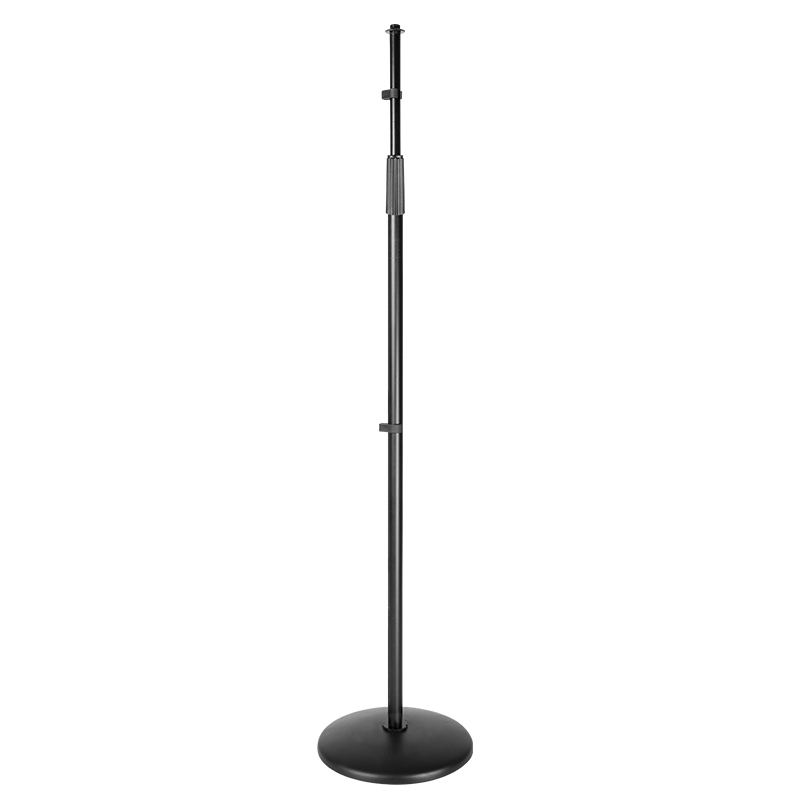
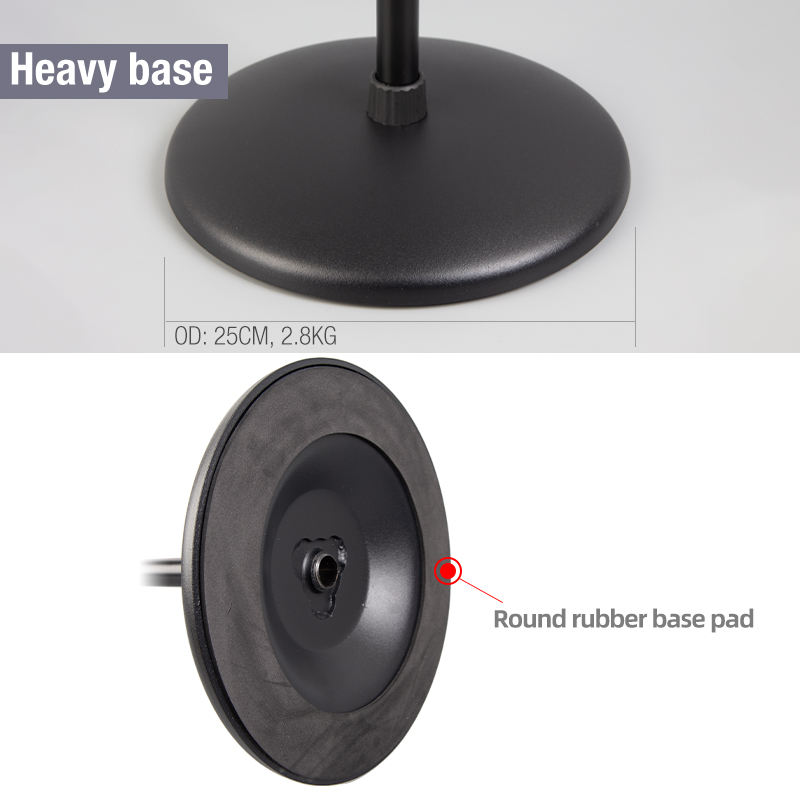
We build these in our own workshop, so the answers below come from units on a bench rather than from a catalogue. Where an answer depends on your own set-up we say so instead of quoting an average.
What a desk stand is deciding before anything else
A desk stand is doing one job, which is to hold a microphone still while somebody talks into it. Everything else about the product follows from that, including how heavy it has to be, what it does to the desk and whether the person using it can move it without dismantling anything.
That’s why the base comes first in any sensible conversation. Ask what the customer does with the microphone, because a stand that sits in one place for a year and a stand that gets moved twice a day are different products wearing the same name.
Base type first, and it’s a different product each time
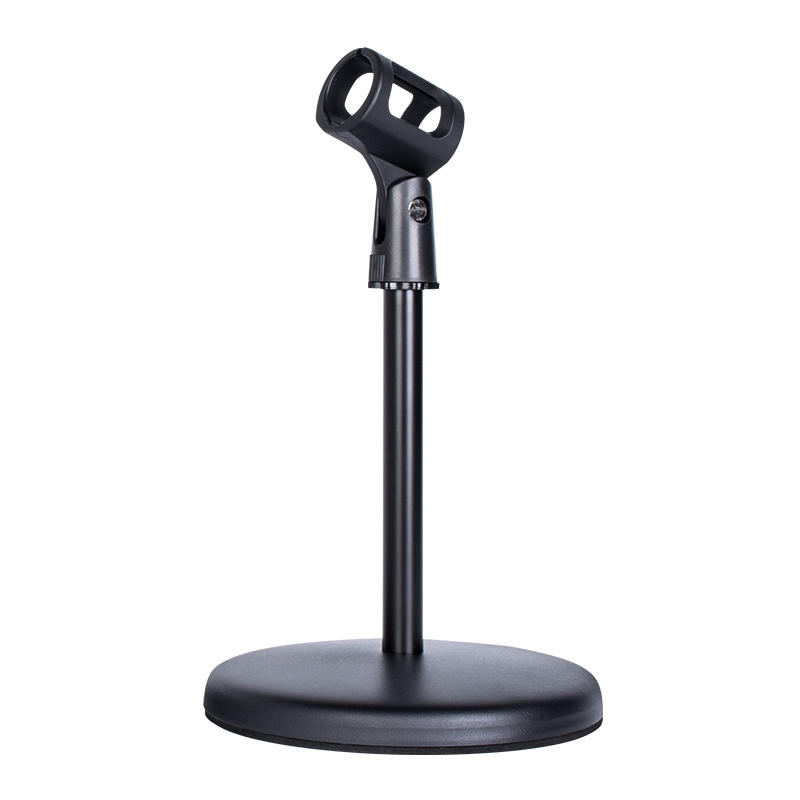
A tripod spreads its feet in three directions, a round cast base puts all its weight in one disc, and a desk base clamps or sits in a much smaller footprint. The three solve three different problems and they aren’t interchangeable across a range.
Ask what the market has been buying rather than what the market asks for. A dealer whose customers describe a layout by pointing at a competitor’s stand is describing a base type, and switching that customer to a different base is a conversation rather than a swap.
Ask whether the factory makes all three off the same tube and clutch. A supplier who makes one base will always recommend that one, and a supplier who makes all three can tell you honestly which suits the order.
Working height and the boom reach
A seated podcaster and a standing vocalist need different numbers out of the same-looking product. Ask what the working height range is and, more usefully, ask which slice of that range most buyers actually use, because a stand is at its least stable at the top of its travel.
If a boom is going on, the boom decides more than the column does. Ask how far the arm reaches, what it weighs and whether the base is rated for that moment, because an arm sold onto a base that was sized for a straight stand is a tipping risk rather than a convenience.
Ask whether the boom tip carries the thread the customer’s clips and mounts already use. That single question prevents more returns than any other on this list, because a thread mismatch is discovered the moment the box is opened.
The thread where the clip or the mount lands
There’s a thread at the top of the stand and there’s a thread at the tip of the boom, and both are small parts under constant wear. Ask whether each is cut into the metal itself or carried on a separate fitting, because a fitting that can be unscrewed is a fitting that can be renewed.
Ask what the insert is made of. A threaded insert in steel takes years of nightly use that a soft metal thread gives up on inside a season, and the failure turns up as a claim long after anybody remembers the sample.
Ask which adapter the factory ships with the stand. Every market has a default, and a stand that arrives without the adapter its market expects is a stand that gets fitted with whatever is in the drawer.
The clutch, tested with weight on it
The clutch is the part that announces a cheap build, and it announces it under load rather than in the hand. Ask how many turns it takes to release, what it’s made of and whether it can be re-tightened once it wears.
Then test it properly. Put the heaviest microphone the customer expects on the stand, raise it to working height and adjust it with the weight still on. A clutch that holds in an empty stand and slips with a microphone on it’s the most common complaint in this product family.
Ask what the factory does to the clutch before packing. A test on every unit is a different claim from a test on a batch, and it’s worth asking which one you’re being offered.
Leg locks and the base joint
On a tripod the leg locks do the same job the clutch does, and on a desk base the joint between the base and the column does it. Ask how each is tightened and whether it can be adjusted with a tool the customer already owns.
Ask the factory to load a sample and then rock it, because a stand that stays put on a showroom floor can still creep on a stage that gets knocked. A stand that creeps is reported as a stand that won’t stay up, and the customer rarely describes it that precisely.
The accessories that get sold with the stand
Buyers often treat the pieces around a microphone as one product, and they aren’t. A pop filter sits between the voice and the capsule and fixes a thump on the hard consonants. A shock mount suspends the microphone on elastic and fixes a rumble coming up the stand or the floor. An isolation shield changes what reflects back into the capsule.
Getting that wrong is expensive in a specific way. The customer buys the wrong part, it doesn’t solve the problem, and the review says the product failed rather than that it addressed the wrong complaint.
A shop that stocks all three and can explain the difference sells more of all three, because the customer comes back for the second one as soon as the first one works. Ask the factory to supply the three together so you can demonstrate the difference on the counter.
Spares that tell you what kind of factory you’ve
The parts that wear on a stand are the clutch, the leg locks and the thread inserts. Ask whether those can be ordered on their own, because a stand that has had two years of use is a repair rather than a replacement if the answer is yes.
That’s also the cheapest test of a supplier you’ll ever run. Order a clutch as a spare part on its own before you place anything large, and watch whether it arrives as a real component in real packaging or as an afterthought in a bag.
Ask how the fittings are packed inside the carton as well. The small parts are what goes missing on site rather than the stand, so a carton that carries a complete set is a carton that doesn’t generate a phone call.
Cartons, small parts and the master quantity
Ask for the master carton quantity and the inner pack before you ask for a unit price, because the two together decide your landed cost more reliably than the invoice does. Freight is priced on volume and weight rather than on the goods.
Ask what the master carton weighs loaded and whether the columns ship apart from the bases. Splitting them costs a little more to pack and it’s what keeps a column straight, and a customer who has received a bent column once will ask for the split by name next time.
Ask whether the shipping carton is the retail carton or a separate box around it. A dealer selling through a shop wants a retail box that survives a shelf, and an installer shipping straight to a venue wants a plain one.
The sample that settles the whole order
Almost every question on this list is answered by one sample, and that’s why the sample deserves more attention than the price negotiation. Ask for the sample with the base the market actually uses rather than the base the factory prefers to build.
Then test it the way the customer will. Load the heaviest microphone the order has to carry, run the height up and down a dozen times with the weight still on, and sit the whole thing on a hard floor to watch for a wobble. Any of those tests can end a conversation that a brochure would have kept going.
Ask how production is held to the sample afterwards. Photos of the batch and of the master carton before the goods leave, plus a note of any drift in the finish or the thread, turns a shipment into something you can plan around.
A short list before the deposit
Which base type is this customer actually asking for?
Ask them to describe the layout rather than name the product, and match the base to the description.
What does the top thread take?
Ask for the thread and the adapter, and check it against the clips the customer already owns.
Will the clutch hold with a microphone on it?
Ask the factory to test it loaded rather than empty, because that’s the test the customer will run.
Can we buy the wearing parts on their own?
Ask for a clutch or a leg lock as a spare, and judge the answer by what arrives.

Send us the microphone and the desk
Tell us the base type your market buys, the height the microphone works at and what the customer already owns for mounting, and we’ll answer against those three lines rather than against a catalogue page. If the customer has described a complaint rather than a product, describe the complaint instead and we’ll say which part addresses it.
Ask for a sample set up the way the customer will use it, because the base weight and the clutch are the two things you can’t judge from a photograph.
A studio building a whole desk position rarely buys one piece. The same order usually carries a Yinyu microphone stand for a position that has to reach, a OEM microphone floor stand where the desk is small, and a OEM base microphone stand for a corner that has to pack away. Audfine headphones go out alongside most of these orders, because the person buying a microphone stand is the person listening through it.
The one question that saves a container
If you take only one thing from this piece, take the loaded clutch test. It costs ten minutes, it needs nothing you don’t already own, and it separates the stands that’ll survive two years from the stands that’ll come back. Ask it of us and ask it of anybody else you’re quoting, and compare the answers rather than the prices.
Desk stands and microphone stands in this range carry the Yinyu name and are made by Ningbo Lesound Electronics in Zhejiang, where each unit is put together and load tested before it goes into a carton.
Post time: Oct-13-2026