


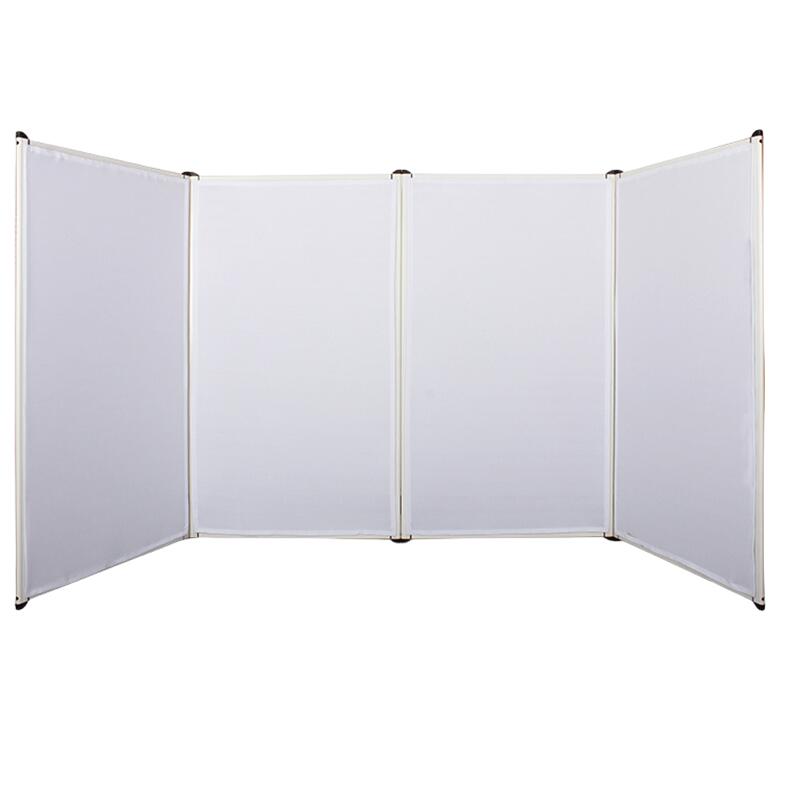
A DJ booth with scrim arrives as several things rather than one. There’s a table, a frame, a front panel and the cover that goes over it, and a buyer who treats them as a single item tends to find out at the sample stage that one part was never specified.


The scrim is the part that decides how the booth reads from the floor, and it’s usually the part buyers leave until last.
What the word booth covers in an order
A booth is a table, a frame and a front panel, and sometimes a printed skin over the panel. If the customer means all three and the supplier hears one, the quote comes back short. Ask for the parts list at the start, and ask which of the parts the factory makes and which it buys in.
The table, and the load it takes on the night
A booth table carries more than a controller. Two laptops, a mixer, a headphone set, a drink and occasionally somebody leaning on it. Ask what the top is rated for, whether there’s a shelf underneath and where it sits, and whether the legs are splayed enough to stop a lean turning into a tip.
Frame rigidity, and where a booth starts to walk
A frame that’s rigid in the warehouse can still walk on a sprung stage floor, because the whole unit moves together. Ask how the frame joins, whether there’s a cross brace behind the panel, and whether the feet can be levelled. A booth that rocks under a jog wheel is a booth that comes back.
The scrim itself, and what to specify
The scrim is a stretch fabric over a frame, and the questions are about tension and recovery. Ask whether the fabric is printed or dyed, how much it stretches, and whether it returns to shape after a night in a case. A cheap scrim sags by the second gig and the customer blames the frame.
Printing the panel, and the file that arrives late
If the panel carries artwork, the print file becomes the item on the critical path. Ask what format the factory needs, whether they can proof it, and how long the proof takes to turn around. Buyers who leave the file until the week of the order are the ones who ship a booth with a blank panel.
It’s worth saying that out loud to the customer as well, because a blank panel is nobody’s fault and everybody’s problem.
How the panel is fixed to the frame
Ask whether the panel clips, slides into a channel or ties on. Clips are quick and they can pop under tension. A channel is slower to fit and it holds. Ties are the answer on a rental booth, because the whole panel can be swapped between venues without tools, and that’s a market in itself.
What to assemble on a sample before the container
- Ask for the parts list and check every item is on it.
- Build the booth once and time it with one person.
- Fit the printed panel and check the tension after an hour.
- Lean on the table the way a DJ will and watch the feet.
- Take it apart and check nothing has to be forced.
Spares a rental booth needs to carry
Rental stock loses clips, feet and the small brackets that hold the panel to the frame. Ask whether those come as a bag rather than a single unit. A booth missing one bracket is a booth that gets taped together on site, and taped equipment gets photographed.
Packing a booth so the frame stays square
A frame packed loose arrives twisted, and a twisted frame means a panel that never sits flat. Ask whether the frame travels in its own bag, whether the corners are protected, and whether the panel and the frame ship in the same carton or two. Two cartons mean one of them can go missing.
What ships with a booth and scrim
A venue fitting out a booth usually wants the rest of the corner too. The same order often includes a Yinyu adjustable dj table for the display side and a OEM portable dj totem stand or a OEM Yinyu foldable dj facade table for the spare position, since a second table costs less than a second delivery.
A DJ who buys a booth usually takes Audfine headphones at the same time, because the booth is where they listen.

Six answers worth having before a booth is built
Is the scrim printed or plain?
Ask early, because a printed panel puts artwork on the critical path and that changes the lead time.
How many parts arrive?
Ask for the count and check it against the parts list. A booth short of one bracket arrives as a complaint.
Can one person build it?
Ask for the build time with one person rather than two. Most venues build booths with whoever happens to be free.
Are the panel fixings sold as spares?
Ask, because clips and brackets are what a rental fleet runs out of first.
Two markets, and how they change the order
A club buys a booth once and keeps it bolted in a corner. A rental house buys the same booth and takes it apart twice a week. The club cares about how it looks, and the rental house cares about how fast it comes apart. Ask which one the customer is, because the two want different fixings on the same frame.
The shelf, and where the cables live
A booth with no shelf is a booth with a cable on the floor. Ask whether there’s a shelf under the top, how much clearance it has, and whether it’s deep enough for a power strip and a laptop bag. The shelf is the cheapest part of the product and the one that decides whether the booth looks tidy from the front.
Ask as well whether the shelf is fixed or removable. A fixed one adds rigidity to the frame and a removable one makes the booth easier to move, and a rental house will usually want the removable version.
Feet, and the floor the booth lands on
A club floor is level and a marquee floor isn’t. Ask what the feet are made of, whether they adjust, and whether they can be replaced when they wear. Rubber feet grip a smooth floor and disappear in grass, and a venue that puts a booth on grass tells you about it afterwards.
Angle, and the panel that leans back
Some booths have a panel that leans away at the top, and the lean changes how the print reads and how the frame braces. Ask what the angle is, whether it’s built into the frame or into the panel, and whether a customer can order it flat. A lean built into the panel is easier to change later than one welded into the frame.
The market for smaller booths
Not every customer wants a full width booth. Weddings, small bars and mobile DJs often want something a third of the size that still reads as a booth rather than a table. Ask whether the factory builds a narrower version from the same frame, because a second size off one tool costs far less than a second tool.
What a second order looks like
A venue that buys one booth usually buys another the season after, and it expects the second to match the first. Ask how the build is held between runs, whether the print colours are held to the same reference, and whether the frame is the same gauge. A second booth that’s slightly different is a booth the customer notices.
Delivery, and the date that moves
Booths tend to be bought for an event with a date attached, which makes the lead time part of the product. Ask what the factory’s realistic build time is and what they do when a print file arrives late. A supplier who gives you the honest figure is worth more than one who quotes the optimistic one.
The printed skin, and how it’s stored
A printed panel gets rolled, and how it’s rolled decides whether it creases. Ask how the panel is packed for shipping and whether the customer gets a tube or a bag. A panel that arrives creased is a complaint on the first day.
Ask the factory what they recommend for storage between gigs as well, because a panel left folded in a case will show that fold under stage light long after it’s been hung up.
What a booth costs to move
Ask for the packed weight and the carton dimensions, because a venue moving a booth between rooms finds out fast what it weighs. A booth under twenty kilos moves with one person, and one that’s over needs a trolley and two people who planned ahead.
Where the booth sits in a room
Ask whether the customer’s booth goes in a corner, against a wall or out in the open. The panel is printed for one viewing angle, and a booth seen from the side needs either a wrap or a second panel. Settle that before the print file is made rather than after.
Send the panel size and the venue
Tell us the front-face size, whether the panel carries artwork, and whether the booth stays put or travels. Those three lines settle the frame, the fixings and the packing.
Ask for a sample with the panel on it. A bare frame tells you nothing about how the booth reads from the floor.
Booths and scrims leave here under the Yinyu name, produced in Zhejiang by Ningbo Lesound Electronics, where the frame and the panel are checked together before packing.
Post time: Oct-13-2026