


An XLR to RCA cable joins two worlds that were never designed to meet. The XLR end carries a balanced signal at studio level, the RCA end is unbalanced and expects a fraction of that voltage, and the cable is the part that has to make the two agree without adding hum. Importers who vet this line learn quickly that the interesting questions have nothing to do with the colour of the connector.


Most of the faults we see come back to one of three things: a drain wire that was never meant to carry audio, a connector soldered in a hurry, and a test sheet written from the drawing instead of from the bench.
What the cable is actually doing
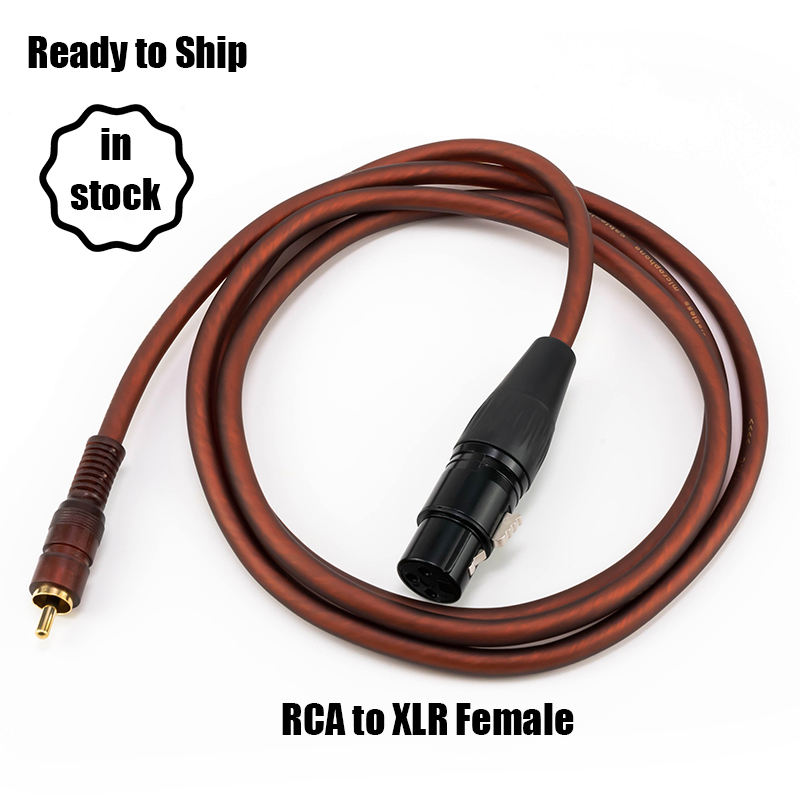
The XLR end has three conductors. Two carry the signal as a pair, one inverted against the other, and the third is the shield that wraps them. The RCA end has two contacts, a centre pin and a shell, so the balanced pair has to be folded into a single signal and a ground. That fold is where the design decisions live, and it’s the part a buyer never sees on a drawing.
A well made cable puts the signal on the centre pin, ties the inverting conductor to the shell through the shortest path it can, and keeps the shield connected at one end rather than both. A cheap cable ties all three together and calls it a day, which works fine until the run passes a lighting dimmer.
Pin 2 hot, and why the RCA end makes it complicated
Pin 2 hot is the convention most of the world settled on, and it matters because a cable wired the other way flips the phase of everything downstream. On a short run into a home amplifier nobody hears it. On a long run into a powered monitor, a flip against the other channel shows up as a hole in the middle of the image, and the customer returns the cable rather than diagnosing it.
Ask the factory to state which pin lands on the centre conductor and whether they wire it the same way on every order. A supplier who can’t answer that in one sentence builds it differently depending on who’s on the bench.
The drain wire isn’t an audio conductor
The drain bleeds off interference that the foil or braid collects. It isn’t a signal path, and a cable that uses it as one will hum the moment the shield picks anything up. Ask how the drain is terminated, whether it reaches the shell or floats at the RCA end, and whether the shield is connected at one end of the run or both.
Both-end grounding is the common mistake. It forms a loop between two pieces of equipment that are already joined through the mains, and the loop becomes an antenna. A single ended shield is the quieter build, and asking for it by name separates the factories that understand the problem from the ones that copy a photograph.
Level mismatch, and where the hum comes from
Studio gear runs at a higher nominal level than consumer gear, so this cable often sits between two devices that disagree about what a normal signal looks like. The cable can’t fix that, but it can make it worse. A long unbalanced run picks up more than a short one, and a run that shares a path with mains cable picks up the most.
For a market fitting these into racks, ask what lengths the factory can hold and whether the same build runs across all of them. A two metre cable and a ten metre cable built to the same recipe behave very differently, and the second one is where the complaint starts.
Where the connectors fail
Connectors fail at the joint rather than in the middle. The solder cup, the crimp and the strain relief are the three places worth inspecting, and only one of them is visible from outside.
- Check that the boot grips the jacket rather than the conductors.
- Flex the cable at the entry point and watch for the jacket sliding inside the boot.
- Ask whether the body is nickel or black chrome, because the plating decides how it wears in a rack.
- Confirm the shell opens far enough for a field repair.
A connector that can’t be reopened turns a five minute repair into a new cable. In a rental market that difference decides which brand gets reordered.
What to put on the bench before the run
- Ask for conductor gauge and shield type in writing, not as a photo caption.
- Ask which pin lands on the centre conductor and how they prove it.
- Request samples at two different lengths taken from the same run.
- Ask what the continuity and insulation checks look like on paper.
- Ask who solders the connector and whether the same person builds the reorder.
Spares and the parts that disappear
The parts that vanish from a cable line are the small ones: the boot, the shell, and the heat shrink that finishes the tail. Ask whether spares can be ordered separately and whether they come from the same mould as production. A spare from a different tool fits badly and gets thrown in a bin.
Packing a coiled cable so it arrives round
A cable coiled tightly and stuffed into a bag arrives with a memory, and the customer blames the cable. Ask how the coil is formed, whether it’s tied with a reusable tie or a plastic one, and whether the bag has room for the coil at its natural diameter. Overhand and figure eight coils travel differently, and only one of them goes back into a case without a fight.
What ships with an XLR to RCA cable
A studio building a monitoring chain rarely buys one cable. The same order usually carries a Yinyu audio cable for the network side and a OEM Yinyu trs to aux cable for the patch, and often a OEM low noise microphone cable as a spare in the bag.
A room mixing on smaller speakers will usually take Audfine headphones on the same order, because one delivery is easier to track than three.

Ask these before the deposit goes out
Which pin ends up on the centre conductor?
Ask for it in writing. It’s the one choice that decides whether the cable is phase correct, and the one most easily changed without telling anybody.
Is the shield grounded at one end or both?
One end is the quieter build. Both ends turns the shield into an antenna and the cable into a hum complaint.
Can the same build be held across lengths?
It can, if the recipe is fixed rather than improvised per order. Ask for gauge and shield to stay put as the length grows.
Are the boots and shells available as spares?
Ask, because a rental market repairs cables rather than replacing them, and a spare that doesn’t fit is worse than none.
Test sheets, and the numbers worth asking for
A test sheet that repeats the drawing tells you nothing. What you want is continuity per conductor, an insulation reading between shield and conductor, and a record that the same test ran on the batch that shipped. Ask whether it happens on every unit or on a sample, and settle which before you assume.
For a market selling to installers a per unit test is worth paying for. For a market selling singles to hobbyists it usually isn’t, and the money is better spent on the connector.
Where an unbalanced link turns up
These leads don’t live in studios alone. A small interface feeding a hi-fi amplifier, a mixer’s unbalanced output feeding a recorder, and a laptop dock feeding a pair of powered speakers all need the same fold. If your market sells into two of those, ask for one build that covers both rather than two part numbers.
You’ll also meet them in the install trade, where a box of these sits in every van. That market buys in tens rather than singles, and it cares about the plug more than it cares about the cable.
Right angle plugs and the rack door
A straight RCA plug sticks out of the back of a rack unit by the length of the plug plus the bend the cable needs, and sometimes that’s more room than the door allows. A right angle plug sits flat against the panel instead. Ask whether the factory offers one, and ask whether changing the angle changes the boot, because it usually does.
It’s a small part, and it’s the one that decides whether a rack closes. Buyers who fit out racks ask for it by name once they’ve been caught out once.
Two metres or ten, and which one sells
Unbalanced leads sell in a ladder of lengths, and the top of the ladder is where the questions start. Ask what the factory holds as standard stock, whether the build stays the same at the long end, and what they’d suggest for a run that goes past the short lengths. You don’t want a ten metre lead built to a two metre recipe.
Send the run length and the finish
Tell us the distance the run has to cover, the gear at each end, and whether the cable shares a path with mains wiring. Those three lines settle the shield and the build faster than any drawing.
Ask for a sample at the longest length the market uses. A short sample flatters a build that struggles at ten metres.
This range leaves under the Yinyu name, built in Zhejiang by Ningbo Lesound Electronics, with the shielding and the terminations handled in the same workshop as the connectors.
Post time: Oct-13-2026