


A microphone pop filter looks like a hoop and a piece of cloth, which is why buyers treat it as a commodity and then wonder why one supplier’s version sells and another’s sits in a warehouse. The differences are in the screen, the clamp and the way the whole thing stays where it’s put.


Choosing a supplier for these is mostly about the parts around the screen, because the screen itself is easy to get right.
What the screen is doing
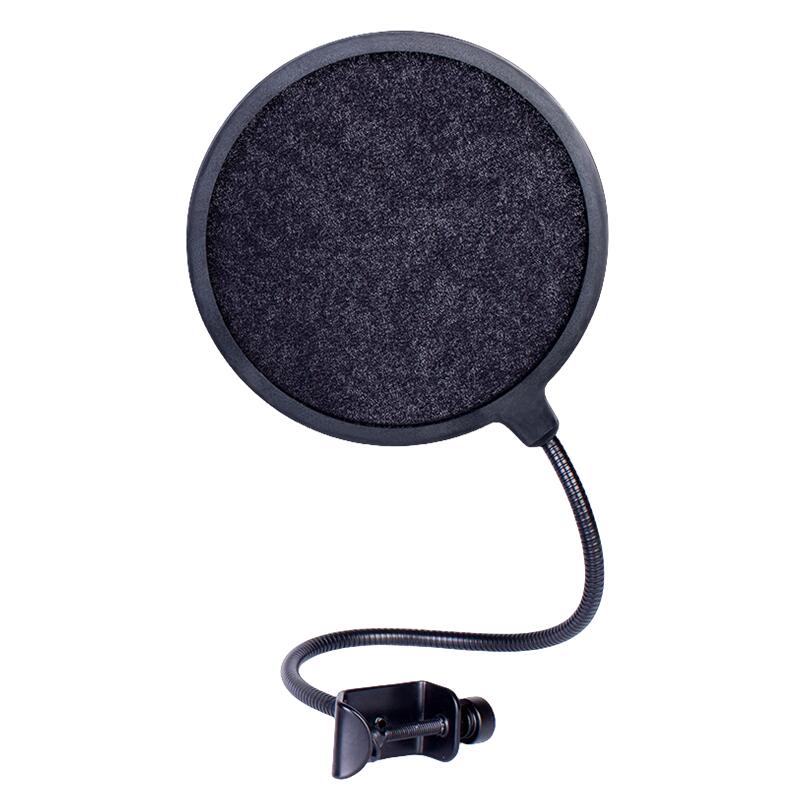
The screen breaks up the puff of air from a plosive before it reaches the capsule. It doesn’t filter sound, it spreads a burst of air over a longer moment. That’s why the material and the distance from the capsule matter more than the size of the hoop, and why a filter set too far forward does nothing at all.
Ask a supplier how they’d position it and why. A supplier who talks about the distance from the capsule has thought about the product rather than about the photograph.
Nylon, mesh or perforated metal
Nylon is the cheapest and it works. A metal screen lasts longer and it can be wiped clean, and a double layer of nylon over a metal screen is the version studios ask for. Ask what the screen is made of, how many layers it has, and whether it can be washed without losing its shape.
The clamp, and the joint that has to hold
The clamp is what fails. It grips a stand tube or a boom and it has to hold a hoop at an angle without slipping. Ask what the clamp is made of, how wide a tube it takes, and whether the joint is a ball or a hinge. A plastic clamp on a metal stand slips once the room warms up.
The hoop, and the arm that reaches
Ask what diameter the hoop is and how far the arm reaches from the clamp. A hoop that’s too small sits inside the mic and does nothing, and an arm that’s too short puts the screen at the wrong distance. Both faults look perfectly fine in a photograph.
What a reliable supplier does differently
Ask for a sample rather than a catalogue. Ask what changes between one order and the next. Ask whether the screen material comes from the same source twice running. A supplier who can answer those questions has a process, and most of the failures in this product come from a supplier who quietly substitutes a part.
It’s worth asking when they last changed a component and why. A supplier who can’t remember has either never changed one or never noticed.
What to check on a sample before the order
- Clamp it onto a stand and try to move the arm without moving the clamp.
- Measure the distance from the screen to where a capsule would sit.
- Wash the screen and check that it goes back to shape.
- Look at the joint again after a week in a rehearsal room.
- Ask what the smallest order is and what changes at that quantity.
Where these filters actually get sold
Podcast kits, school studios, home recording and live venues all buy them, and each one breaks them differently. A school loses the clamp, a podcast studio wears out the screen, and a venue breaks the arm. Ask which market your customer serves, because it decides which spare to keep.
Packing a hoop so it doesn’t arrive oval
A hoop in a bag with a clamp arrives oval if nothing holds its shape. Ask whether the hoop ships flat, whether it’s bagged on its own, and whether the clamp is separated from it. A filter that arrives out of round never sits level again.
What ships with a pop filter
A studio setting up a vocal corner usually takes the accessories together. The same order often includes a Yinyu metal professional pop filter to isolate the mic, a OEM microphone isolation shield to hold it, and a OEM foldable microphone isolation shield where a heavier microphone needs a different mount.
Audfine headphones go out with most of these orders, because the person buying a filter is the person tracking a vocal.

Six questions for a supplier you haven’t used before
What’s the screen made of, and how many layers?
Ask for the material and the layer count. The two together decide how the filter behaves and how long it lasts in a room that’s used daily.
How wide a tube does the clamp take?
Ask for the range in millimetres and check it against the stands the customer already owns, because that’s where the first complaint comes from.
Which part do you see come back most?
Ask, and listen to whether the answer is specific. A vague answer usually means they don’t track returns at all.
Can the screen be bought on its own?
Ask, because a studio that wears a screen out wants to replace a screen rather than a whole filter.
The part that decides whether it gets used
A filter that takes twenty seconds to fit doesn’t get fitted. Ask how many turns the clamp takes, whether it needs a tool, and whether it can be moved between two stands without being taken apart. The best filter in the catalogue is the one the engineer actually puts on the mic.
Where the money goes in a filter
Almost all of the cost sits in the clamp and the arm rather than in the screen, and almost all of the visible appeal sits in the screen. That mismatch is why cheap filters sell and why they come back. Ask the factory where they’d spend an extra fifty cents, and a good one will say the clamp.
It’s a useful question to ask any supplier about any product, because the answer tells you whether they understand where the failures happen or only where the photographs look good.
The arm, and the angle it has to hold
A filter has to sit at an angle to the mic, and the arm has to hold that angle while somebody sings into it. Ask how the arm locks, whether it can be set with one hand, and whether it drifts once the clamp warms up. An arm that drifts gets re set every take and then stops being used.
What schools do to a filter
A school loses the clamp, bends the arm and unwinds the screen, usually in that order and usually within a term. Ask what the factory recommends for that market, because a filter built for a studio doesn’t survive a room full of teenagers. Sometimes the answer is a simpler product.
How the screen is fitted to the hoop
Ask whether the screen is sewn, stapled or held in a groove. A screen in a groove can be replaced and a stapled one can’t, and a screen that’s stretched onto the hoop will slacken off after a season of use. This is the joint that decides whether the filter can be repaired at all.
Two sizes, and the one that sells
Filters come in a couple of hoop diameters, and one of them outsells the other in every market. Ask the factory which they ship most and compare it with your own sales. Stocking the size your buyer doesn’t want is the most common way this product sits on a shelf.
What a reorder has to match
A customer reordering six months later expects the same clamp tension, the same screen and the same colour. Ask how the build is held between runs and whether the screen supplier is the same one. A filter that’s slightly different on the second order generates a complaint that reads like a quality problem and is really a sourcing one.
Advice the customer will remember
Tell them how far to set the screen from the capsule, and tell them why. It’s a thirty second piece of advice that makes the product work better, and a customer who hears it once buys the next one from you rather than from a list. It costs nothing to include and it’s the part of the sale nobody else bothers with.
The tooling, and who owns it
Ask whether the mould belongs to the factory or to a bigger customer. A shared tool can be changed without telling you, and the change shows up as a clamp that suddenly grips differently. A supplier who owns the tool can hold the build, and that’s worth paying a little more for.
Lead time on a small item
A filter looks like a quick part to make and it usually isn’t, because the screen, the clamp and the hoop come from three places. Ask what the factory holds in stock and what the honest lead time is when they don’t. A small item with a long lead time costs a customer a season.
What a filter costs to ship
Filters are bulky for what they weigh, so freight is charged on volume rather than on mass. Ask how many units fit a carton before you compare a landed figure, because a supplier with a slightly dearer product and a much better pack can still be the cheaper one to land.
Two buyers, two products
A studio buyer and a school buyer both want a pop filter and they want different ones. Ask your customer which of the two they sell to, because a studio will pay for the clamp and a school will pay for a price. One product aimed at both ends up fitting neither.
The screen nobody specifies
The screen is the part that gets specified last and replaced first, and it’s the part that decides whether the filter is any good. Ask what the factory’s default screen is and whether it can be changed for your market. Most suppliers have a better screen available and don’t offer it unless asked.
Training the customer in one line
Tell them how close to set the screen and why it matters, and you’ve given them something no catalogue does. A customer who understands the product sells more of it, and a customer who doesn’t will sell whatever is on the shelf beside it.
What packaging says about the supplier
Ask to see a packed carton rather than a packed unit. How a supplier nests hoops, protects clamps and labels a box tells you more about their process than a photograph of the product ever will, and it’s the difference between a shipment that arrives and one that arrives damaged.
A question worth asking every time
Ask what they’d change about the product if it were theirs. A supplier with an answer is a supplier who thinks about the thing they make, and that answer is often the improvement your customers have been asking for without knowing how to describe it.
Send the mic and the stand
Tell us the microphone the customer uses, the stand it sits on, and whether the filter has to move between them. Those three lines settle the hoop size, the arm and the clamp.
Ask for a sample fitted to a stand rather than one in a box, because the clamp is the part you can’t judge from a photograph.
Filters in this range carry the Yinyu badge and are made by Ningbo Lesound Electronics in Zhejiang, where the hoop, the screen and the clamp are checked as one assembly.
Post time: Oct-13-2026