


A portable DJ booth is not simply a smaller version of a club installation. It is a piece of equipment that has to be loaded into a van, carried up a staircase, assembled by one or two people, and struck again at the end of the night — often in the dark. Every design decision that makes a booth convenient to move also changes how it behaves under lighting, how rigid it feels under a laptop, and how quickly a cable can be traced when something stops working mid-set.
This guide covers the practical criteria that separate a booth that survives a mobile calendar from one that becomes a spare in the storeroom: format, folded dimensions, assembly sequence, cable access, and the wear points that show up first. It is written for hire companies, rental fleets and distributors specifying DJ furniture for mobile operators.
What “Portable” Has to Mean in Practice
Portability is not one property but four, and they trade against each other:
- Folded volume. The packed size determines how many booths fit in the load space and whether the unit travels upright behind a seat or has to sit flat on top of the speaker stack.
- Unit handling weight. A booth is usually moved by one person. The relevant question is not total mass but the weight of the heaviest single panel or case.
- Assembly time and tool dependence. A booth that needs tools to assemble is a booth that will be assembled late.
- Rigidity in use. Folding hardware concentrates stress at hinge points, so rigidity has to be designed in rather than assumed.
Manufacturers who build both stage furniture and stands approach these four differently depending on the format chosen, which is why the first decision is not “which booth” but “which format”.
The Two Portable Formats: Screen Facade and DJ Table
Folding screen facades
A folding screen facade is a set of hinged panels that unfold into a surround in front of, and sometimes partly beside, the operator. The format’s strengths follow directly from its geometry: the panels fold flat for transport, they hide the cable runs and the operator’s laptop area from the audience, and the front face is a natural surface for lighting — either by backlighting translucent scrim panels or by washing the front from fixtures placed on the floor.
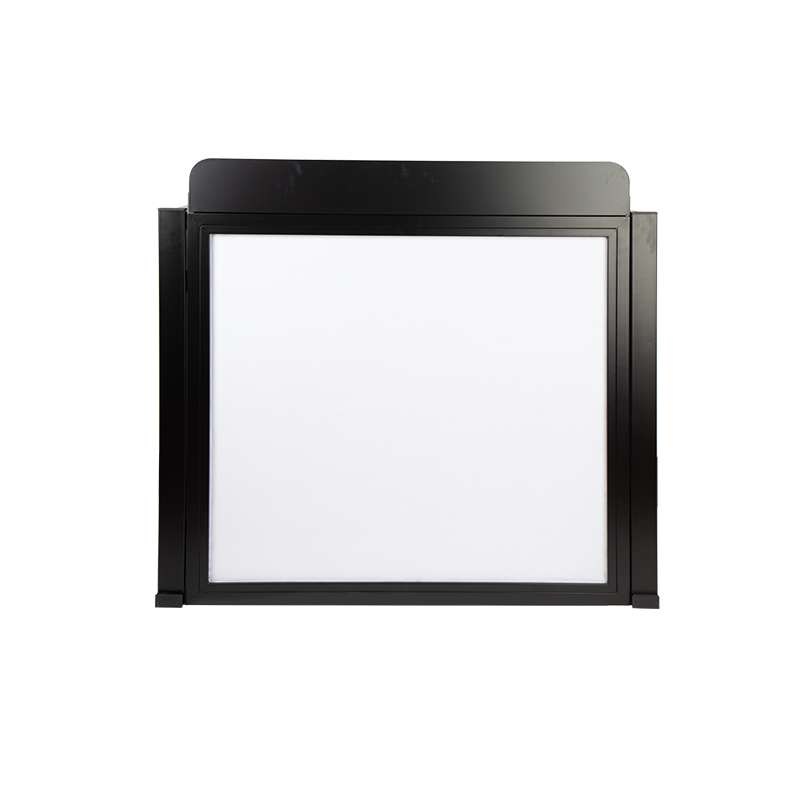
The format’s limits are equally predictable. A facade is a surround, not a work surface: there is no place to put a laptop, a controller or a drink unless a separate table sits behind it. It also depends on the venue for stability — on a low stage with a firm floor it is entirely adequate, while on a riser in a draught or near a dancefloor edge it needs to be positioned so it cannot be leaned on. Facades are best understood as visual equipment that happens to be portable, and the specification question is usually about panel count, hinge hardware and scrim material rather than dimensions.
DJ tables with integrated work surfaces
A folding DJ table inverts the priority: it is furniture first and screening second. The work surface is the product — a rigid top at working height, sized for a controller or a pair of decks plus a laptop, with the frame folding into a package that one person can carry.
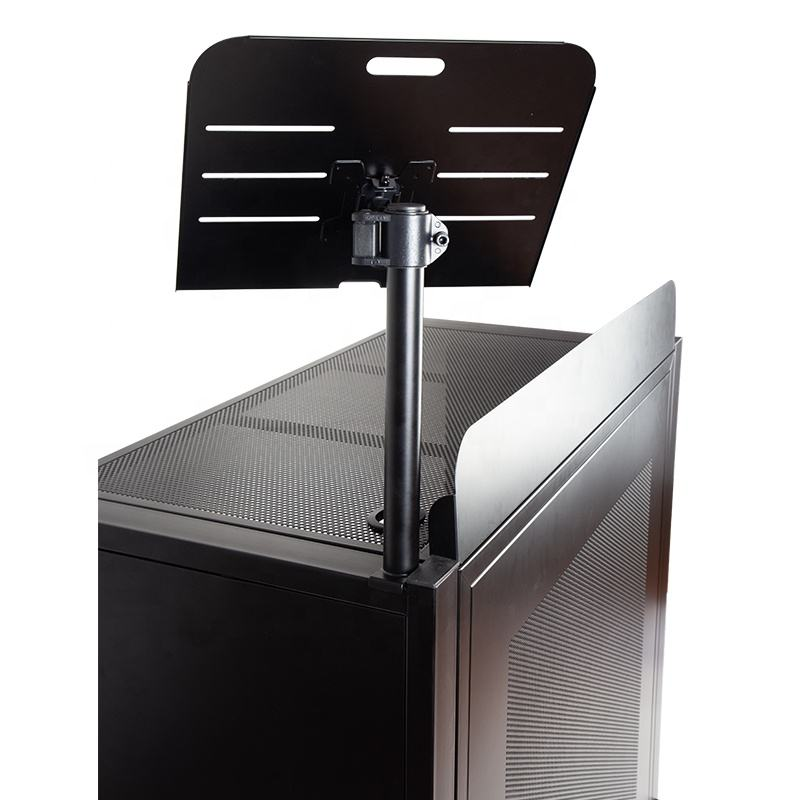
For mobile work the table format usually carries the day, because a mobile operator needs somewhere to actually put the equipment. Many designs add a front panel or a scrim frame so the table can perform the screening role of a facade as well, and a device holder or rear rail keeps a laptop or small monitor at eye level instead of on the work surface. The trade is packing volume: a table with an integrated surround is a larger package than a flat-folding screen of the same coverage.
If both roles are required — screening the audience side and supporting the equipment — the more robust arrangement is often a table plus a facade rather than one hybrid unit. Two light packages are easier to handle than one awkward one, and each can be replaced or upgraded independently. Our DJ table and DJ booth ranges are built to be specified together for exactly this reason.
The Dimensions That Decide Whether It Fits
Three measurements should be settled before format is finalised, and all three come from the operator’s vehicle rather than the catalogue:
- Folded footprint. Measure the load space and the door opening. A booth that fits the van floor but not the door aperture will be carried at an angle every night.
- Working height. The surface height that suits a standing operator differs from the one that suits a seated one, and a booth that is wrong by more than a few centimetres is tiring across a four-hour set.
- Coverage width. The surround only does its job if it screens the working area from the audience’s sight lines, which depends on stage height and how far the dancefloor edge sits from the booth.
Height and load questions are the ones buyers most often leave to chance. A table rated generously but specified at the wrong height will still be uncomfortable; a surround that is narrow enough to pack small may leave the operator visible from the side. Neither issue is solved by a specification sheet — it is solved by answering the three questions above against the actual gigs the booth will work.
Assembly Sequence and Setup Time
The assembly order of a folding booth matters more than its assembly time, because a booth assembled in the wrong order has to come apart again. The sequence that works across most folding designs is consistent:
- Position the packed unit on the stage, not beside it.
- Unfold the frame on the floor and lock the hinges before lifting anything upright — a partially locked frame raised vertically is where fingers get caught.
- Stand the assembly up and check the feet sit flat and level before loading anything onto it.
- Fit the panels, scrims and screening surfaces next, while the frame is still empty and accessible from both sides.
- Place the equipment last, and route cables as each device goes down rather than afterwards.
Pre-locking hinges and fitting panels on an empty frame are the two steps that remove most of the frustration from mobile setup, and both are consequences of booth design: hinges that lock positively, and panels that attach without tools.
Cable Access and Signal Routing
A DJ booth is a cable junction before it is anything else. At minimum it concentrates a power feed, the audio output to the system, headphone leads, and one or more USB connections — and on a mobile job the routing has to survive being dressed and struck repeatedly.
What to look for is straightforward: openings that let a cable pass through a panel without being trapped against a sharp edge, enough clearance under the work surface for a power strip and a small interface, and a route to the floor that keeps signal and mains cables separated where possible. Signal runs leaving the booth — typically a balanced pair to the system — are better treated as a single dressed loom than as individual leads, which is what a snake cable provides when the booth is feeding a small stage system.
Power and signal in the same channel is the most common avoidable mistake in a mobile booth. Where both must share a route, fanning them apart at the entry and exit points costs nothing and removes a frequent source of hum.
Transport and the Wear Points That Appear First
On a booth that works three nights a week, the components that fail are rarely the panels. They are the parts that move and the parts that touch the ground:
- Hinges. The single highest-load component in a folding design. Look for a hinge with a positive lock and a bearing surface rather than a pin in a thin plate.
- Corner and edge protection. Most transport damage happens in the van, not on stage. Packed booths should be able to sit against each other without the frame bearing on the panel face.
- Feet. Adjustable feet on a folding frame are a maintenance item — threaded inserts are commonly specified in metal, and plastic threads in a moving frame have a short life.
- Scrim and panel fixings. Panels that attach with hand-tightened hardware survive; those that rely on friction or adhesive tape do not.
For lighting, booths are usually paired with floor fixtures on a T-bar or a pair of lighting stands, which also keeps the fixtures off the booth frame itself — and therefore keeps the frame free of vibration and heat. Fleets that also supply microphone stands and cables generally consolidate all of it with one supplier so that wear items are ordered together.
Sourcing Checklist
Condensed to the questions worth asking before a batch is specified:
- Does the folded package fit the vehicle and the door opening, and can one person lift the heaviest piece?
- Is the working height right for a standing or seated operator, as applicable?
- Do the hinges lock positively, and is the frame rigid once upright?
- Can the booth be assembled without tools, and can one person do it?
- Are there cable pass-throughs, and is there room beneath the surface for a power strip and interface?
- Are the screens removable or replaceable, and are the fixings hand-tightened?
- Are the moving and ground-contact parts available as service components?
FAQ
Facade or table for a one-person mobile setup?
A table, in most cases. It provides the work surface the operator cannot do without, and a table with a front panel covers the screening function as well. Add a separate foldable facade only if audience-side coverage needs to be wider than the table provides.
How much setup time should a folding booth take?
Not a fixed figure — it depends on panel count and how the equipment is cased. What matters when comparing designs is whether assembly requires tools and whether hinges lock without adjustment. A booth that needs tools or re-tensioning at every setup will be the slowest part of the load-in regardless of its panel count.
Does a portable booth need to be heavier to be stable?
Not necessarily — stability comes from frame geometry and how the load sits over the footprint, not from mass alone. A wide, positively locked frame with adjustable feet can be steadier than a heavier unit whose weight sits on a narrow base. That is why the frame and hinge specification deserves more attention than the total weight figure when comparing mobile DJ furniture.
Yinyu DJ Furniture and Stage Accessories
LESOUND manufactures professional audio accessories in Ningbo, China, and our DJ furniture is produced under the Yinyu brand. The DJ range covers folding screen facades in multi-panel formats, folding DJ tables with integrated work surfaces and device holders, and the lighting and microphone stands that are specified alongside them. Because frames, hinges and hardware are made in the same operation as our DJ tables and stand ranges, service components and panels can be specified as separate line items rather than as spare assemblies.
We supply both OEM programmes and small-batch wholesale. Tell us the format your customers work in — folding facade, table with surround, or both — and the folded space they have to work with, and we will map the requirement against the existing range or build to your drawing, confirming the specification in writing before sampling.
Post time: Sep-21-2026