


Buyers who ask whether an adjustable DJ table is still worth sourcing usually mean one of two things. Either they’re weighing the cost of an adjustment mechanism against a fixed table, or they’re asking whether the adjustment survives a season of use. Both questions have answers, and neither is about the frame.


The frame on an adjustable table is rarely the weak point. The mechanism is.
What the adjustment actually buys the customer
Adjustment lets one table serve a seated operator and a standing one, which matters for schools, hire fleets and venues that change their layout. It also lets a venue correct for a floor that isn’t level. If the customer’s market needs neither, the mechanism is cost without benefit.
Pin, screw or gas, and what each one does
A pin gives discrete heights and it’s the simplest to make and repair. A screw gives a continuous height and it’s slower to set. A gas strut is the fastest and the most expensive, and it needs the most care in shipping because it holds pressure. Ask which the market uses before you settle the build.
Range, and the two heights nobody uses
Every adjustment range has a top and a bottom that nobody sets. Ask where the customer’s market actually sits and whether the range covers it with room to spare. A table that only reaches the right height at the very top of its travel is least stable exactly where it’s used.
Stability at the top of the travel
Ask how the table behaves with the mechanism at full extension, because that’s the position where a sliding fit has the most leverage on the joint. Ask for the rated load at full height rather than at the closed position. A single load figure that quietly assumes the low position is the classic way a customer gets caught.
Re-levelling when the mechanism drifts
An adjustment mechanism goes out of level before it fails, and a customer notices a wobble long before they notice a fault. Ask how the table is levelled, whether it’s done with the feet or through the mechanism, and whether a customer can do it without tools. A table that needs a workshop visit to sit flat gets left uneven.
What to adjust on a sample before ordering
- Set it to the height the market uses rather than the extremes.
- Load it at full height and watch the joint.
- Move it through the range ten times and listen for a change.
- Check the levelling again after ten moves.
- Ask what the mechanism is rated for over its working life.
Spares for the part that wears out first
On an adjustable table the mechanism wears before the frame does. Ask whether the pin, the collar or the strut can be bought separately and whether a customer can fit it. A mechanism that can’t be serviced turns a table into a consumable, and a hire fleet won’t buy a consumable.
Packing a table that moves internally
A table with a sliding mechanism has to be packed so the mechanism can’t travel in transit. Ask whether it ships at its lowest position, whether the moving part is strapped, and whether the carton has packing that stops the top riding down. A table that arrives at the bottom of its travel with a bent stop is a warranty claim.
What ships with an adjustable dj table
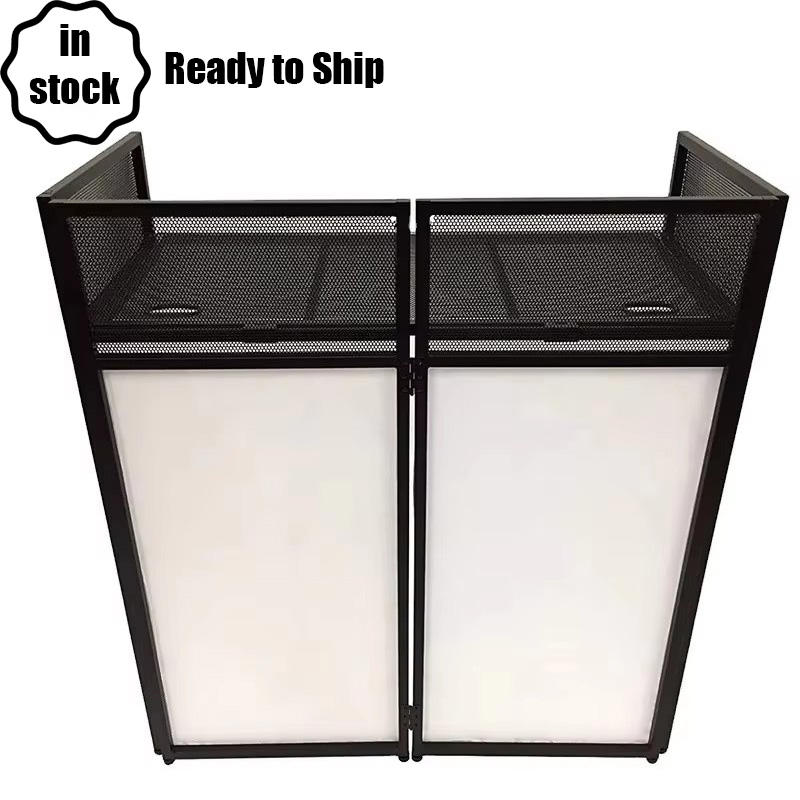
A venue buying an adjustable table usually adds the fixed furniture around it. The same order often includes a Yinyu dj table with tv bracket where a screen has to go up with the table, a OEM dj table with tv bracket for a floor position, and a OEM portable dj totem stand for the spare room.
Audfine headphones travel with most of these orders, since the person specifying the table is the person working at it.

Four answers worth settling before the deposit
Where in the range does the market sit?
Ask for the working height rather than the full range. A table that only reaches it at the top is least stable where it matters.
What’s the load at full height?
Ask for that figure specifically. One number covering the whole range usually assumes the closed position.
How is it levelled?
Ask whether the customer can do it by hand. A table that needs tools to sit flat gets left uneven.
Is the mechanism serviceable?
Ask whether the wear parts come separately, because a hire fleet won’t buy a table it can’t repair.
The markets that want adjustment, and why
Schools adjust because the operator changes. Hire fleets adjust because the venue changes. Retail display adjusts because the product changes. Ask which of those the customer serves, because the answer decides whether the mechanism needs to be fast, robust or cheap.
Fixed or adjustable, and the honest comparison
An adjustable table costs more than a fixed one and it does less well in one respect, because a sliding joint is never as rigid as a welded frame. Ask the customer whether they need two heights. If they don’t, a fixed table is the better product, and recommending it builds more trust than selling the dearer one.
The exception is a floor that isn’t level, because that’s a problem only adjustment solves. Ask about the floor before you argue about the mechanism.
How the mechanism is assembled
Ask whether the sliding column is machined or welded, how much clearance it has, and what stops it rotating inside its sleeve. A column with too much clearance wobbles at the top, and a column with too little seizes after a wet season.
What a school order looks like
Schools buy adjustable tables because the operator changes, and they buy them in tens rather than singles. Ask whether the factory can supply a batch set to the same height with a marked scale. A school that has to adjust by eye will set every table differently.
The floor, and why it decides the feet
Ask what the feet are and whether they adjust independently. A level floor needs simple feet and an old one needs an adjustable foot on every leg. It’s the cheapest part on the table and the one that decides whether it sits flat in the room it was bought for.
Lead time on the mechanism
A mechanism has more parts than a frame and more suppliers behind it. Ask what the factory holds in stock and how long a batch takes when they don’t. A table quoted at four weeks and delivered at ten has cost the customer a season.
What a service kit should contain
If the mechanism is serviceable, ask what the kit holds. A pin, a collar, a set of feet and the fasteners are enough for most repairs, and a kit that includes them turns a warranty claim into a spare part sale.
What the adjustment does to the shipping weight
A sliding column and its locking parts add weight to the carton, and weight is what moves the freight figure. Ask for the packed weight rather than the product weight, because the difference is the packing and the difference is real.
What a hire fleet does with an adjustable table
A hire fleet takes the same table to a school on Monday and a hotel on Friday, and it sets a different height each time. Ask how many moves the mechanism takes before it needs attention, because a fleet measures a table in setups rather than in years.
Ask whether the height can be changed by one person with the table loaded. A mechanism that needs the top cleared first gets left at whatever height it was set to.
The scale, and how a customer reads the height
Ask whether the mechanism carries a height scale and whether it’s marked in the units the market uses. A customer setting a table by eye gets a different answer every time, and the complaint that follows is about the table rather than about the operator.
What a locking mechanism has to do
Ask how the mechanism locks and whether the lock can be released under load. A lock that releases when somebody leans on the table is a lock that fails in the room. Ask what the factory tests it against and whether the test is done loaded.
The frame under an adjustable top
An adjustable table puts its load into a smaller area of the frame, so the frame has to be braced where a fixed table doesn’t need it. Ask what sits under the top and whether there’s a plate to spread the load. A mechanism bolted straight into a thin top works loose inside a season.
Spare feet, and why fleets ask for them
Feet wear on every floor and a fleet replaces them long before the mechanism. Ask whether they come in a bag of ten and whether they’re the same foot used in production. A foot from a different tool fits badly and rocks.
Where the adjustment stops being worth it
Past a certain height a single column can’t hold a loaded table steady, and the customer needs a different product rather than a taller mechanism. Ask the factory where they’d stop, because that number is the honest limit of the design.
What the customer asks after the first season
The question a year in is almost always about a wobble rather than a break. Ask the factory what they’d suggest when that call comes, because a supplier with a service kit and an answer keeps the account and one without loses it.
Send the standing height and the venue
Tell us the height the operator works at, whether the floor is level, and whether the table moves between rooms. Those three lines settle the mechanism and the range.
Ask for a sample set at the working height rather than folded, because a folded table tells you nothing about the joint.
Tables in this range carry the Yinyu badge and are made by Ningbo Lesound Electronics in Zhejiang, where the mechanism and the frame are assembled and checked as a set.
Post time: Oct-13-2026