


A totem stand is the cheapest large piece of branding an event company owns, and the easiest one to get wrong. It stands in the busiest part of the room, it gets bumped all night, and it has to look the same at ten in the evening as it did at setup. That’s a different brief from a speaker stand, even though the two share a footprint.


Totems come out of the same Yinyu workshop as the rest of the booth line, so the notes below are about the parts that make a tower survive a season of events rather than one night.
What a totem is actually for
Strip the branding away and a totem does three jobs. It puts a message at eye level where people walk, it holds a light or a small screen where the message can be seen, and it keeps cables and power off the floor. A tower that does all three is worth keeping. A tower that only holds a panel is a poster with legs.
- Message at height, so it reads over a crowd rather than into their backs.
- A mounting point for a light or a small display, kept off the floor and out of reach.
- A route for power and signal, so the floor beside the bar stays clear.
Footprint is the spec buyers forget
A totem lives where people are walking, so its footprint isn’t a warehouse number, it’s a safety number. Ask how wide the base is against how tall the tower goes. A tall tower on a narrow base is a tip risk in a crowd, and no amount of heavy base fixes that if the base is also narrow. The pair of numbers matters, not either one alone.
Panel height and where the eyes are
Panel height should follow the sightline of standing guests, which is higher than most people guess and higher again if the venue has a raised area. The mistake is to build a tower around a panel size rather than around the height the message needs to sit at. Decide the height first, then let the panel size follow.
If the tower carries a screen, the height changes again, because a screen wants to be looked at rather than read from across the room. That’s a separate brief and worth its own drawing.
Swappable panels, and why a client will ask for them
The companies that get the most out of a totem are the ones that change the panel rather than the tower. A venue with a regular programme wants to swap a sponsor panel in and out without tools, so ask how the panel attaches and how long a swap takes once the tower is up.
The mounting method decides this. A sleeve or a printed insert changes in seconds. A screwed panel is permanent enough that a client stops using it. For any market with repeat events, ask for the quick change method rather than the cheapest one.
Indoor, outdoor and the wind question
A totem that lives indoors and one that goes outside are two products wearing the same name. Outdoors, wind is the load case that matters, and a tall panel acts like a sail. The base gets heavier, the footprint grows, and the question becomes how the tower is meant to stay up when the panel is catching air. If your market takes totems to outdoor events, say so at the start, because the answer changes the base rather than the panel.
Transport, the part that ends the romance
A totem that’s awkward to move stops being used. Ask how it folds or breaks down, whether it fits a small van with the rest of the kit, and how many hands it takes to put up. A tower that needs two people and a trolley every time will sit in the store while a flimsier one that one person can carry goes out every weekend.
Bagging matters here too. A totem with a bag lasts a season longer than one without, because the thing that kills a tower is the edge of a van, not the crowd.
How to check a totem before a bulk order
- Load the panel and push the top sideways with a hand. Watch the base rather than the panel.
- Swap the panel the way a client would, and time it.
- Fold and unfold it alone, with the bag, in the space a van actually gives you.
- Walk into it from the side, since that’s what a guest does at a busy event.
- Check the cable route from the base to the light with the tower up.
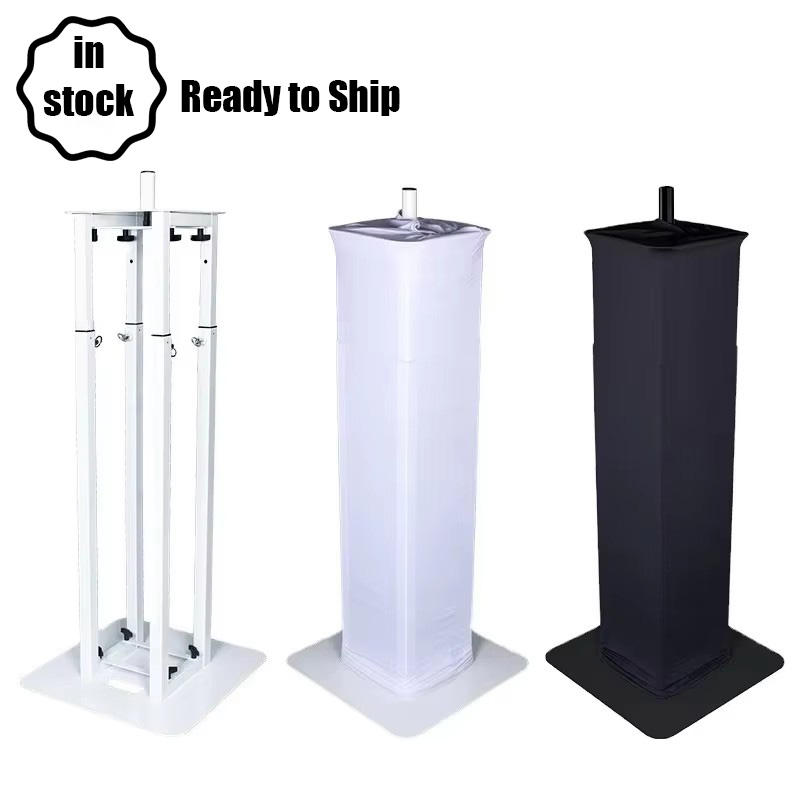
Base, panel and the parts worth holding as spares
The parts that wear on a totem are the panel mounts and the joints that take the folding. If a distributor can hold those as spares, a damaged tower becomes a repair rather than a write off. For an event market that’s the calculation that decides whether the tower earns its keep.
Packing a tower so it arrives straight
Towers travel long and thin, which is the shape that bends if the carton has nothing inside to hold the middle. The panel and the frame want separate protection, since a panel that rubs against an aluminium edge in transit arrives marked. Ask how the panel is separated from the frame before the carton is closed.
For retail, a tower that ships in a flat carton with a bag inside sells better than one that arrives assembled and needs a truck.
What ships with a totem
A totem order usually grows before it ships. Someone dressing a branded corner adds the Yinyu dj table with tv bracket and the OEM foldable dj table to the tower, then the OEM foldable dj table, and the whole corner leaves in one go.
Event companies often add Audfine headphones for the crew on the same order, since fewer deliveries means fewer things to chase on a show day.

Questions before a totem goes on the order
Can one tower take different panel sizes?
Some can, if the mounting method is built for it. Say at the start how many panel sizes the market expects, because it changes the mounts rather than the frame.
Is it stable enough for a busy venue?
That depends on the base against the height, which is why we ask for both. A tall tower on a small base is a risk wherever people walk, indoors or out.
Does it need power at the base?
If the tower carries a light or a screen it does, and where that lead enters the tower matters for how the floor looks. Ask for the cable route as a drawing.
Can the panel be replaced when it wears?
Yes, and that’s the point of the quick change mount. A tower whose panel swaps outlasts one whose panel is fixed to the frame.
How do you keep the finish consistent across a run?
On a branded tower the colour is the product, so it gets checked tower after tower before the carton is closed. A second unit that misses the first shade is a unit the client leaves in the store.
Panels that carry a screen instead of a print
More totems now carry a screen, and that changes the tower rather than the panel. A screen wants a mount, a power route and a viewing height, and it’s heavier than a printed panel of the same size. If you’re not told at the start that a screen is coming, you’ll build a tower that can’t take one, and there’s no cheap fix once the frame has been cut.
Ask whether the mount is a standard pattern or a custom one. A standard pattern lets the client fit their own display. A custom one ties them to you, which sounds good until they can’t source a replacement and stop using the tower altogether.
Sponsor panels and the swap that decides the sale
A venue with a regular programme lives on changeable panels, so the swap has to be tool free. If it isn’t, the sponsor panel stays up long past its event and the venue stops seeing any value in the tower. That’s the point at which a totem becomes clutter in a store room.
Ask how the panel locks once it’s in. A panel that a guest can lift out isn’t a panel, it’s a giveaway, and you’ll hear about it from the client rather than from us.
Colour, finish and matching a venue
A totem is usually bought to match a colour, and colour is where cheap frames fail. Ask how the finish is applied and whether a repeat order can hit the same shade, because a second tower that doesn’t match the first is a second tower the client won’t use.
If you’re stocking for a market with a lot of venues, hold two or three neutral finishes rather than a long colour list. Neutral moves faster and it’s cheaper to hold.
Assembling a tower with people who have never seen one
A totem usually gets built by whoever is free at the venue rather than by the crew that specified it, which is why the part count matters more than the assembly speed. Ask how many pieces leave the carton, whether one person can stand it up without a second pair of hands, and whether the fitting notes are pictures rather than paragraphs.
If a venue has to fill the base on site, that’s one more thing that can go wrong on a busy morning. Find out whether the base arrives ready or whether somebody is hunting for ballast before the doors open, because the second version is where the damage happens. Ask how the base is sealed as well, since one that takes on water is one that sits in a store room until it rusts.
Send the height and the venue
Tell us the height the message needs to sit at, whether the tower goes outdoors, and how the panel changes. That’s enough to size the base rather than guess at it.
Ask for a sample with a panel on it. A tower tested bare says nothing about how it behaves once it’s catching air.
Booth and tower work leaves here under the Yinyu name, produced in Zhejiang by Ningbo Lesound Electronics. Base, mounts and finish all come off the same floor.
Post time: Oct-13-2026