


Keyboard stands look interchangeable in a product photograph, yet three structural families sit behind them — the folding X-frame, the rigid Z-frame, and the table-style platform — and each one serves a different kind of player and a different kind of market. Distributors and music-store buyers who treat them as one category tend to stock the wrong variant for their customers: a gigging keyboardist needs a stand that folds flat and sets up in seconds, a home-studio player wants stability and cable tidiness, and a classroom or house-of-worship programme often needs two keyboards on one footprint. This guide compares the three families the way we build them at LESOUND across the Yinyu stand range, with the construction details that actually decide whether a stand suits your market.
X-Frame Keyboard Stands: The Folding Workhorse
The X-frame is the most widely stocked keyboard stand in the world, and for good reason. Two legs cross at a central pivot; spreading or closing the scissors changes the playing height, and when the job is done the whole stand closes to a slim profile that slips into a car boot or a gear bag. Setup and breakdown take seconds, which is why the X-frame dominates the mobile-gig and rental segments.
Single-X versus Double-X Construction
The first fork in the X-frame family is the number of legs per side. A single-X stand carries the keyboard on one pair of crossing tubes per side — the lightest and most affordable build, represented in our range by the KS032. A double-X stand adds a second pair of crossing tubes, so the keyboard rests on four contact points instead of two. The KS030 (double-X) and the KS033 (double-X with a second tier) follow this layout, with a 40 cm arm length and 28 mm tubes, a height window of 53–95 cm, and a width that opens from 37 to 87 cm to take anything from a 61-key controller to an 88-key stage piano.

What does the second pair of tubes buy you? Contact area and rigidity. A wide 88-key instrument sits more confidently on a double-X, and long instruments stop the small rocking motion that single-X builds can show at their tallest settings. The trade-off is packed size and weight. For a store that sells mainly to beginners with 61-key instruments, a single-X covers the need; for players with weighted 88-key boards, the double-X is the safer recommendation.
Locking Mechanisms: Knob, Trigger and Quick-Release
Within the X-frame family, the height-locking mechanism is where models differ most in daily feel:
- Screw knob. The classic arrangement, used on the KS260 folding heavy-duty stand. A knurled knob clamps the central pivot at the chosen height and width. It is the slowest to adjust and the most secure against slippage, and it adds no moving parts beyond the clamp itself.
- One-hand trigger. The KS030 series uses a trigger at the central joint: squeeze, set the height, release. Players who adjust height between sets — or teachers who move a stand between seated and standing students — notice the difference immediately. The L-shaped arm ends stop the keyboard from sliding off accidentally, and the stabilising feet can be adjusted for uneven surfaces.
- Quick-release clamp. A lever-operated cam clamp, as on the KS105 series with its metal-gear clamp handle and longer 50 cm legs. This sits between the other two: faster than a screw knob, more positive than a friction-only lever, and familiar to any player who has used a cymbal stand tilter.
- Gas spring. The KS035 adds a gas strut to the double-X, so the frame glides to any height between 56 and 100 cm and stays there. The screwed, detachable X-frame also packs down smaller for transport. This is the premium option in the family and the one to show players who adjust constantly.
Detachable Designs and Small Packing
A second fork is whether the X-frame folds or comes apart. Folding frames close at the central hinge — the KS260 closes to a 72 × 33 × 10 cm package. Detachable frames, such as the KS011 and KS019, unscrew at the joints into a package small enough to change the shipping economics of the product: smaller cartons mean lower freight and storage charges per unit, which matters to importers running sea-freight programmes. The KS015 and KS016 go further and add a 270° angle-adjustable arm, useful when a player wants the keyboard tilted toward them rather than flat.
Z-Frame Keyboard Stands: Rigid Columns for Studios and Classrooms
The Z-frame replaces the scissors with two vertical columns, each shaped like a flattened Z. Nothing folds at a central pivot, so the frame relies on telescoping sections with a stability lock mechanism — our KS040 series adjusts in height from 66 to 96.5 cm and in width from 59.5 to 86.5 cm, again taking 61-key to 88-key instruments. Because the columns do not splay outward the way X-frame legs do, a Z-frame keeps a compact rectangular footprint that tucks against a wall or under a desk when not in use.
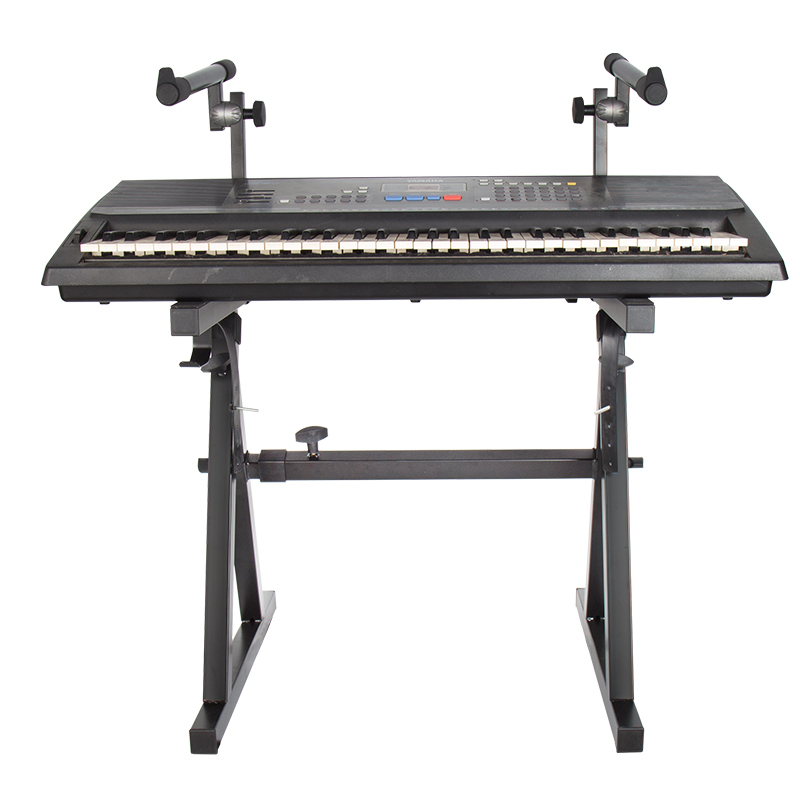
Three details define the Z-frame experience:
- EVA-padded arms. Foam pads on the arms grip the instrument without scratching the finish and stop the small sideways slide that bare tubes allow. On the KS040 the arms carry EVA padding as standard.
- Integrated accessories. The KS040 carries a headphone holder on the arm — a small touch that home-studio players use every session. A wheeled variant is available in the series, so the stand can be rolled between practice rooms rather than carried.
- Second tier. The KS042 and KS043 add a detachable second tier above the main arms, so a controller and a master keyboard can share one footprint — the same stacking logic the table-style family uses.
Where does the Z-frame win? Fixed and semi-fixed setups: home studios, classrooms, rehearsal rooms, and stage positions that stay assembled for weeks. The rider is transport. A Z-frame folds flatter than an A-frame table but does not close to the slim stick that an X-frame becomes, so mobile players still prefer the scissors. Catalogue positioning follows directly: lead with X-frames for the gigging segment, Z-frames for the studio and education segment.
Table-Style Stands and Second Tiers
The third family is less a single structure than a way of thinking about the keyboard: give it a table. The KS260 belongs here in spirit — its double-X legs carry a broad table-style surface with skidproof pads, a detachable second tier, and adjustable feet, so it behaves like a table while still folding to a 72 × 33 × 10 cm package. For players who never got on with narrow X-frame arms, a table surface is the comfort answer.
Two other products extend the idea:
- KSB02 / KSB03 second-tier shelves. A standard and an upgraded tabletop shelf that bolt onto most keyboard stands, instantly turning a single-tier stand into a two-keyboard rig. For retailers, the shelves are an easy attachment sale; for players, they are cheaper than replacing a stand they already own.
- KS1000B / KS1000W multi-tier A-frames. A four-tier aluminium A-frame, 145 cm long and 144 cm tall, with hinged folding legs, a double-lock feature for added rigidity, and adjustable height and playing angle on both keyboards. This is the flagship format for schools, houses of worship and rehearsal spaces that need several keyboards permanently mounted in one spot.
Side-by-Side Comparison
| X-Frame | Z-Frame | Table-Style | |
|---|---|---|---|
| Structure | Crossing legs with central pivot | Rigid telescoping columns | Broad platform surface on folding legs |
| Height range (our range) | 53–95 cm typical (KS030); 56–100 cm with gas spring (KS035) | 66–96.5 cm (KS040) | 46–80 cm (KS260) |
| Packed profile | Folds to a slim stick; detachable builds pack smaller still | Compact rectangle, no pivot fold | Folds flat (KS260: 72 × 33 × 10 cm) |
| Setup speed | Seconds, one person | Fast, but two sections per side | Fast once unfolded |
| Best for | Gigging players, rentals, retail entry level | Home studios, classrooms, fixed stage positions | Comfort players, two-tier rigs, schools |
| Watch-outs | Narrow arms on basic builds; check locking type | Heavier to carry; less slim when packed | Largest footprint of the three |
How to Choose for Your Market
For distributors building a keyboard stand programme, four questions sort the assortment quickly:
- Who moves the stand, and how often? Frequent movers need an X-frame — trigger or quick-release locks for players, screw knobs where security matters more than speed. Rarely moved instruments justify a Z-frame or table-style stand.
- What instruments will sit on it? 61-key controllers are comfortable on a single-X; weighted 88-key boards justify a double-X or Z-frame with EVA-padded arms. Confirm the width range against the widest instrument your customers sell.
- Is a second tier in the plan? If your market includes players with controller-plus-module rigs, stock double-X stands with second tiers (KS033, KS260), Z-frames with tiers (KS042/KS043), or the KSB02/KSB03 shelves as add-ons.
- How is the product shipped? For sea-freight programmes, the detachable KS011/KS019 frames with their small cartons change the landed economics per unit. For air or small-parcel channels, folding X-frames carry the argument.
One habit protects all three families: ask the supplier for the rated specification of each model in writing, per model, rather than assuming a figure carries across a series. Construction, tube diameter (25 mm and 28 mm in our X-frame range) and locking hardware all differ between models that look similar in a thumbnail image, and the written specification is what your own customers will ask you for.
Bringing It Together
The three keyboard stand families are complements, not competitors. The X-frame wins the boot of the car and the entry-level shelf; the Z-frame wins the practice room and the studio corner; the table-style stand and its second tiers win the player who wants everything on one surface within arm’s length. Stocked together, they cover a music store’s full keyboard customer base with no internal competition.
The Yinyu stand range from LESOUND covers all three families alongside our microphone stands, speaker stands and guitar stands, so a retail programme can be built around one manufacturing partner. To see the current keyboard stand line-up and request the per-model written specifications discussed above, browse our keyboard stands or explore the wider music stands and headphones categories.
Post time: Oct-13-2026