


A keyboard stand is a few metres of tube and a pin until somebody leans on the end of it at a soundcheck. Ask two factories for the same double X keyboard stand and you’ll get two frames that look identical in a photo and behave differently within a month. The difference hides in three places, which are how the load figure was arrived at, how the two X frames are tied together, and what holds the joint once the frame is set to its highest notch.

This is written for importers and dealers placing a stage or shop order, not for a player buying one stand on a Saturday. If your buyers are hire companies, churches, schools and touring bands, the questions below are the ones that arrive after the second delivery rather than the first. Yinyu stands builds the double X range in our own workshop, so we can talk about the parts plainly. Send us the model you’re comparing through our contact page and we’ll tell you what it will and won’t carry.
What the load figure on a keyboard stand covers
Every catalogue prints a load figure, and hardly any buyer is told what that figure measured. On a double X frame the number usually comes from a static test, which means a weight placed on the centre of a closed frame and left there. That says nothing about a player leaning on one end, and that’s how a stand gets loaded in a rehearsal room. It says nothing about the notches either. A frame that holds its figure at the lowest setting can behave differently at the top of its range, where the legs sit closer together and the leverage on each joint grows longer.
So ask two follow up questions. Where was the weight placed, and at which height setting. A supplier who can answer both has tested the product rather than copied a number from an earlier mould. If the answer is vague, it’s decoration. You can still buy the stand, but don’t base the order on the number on the box. Base it on a sample you’ve loaded yourself.
The X in the name, and why two tubes carry more than one
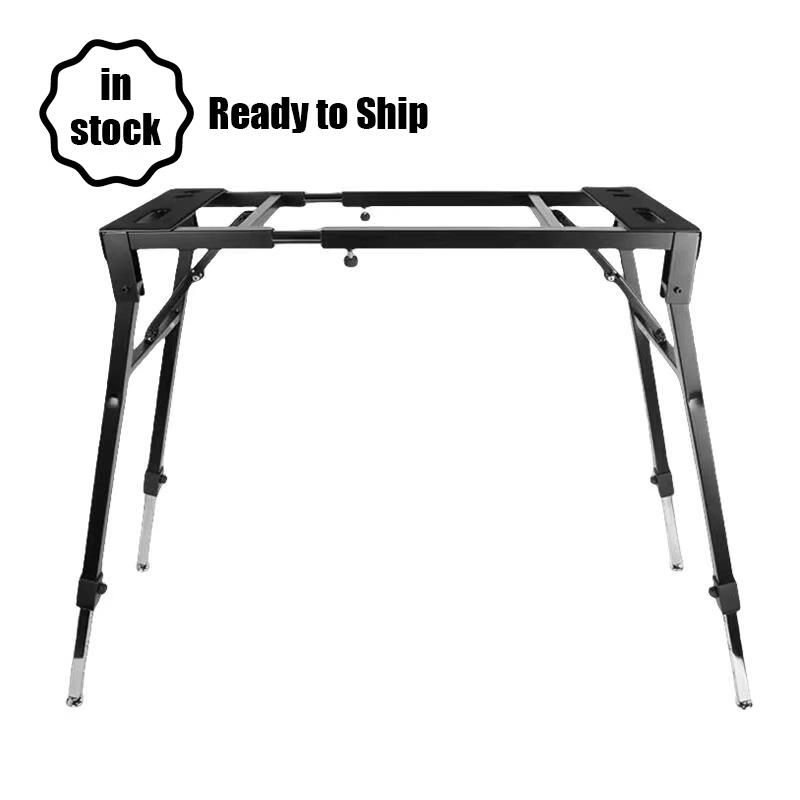
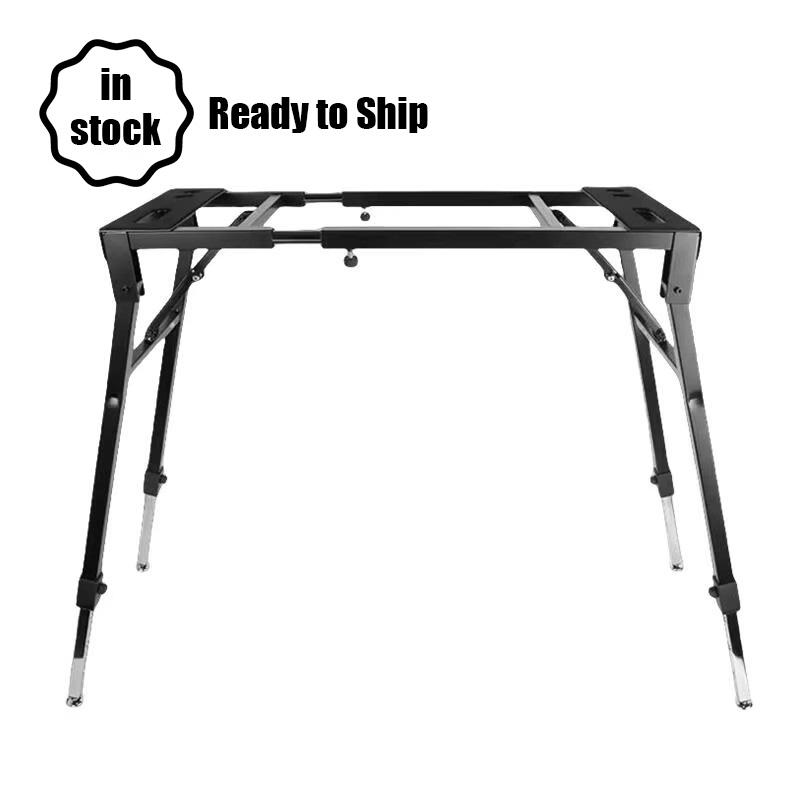
A single X stand folds into the shape of the letter and leans on four floor points. A double X frame doubles the tube runs, so the middle of the X becomes a pair of parallel tubes joined across the centre. That joint is the whole product. On the Yinyu KS016 double X keyboard stand the main X tubes run about twenty five millimetres across and close to a metre long before they fold. Two tubes in the same plane resist a side twist that one tube can’t, and side twist is what makes a keyboard rock under a player’s left hand.

You can see the difference without tools. Set the frame up, put one hand on the left end of the top rail and push it away from you. A single X frame turns into a parallelogram under almost no effort. A double X frame resists, and how much it resists tells you how tightly the centre joint was riveted. Run that test at the top setting and again at the bottom, because a frame can be tight in one position and loose in the other.
Detachable means the frame breaks in half
Detachable is the feature that sells this stand to hire companies and to anyone working out of a small van. The frame separates at the centre joint, so each half folds into a flat X that stacks against a wall. The trade off sits at the connection. A pinned joint that’s set up and pulled apart every week will wear sooner than a welded frame that never comes apart. Look for a pin with a positive retainer rather than a plain through hole, and check whether the two halves can be put back together the wrong way round.
If your buyers are more likely to leave a stand set up in a studio, a fixed frame is the better answer, and the same conversation usually reaches the seating. A Yinyu X-frame keyboard bench pairs with the double X stand and keeps the player at the right height under the keyboard, which is the complaint that follows a stand sale more often than any other.
Height range, and whether your buyer sits or stands
Keyboard stands get bought for two postures that want different things from the same frame. A seated player wants the top rail at forearm height with the hands resting on the keys, which usually means the lower half of an adjustable range. A standing player wants the rail higher, so the frame opens further and the legs spread wider. Our KS016 runs from about sixty two to ninety seven centimetres, which covers both, but the useful slice of that range for any one buyer is much narrower. Ask which part of the range your market lives in and order the frame that’s stable there.
One more thing about height. The figure on the box is usually the top rail height, not the height of the key bed. A keyboard with any depth sits above the rail, so the hands end up higher than the number suggests. It’s a small detail that changes the answer for a tall player. If your customer is tall and the range looks marginal, ask for the frame that opens further rather than the frame that folds smaller.
Where a double X frame gives up first
Frames rarely fail in the middle. They fail at the joints and at the ends. The four points that touch the floor are usually plastic or rubber caps pressed into a tube end, and those caps take every side load the player puts into the stand. The centre rivet carries the twist. The height notches carry the full load through a small patch of tube wall. When a stand comes back to a dealer, the complaint points at one of those three, and each one leaves a visible sign.
- Rock it and watch the floor caps
- Set it high and push the centre rivet
- Look for a stretched notch hole
A cap that turns inside the tube is on its way out. A centre rivet with a bright ring of fresh metal around it has been moving. A notch hole gone oval is the clearest warning of the three, because it means the frame has been opened and set while the player’s weight was already on it. None of those signs show up in a product photograph, and that’s the trouble.
Testing a stand you cannot put your hands on
Most importers never touch the product before a container ships, so the real question is what a remote check can establish. Ask for a short video instead of a still image. Have the supplier set the frame to its highest notch, lean on one end with a hand, then fold it and set it up again. Twenty seconds of that beats a page of specification. A supplier who won’t film it either doesn’t have the stand in the workshop or doesn’t want you to watch it move.
Three checks importers use before a stage order
Stage and hire orders concentrate the risk, because one weak batch goes out on a tour instead of sitting quietly in a shop. Three checks have settled most of the orders we’ve watched.
The first is to load the stand the way the end user will. Set it at the height the customer plays at, put weight on one end rather than the middle, and hold it there. A frame that creeps or clicks through that test will do the same on a riser. Ask for the test on video and compare it with the sample you keep in the office, because a stand that passed at the lowest notch won’t necessarily pass at the highest one.
The second is to count joints rather than tubes. Two X frames joined at the centre means three joints that matter, and each should be riveted or bolted to the same standard. Ask how many rivets hold the centre joint and whether a single tool sets all of them. A frame assembled by hand with a hammer looks fine on day one and loose by month three.
The third is to check the carton figure against the frame. A double X stand that folds into a box no bigger than a single frame model is a warning rather than a bargain. Compare the packed dimensions with the folded frame and the inner pack drawing. If the numbers won’t sit together, ask for a photograph of an open carton before you book anything.
Mixed loads and the small parts bag
Keyboard stands rarely ship on their own. A typical dealer order runs a double X frame, a folding piano bench, a music stand and a couple of cable runs on the same pallet. That’s what changes what you ask for. Small parts belong in one labelled bag per unit instead of loose in the carton, because a missing bolt turns a delivered stand into a return. If the same shipment needs a Yinyu cables run for the keyboard output, or Audfine headphones for a player practising at home, both can be planned into the same carton list.
Questions dealers send before ordering a double X stand
Is a double X stand worth the extra over a single X frame?
For a seated player in a studio, a single frame does the job. For anyone who plays standing, leans on the stand or hires it out, the second set of tubes is the difference between a frame that stays square and one that turns into a parallelogram under a hand. It’s the standing player who needs those two extra tubes.
What does the load rating on the box actually test?
Usually a static weight placed at the centre of a closed frame. That isn’t the same as a player leaning on one end at the top setting. Ask where the weight sat and at which height, then run your own test on the sample before you accept the figure.
Can the two halves be put together the wrong way round?
On a properly designed frame the pin and the bracket only line up one way, so it can’t be closed backwards. Check that on the sample. If both ends look identical, a hire company will eventually get one back assembled the wrong way and conclude that the stand is bent.
Does the stand ship with a keyboard retaining arm or strap?
That depends on the model. Tell us what your buyers expect to find in the box and we’ll confirm what actually ships with the frame, so your listing matches what arrives. Few things generate returns faster than a strap that was assumed rather than asked about.
At what point in the height range is the frame least stable?
At the top, because the legs sit closer together and the leverage on every joint grows. If most of your customers play standing, ask for a frame that reaches their height before the adjustment runs out rather than one that only just gets there.
Do you build these frames with our own brand and packaging?
Yes. The range is made for OEM work, with the brand on the frame and your artwork on the carton. The frames come out of a workshop in Zhejiang that Lesound Electronics runs alongside its stand and cable lines. Send the marking position and the box design and we’ll confirm both before production, so nothing has to be reprinted at the port.
A double X stand is a simple product with three places where cheap frames show themselves. If you know which of those places matters to your market, we’re happy to point you at the right frame and pack it the way your pallets need. Reach us through our contact page with the models you’re comparing, and tell us the height your buyers play at. That one detail changes the answer more often than anything else on the specification sheet.
Post time: Oct-19-2026