


A foldable microphone isolation shield is a set of panels that fold around a microphone, and the folding is the whole product. A shield that doesn’t fold is a wall, and a wall can’t be carried to a session in a bag with a laptop.


So the questions are about the hinge, the panels and what’s inside them rather than about how the shield looks when it’s open.
What the panels are filled with
A shield works by absorbing what bounces back into the capsule from behind and above. Ask what’s inside the panels, how thick it’s, and whether it’s a foam or a fibre. A thin foam panel looks convincing on a photograph and does very little in a room.
Ask how the panel is finished on the front as well. A perforated face lets the absorption work and a solid face reflects, which is the opposite of what the customer is paying for.
How many panels, and what the fold does
Three panels fold into a shell and five fold into a deeper one. Ask how many the customer’s market needs and whether the two sizes come off the same tool. More panels means more absorption and more weight sitting on the stand.
The hinge, and the panel that sags
Ask what the hinge is made of and whether it has a stop. A shield that opens past flat loses its shape and stops closing cleanly. A hinge with a stop is a hinge that still folds properly after a year of being opened and shut.
Mounting, and the weight on the stand
A shield puts weight and leverage onto whatever holds it, and a light boom will droop under it. Ask what the shield clamps to, whether it has its own mount, and whether the customer needs a heavier stand to carry it. Selling a shield without that warning creates a complaint about the shield.
What to look at on a shield sample
- Fold and unfold it ten times and check the hinge keeps its tension.
- Look at the panel faces for scuffs straight out of the bag.
- Fit it to the stand the customer uses, not a workshop one.
- Check what the front face is and whether it reflects.
- Ask what the assembled weight is with the mount.
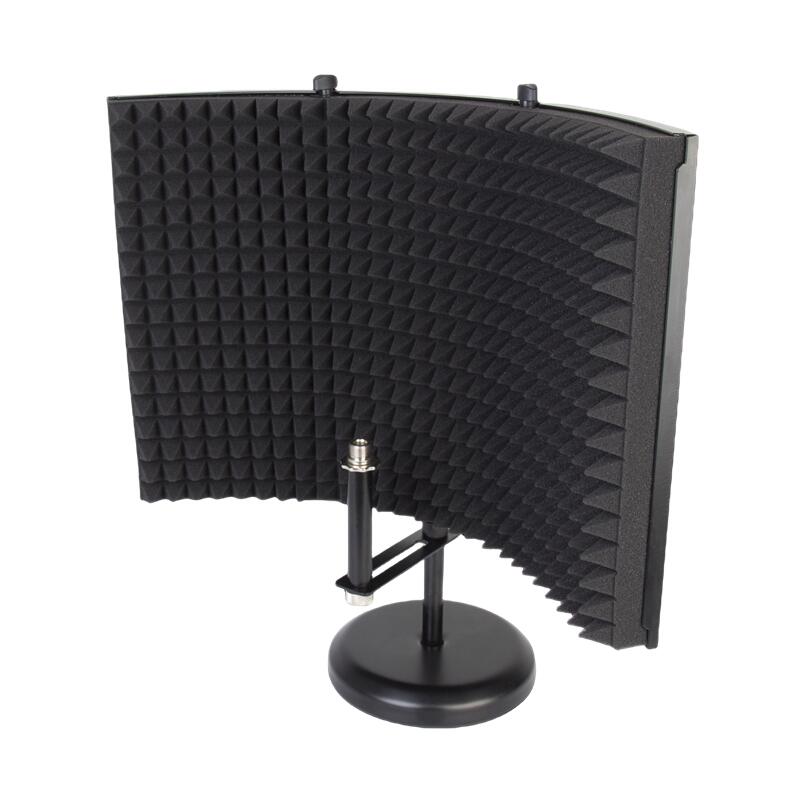
Where a folding shield gets used
A shield sells into home studios, podcast setups, schools and anywhere the room can’t be treated. Ask which one the customer serves, because a school breaks the hinge and a home studio wears the foam out.
Packing a shield that has to fold flat
Ask how the shield ships, whether it goes folded or open, and whether the panels are separated by anything. Panels that touch in transit arrive with scuffs on the face, and a scuffed face is the first thing a customer sees when the box opens.
What ships with a folding shield
A podcaster buying a shield usually buys the rest of the corner with it. The same order often carries a Yinyu microphone shock for a second position, a OEM microphone pop filter for the vocal itself, and a OEM wireless microphone where a metal face is preferred.
Audfine headphones go out with nearly every shield order, because a shield is bought by somebody tracking in a small room.

Four answers worth having before the tooling
What’s inside the panels?
Ask for the material and the thickness. Those two decide whether the shield absorbs anything or only looks as though it does.
How many panels, and does it fold flat?
Ask for the folded size as well as the open size, because the folded size is what the customer carries.
What holds it onto the stand?
Ask whether it uses its own mount or a clamp, and whether the customer needs a heavier stand than they own.
Does the front face reflect or absorb?
Ask what the face is made of. A solid face works against the shield and it’s the mistake that’s hardest to spot from a photo.
Weight, and the stand it needs
Ask for the assembled weight, because it decides the stand. A shield that needs a heavier stand is really a bundle sale rather than a single product, and the customer should hear that before they buy rather than after.
What a shield can and can’t do
A shield reduces what comes back at the microphone from behind and above, and it doesn’t treat the room. Ask what the factory would claim for it and check that against what the customer expects, because a shield sold as a room solution creates an unhappy customer in a hard room.
Telling a customer that honestly is worth more than the sale, and it’s the reason they come back for the next piece of kit.
The panel face, and the fabric over it
Some shields put a fabric over a perforated face and some leave the perforation open. Ask which one the factory builds and what the fabric is. A fabric face gets dusty in a room with carpets, and a dusty face does less than it did when it was new.
Shields on a boom, and the sag
A shield on a boom arm moves the load a long way from the stand, and the arm droops. Ask what the factory suggests for a customer using a boom, because a shield that pulls the arm down gets taken off and left in a box.
Where the shield stores between sessions
Ask whether it folds into something that fits a shelf, a bag or a drawer. A shield that has no home between sessions ends up open on a desk taking the space it was supposed to save.
School and podcast markets
A school breaks hinges and a podcast studio wears foam. Ask which one the customer supplies, because the two want a different panel and a different hinge. One product can serve both, and only one of the two builds will last in the harder market.
The colour, and the one that sells
Shields sell in black and, in a few markets, in a brighter colour for a school or a content room. Ask the factory which colours they hold and whether a colour change needs a new tool. A colour that needs a new tool is a colour you order once.
What a second order has to match
A customer who bought twenty shields for a building will buy twenty more, and they need to match. Ask how the foam and the fabric are held between runs. Foam changes shade between batches, and twenty shields that don’t match twenty others is a visible problem in a room.
What a shield isn’t
A shield isn’t acoustic treatment and it isn’t a booth. It reduces what comes back at the capsule from the near field, which is a real improvement in a small room and a small one in a live space. Tell the customer that before the order and you’ll sell fewer, better ones.
Panels that fold the wrong way
Ask which way the panels fold and whether the shape stays when it’s opened. A shield that folds outward and stays flat is easier to store and less effective, and one that folds inward holds its curve and takes more space. Ask which the factory builds as standard.
The stand the customer already owns
Most customers already have a stand and it’s often a light one. Ask what the shield weighs assembled and whether the customer’s stand can carry it. Selling a shield without that question produces a complaint about the shield rather than about the stand it’s on.
How a shield is counted in a carton
Shields are bulky, so the carton count is small and the freight is charged on volume. Ask how many fit a carton and how the panels are stacked. A carton that fits six instead of four changes the landed figure far more than a swap of supplier does.
Absorption, and the thickness that matters
Ask for the panel thickness and what the material is. A thicker panel absorbs more and weighs more, and the trade is worth explaining to the customer. Most buyers assume all shields are equivalent, which is why the thin ones sell and disappoint.
Two colours and one tool
Ask whether a colour change needs a new mould or only a new material. A colour that needs a new tool is a colour you order once and can’t reorder, and buyers discover that too late. A colour that runs off the existing tool is stock you can hold.
What a shield does to a session
A shield changes the tone a little and the plosives a lot, and it makes a small room usable rather than good. Ask the factory what they’d say to a customer who expects a booth, because a supplier with an honest answer saves you a return further down the line.
One question that saves a run
Ask what the panel faces are finished with before the order. A supplier who leaves the perforation open and one who covers it in fabric make two different products, and the difference is invisible in every catalogue photograph you’ll ever be shown.
Send the room and the mic
Tell us what the customer records, how much space they have, and which microphone sits inside the shield. Those three lines settle the panel count, the mount and the packing.
Ask for a sample folded, because the folding is what the product is for and a sample that arrives open tells you nothing about it.
Shields in this range are badged Yinyu and produced by Ningbo Lesound Electronics in Zhejiang, where the panels and the hinge are assembled and checked together.
Post time: Oct-13-2026