


Two numbers decide whether a microphone clip screws onto a stand smoothly or strips the thread in front of an audience: 3/8″ and 5/8″. They are the two dominant mic stand thread standards in the pro audio world, and almost every importer, rental house and distributor eventually ships a container that mixes both. This guide explains where each standard came from, how to tell them apart at a glance, and how a factory like LESOUND handles the mismatch with adaptors so the problem never reaches your customer.
Why Thread Standards Matter More Than Buyers Expect
A microphone stand looks like a simple product until you count the threaded joints on it. The top of the upright takes a mic clip. A boom arm pivots on a threaded clutch. A gooseneck screws into a base fitting. A tablet holder or a second mic clip hangs off a side thread. Every one of those joints is a place where two suppliers’ parts meet, and if the threads do not match, the hardware either refuses to assemble or gets forced together and damaged.
For B2B buyers the stakes are higher than for a single musician. A distributor stocking stands from one region and clips from another can end up with a shelf of accessories that fit nothing. A rental company mixing inventory after a merger finds the same thing on a larger scale. Thread standards are invisible on a quote sheet, yet they decide whether the kit works the first time it is opened.
The Two Standards: 5/8″-27 and 3/8″-16
5/8″-27: The North American Standard
The 5/8″-27 thread, often written simply as 5/8″, is the traditional North American mic stand standard. The number describes a thread with a 5/8 inch major diameter and 27 threads per inch. It is coarse enough to assemble quickly by hand, fine enough to hold a microphone clip securely, and it is the thread you will find on the vast majority of mic clips, shock mounts and desktop boom arms sold in the United States. If your market is North America, this is the thread your customers expect to find on top of a stand.
3/8″-16: The European and International Standard
The 3/8″-16 thread uses a 3/8 inch major diameter with 16 threads per inch. It is the common standard across Europe and much of the international market, and it is shared with lighting and rigging hardware, which is one reason it dominates there: the same thread family runs through stands, clamps and spigots. A 3/8″ fitting is visibly slimmer than a 5/8″ fitting, and its thread pitch is coarser in feel because the thread is cut deeper relative to its diameter.
The 1/4″ Camera Thread in the Background
A third size, 1/4″-20, belongs to the camera and tripod world, but it keeps appearing in audio: small desktop stands, phone and tablet holders, and compact recorders all use it. It is not a microphone standard, yet buyers of accessory packs keep meeting it, which is why a full range of adaptors usually includes 1/4″ conversions as well.
How to Tell Them Apart at a Glance
On a packed trade show floor nobody carries thread gauges. Two visual checks are enough in practice. First, diameter: a 5/8″ male thread is noticeably chunkier than a 3/8″ male thread, and after you have handled both a few times the difference is obvious. Second, context: clips and mounts made for the North American market are almost always 5/8″ female, while European clips, goosenecks and lighting fittings lean 3/8″. When in doubt, screw the suspect part onto a known stand; a correct thread engages smoothly for its full length with two fingers, while a mismatched one binds after a turn and a half.
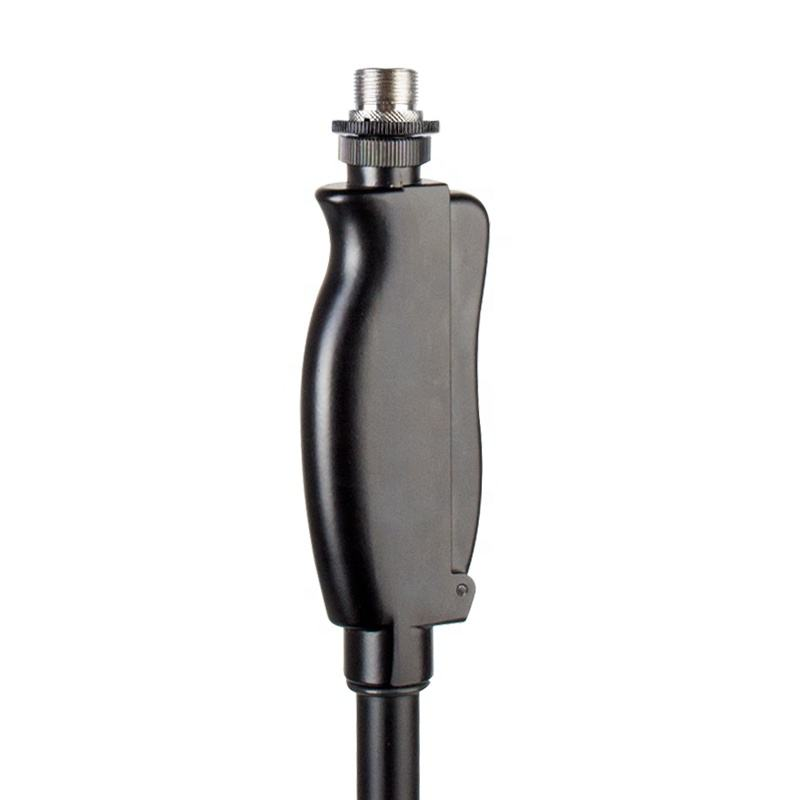
Where Each Thread Lives on the Stand
Stands do not use one thread everywhere, and this is the part most often misunderstood. On the LESOUND MS015 and MS017 round base series, for example, the top fitting carries a male 3/8″ thread and the stand ships with a 5/8″ adaptor included, so a clip from either side of the Atlantic screws on out of the box. The stamped steel base with its rubber ring padding carries the upright through a separate clamping joint, which is a mechanical fitting rather than a thread standard. Boom arms add another layer: the boom pivots on a clutch with its own screw adjustment, and the far end of the boom usually carries a second thread for a counterweight-side accessory.
The practical consequence for importers: when you specify a stand, specify the top thread and the included adaptor, not just “microphone stand”. Two stands with identical height range and base design can still arrive with different top threads depending on the production batch and destination market.
Adaptors: The Small Part That Solves the Whole Problem
Thread adaptors are machined short cylinders, male on one side and female on the other, and they add negligible weight to a shipment relative to the trouble they prevent. The common conversions are worth memorising:
- 3/8″ male to 5/8″ female — the classic European-to-North-American converter; it screws onto a 3/8″ stand top and presents a 5/8″ socket to the clip.
- 5/8″ male to 3/8″ female — the reverse converter, used when a North American stand meets a European gooseneck or accessory.
- 3/8″ to 1/4″ and 5/8″ to 1/4″ — bridges into the camera-thread world for desktop stands and tablet or phone holders.
The LESOUND MSA adaptor series covers this full matrix, including the MSA015 (3/8″ to 5/8″), the MSA017 reverse conversion, and the 1/4″ variants used for camera-thread accessories. Factories that make both stands and adaptors under one roof can pair them at packing instead of leaving the mismatch to be discovered at the customer’s door.
What B2B Buyers Should Specify on the Order
Thread problems are order-sheet problems. Four lines on a purchase order remove almost all of the risk:
- Top thread of the stand. Write the exact standard, for example “male 3/8″-16 with 5/8″-27 adaptor included”, the way the MS015/MS017 series is specified in the LESOUND stand catalogue.
- Thread of every bundled accessory. If the order includes clips, goosenecks, tablet holders or desktop booms, list the thread of each. Mixed-container orders are where mismatches hide.
- Destination market. A factory shipping to distribution in Europe and to rental fleets in North America can pre-fit different defaults per batch, provided the order says so.
- Adaptor packing. Ask that adaptors be packed with each stand rather than bulk-bagged, so the end user never has to source one separately.
Threaded Joints in Daily Use: Small Habits That Save Hardware
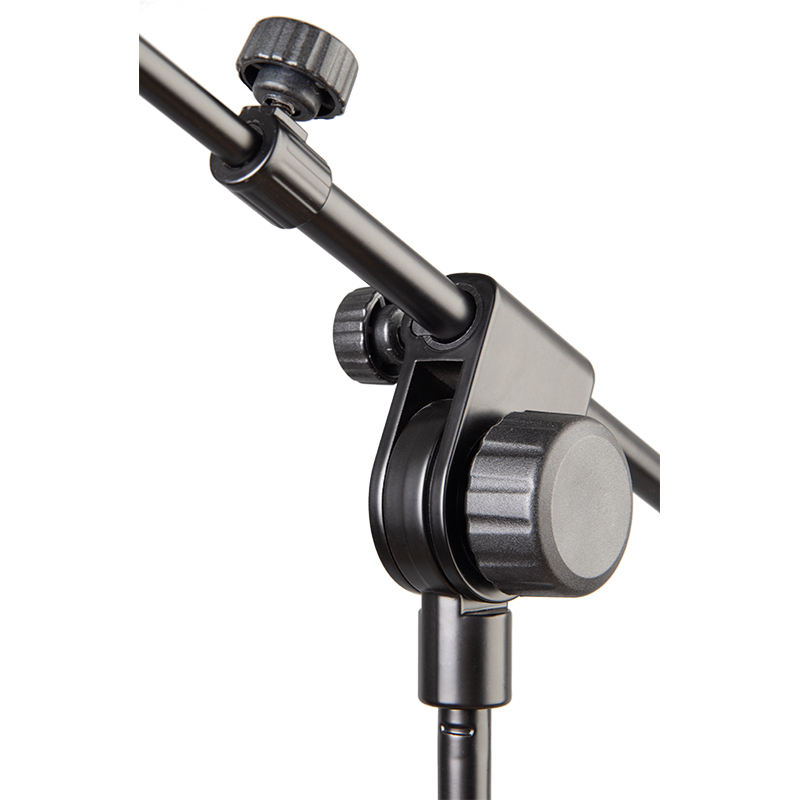
Most damaged threads are user-made, not factory-made. Cross-threading happens when a clip is started at an angle and forced; the fix is to start every thread straight, turn it backwards until the first click of engagement, then run it in. Overtightening a plastic clutch deforms the fitting and is the most common cause of a boom that slowly sinks mid-show — snugged firmly by hand is the correct end state, and the knurled clutch knob on a well-made stand is designed to be tightened without tools. Metal thread fittings, like the machined top on the Yinyu stands, survive careless handling far longer than all-plastic fittings, which is worth checking when comparing suppliers at the same level.
The OEM Angle: Threads Are a Customisable Detail
For buyers building a private-label programme, thread configuration is one of the cheapest customisations available. A factory can ship the same stand platform with a 5/8″ top for a North American programme and a 3/8″ top for a European one, or bundle specific adaptor combinations per SKU. LESOUND produces stands under its Yinyu brand and offers OEM configuration across the microphone stand range, including base style, height range, boom type and thread specification. The brand on the box may be yours; the thread on the top fitting should be your market’s.
Quick Reference Summary
| Standard | Major diameter | Threads per inch | Typical home |
|---|---|---|---|
| 5/8″-27 | 5/8 inch | 27 TPI | North American mic clips, booms, desktop arms |
| 3/8″-16 | 3/8 inch | 16 TPI | European stands, goosenecks, lighting fittings |
| 1/4″-20 | 1/4 inch | 20 TPI | Camera tripods, desktop stands, device holders |
No thread family is a quality tier above the other — they are regional conventions, and the industry has long since solved the interface problem with adaptors. What separates a smooth shipment from a support ticket is whether somebody thought about the thread before the container was stuffed. Specify it, verify it, and pack the right converters, and the 3/8″ versus 5/8″ question stays exactly where it belongs: on the spec sheet, not on the stage.
Looking for microphone stands specified the right way for your market? Browse the LESOUND microphone stand range, or explore our guides on tripod versus round base stability. For the wider rig, our audio cable and monitoring headphone ranges follow the same OEM logic.
Post time: Nov-11-2026