


In a product catalogue, almost every microphone stand looks the same: a pole, a clutch, a clip. On an actual stage the differences show up fast. A vocal stand drifts across slick flooring during an energetic chorus. A lectern mic gets knocked by an enthusiastic speaker. A rental company packs forty stands into a van and wonders why half of them wobble after a season of folding and unfolding. The single biggest decision behind those day-to-day outcomes is the one buyers make first: tripod base or round base.
This guide compares the two families the way they behave on real stages, podia and studio floors — not the way they look on a spec sheet. The examples below come from our own stand programme at LESOUND, a professional audio accessories manufacturer in Ningbo, China, where both families are produced side by side under our house brand Yinyu.
What Actually Makes a Microphone Stand Stable
Two physical levers decide whether a stand stays put: footprint geometry and base mass. Everything else — clutch quality, leg hinges, thread fit — is fine-tuning on top of those two.
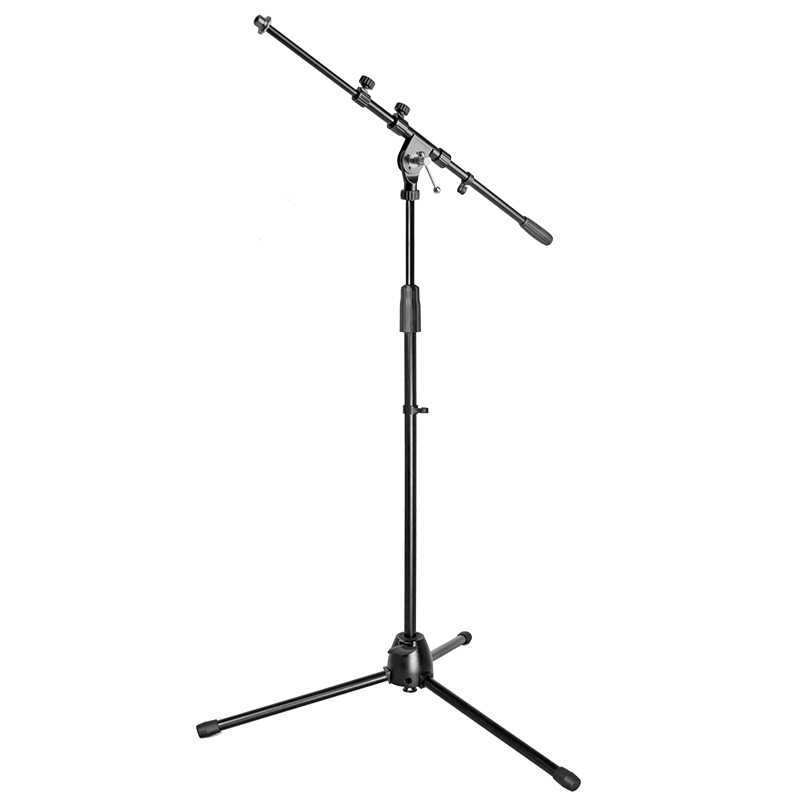
A tripod stand wins its stability through geometry. Three legs splayed at an angle create a wide effective footprint relative to the stand’s own diameter, and the mass of the upper structure sits low, close to where the legs meet the column. When a singer leans into the mic, the tipping moment has to lift the stand over one of three leg feet, which are usually a long way out from the centre.
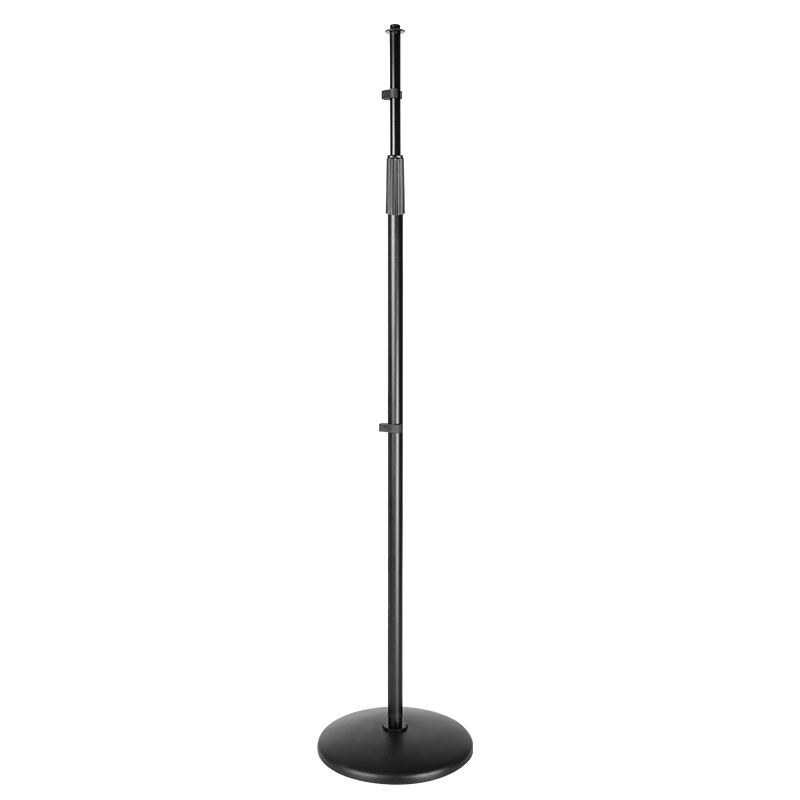
A round base stand wins its stability through mass. The whole structure is a column mounted into a stamped steel disc, so the resisting force comes from the weight of that base rather than from its spread. Rubber ring padding under the base adds grip on hard floors and protects stage finishes. The result is a stand that occupies almost no floor area beyond its own disc — invaluable wherever legs would collide with feet, chairs, monitors or an audience.
Neither approach is universally better. Each maps to a different set of stage conditions.
Tripod Microphone Stands: Where They Win
The tripod is the default choice for live vocal reinforcement, and for good reasons that show up in daily use:
- Uneven surfaces. Three independently placed legs settle onto raked stages, carpet edges, outdoor grass and cable-strewn floors far more comfortably than a flat disc, which can rock on its rim when the surface is not level.
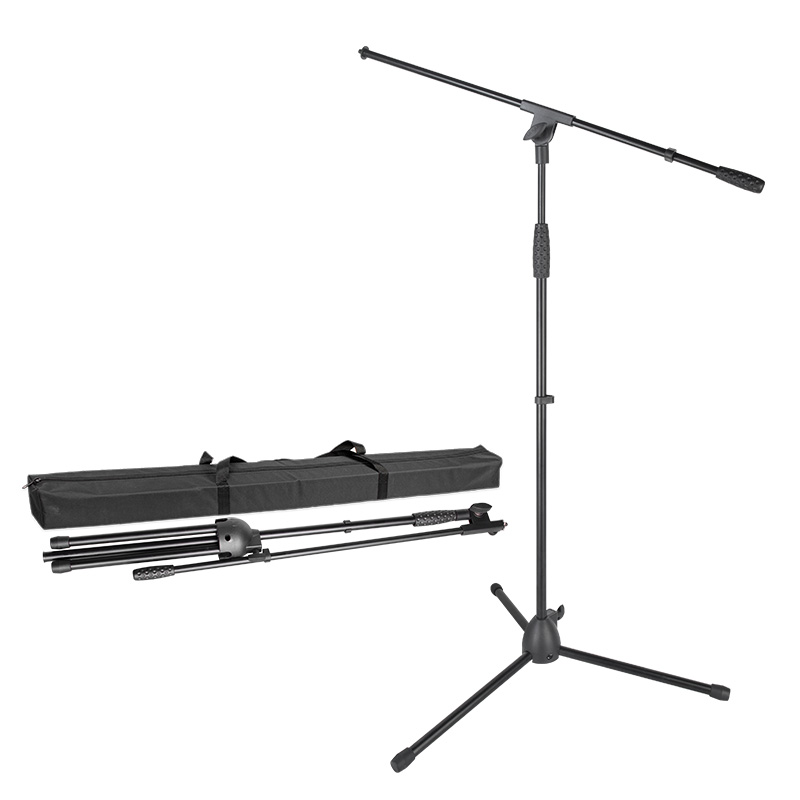
- Fast changeovers. Legs fold parallel to the column in one motion. A crew can collapse, bag and redeploy dozens of stands between acts.
- Height range. A full-size tripod such as the MS002 covers roughly 0.9 to 1.65 m on the column, which spans seated podium work to an adult standing vocalist without extension pieces.
- Boom extension. The MS002 series is available with a 76 cm fixed boom or a 48–87 cm telescopic boom, so the capsule can hang over a drum kit, an amplifier or a presenter who refuses to step forward.
Hardware details matter here too. The MS002 uses a metal boom joint and a metal base hub — the two points where cheaper stands develop wobble first — and carries a male 3/8″ thread with a 5/8″ adaptor, so both European and North American mic clips fit without adaptors bought separately. For low applications such as guitar amplifiers or kick drums, a low-profile tripod in the same family, the MS905, works from roughly 0.5 to 0.7 m with an aluminium base.
Round Base Microphone Stands: Where They Win
The round base family trades packability for permanence, and on the right stage nothing else behaves as well:
- Crowded floor plans. With a footprint equal to the base disc itself, a round base stand slots between monitor wedges, under choir risers and along the front edge of a stage where tripod legs would trip performers or collide with lighting stands.
- Knock resistance. Because the resisting mass is concentrated low in a heavy stamped-steel disc — around 3.5 kg for the base alone on our MS015/MS017 series — an accidental kick moves the mic, not the stand.
- Fixed positions. Podiums, lecterns, houses of worship, council chambers, broadcast desks: anywhere a mic lives in one place, a round base looks intentional and stays exactly where it is put.
The MS015/MS017 family spans roughly 85–155 cm, with taller variants extending to about 185 cm, all on a stamped steel base with rubber ring padding. Gooseneck options place the capsule precisely over a lectern reading surface. Thread is male 3/8″ with a 5/8″ adaptor.
For table-level work the same logic shrinks down: the MS028 desktop stand pairs a 180 mm stamped steel base with a 30 cm column and a male 5/8″ thread. It is the natural choice for conference tables, podcast and streaming desks, and lecterns where a full-height stand would block the speaker’s face to the audience — or the camera.
Matching the Stand to the Application
Procurement teams servicing multiple venue types rarely pick one family; they stock both in known ratios. As a starting point:
- Touring vocal acts and rental fleets lean tripod — folding hinges, carry bags and the ability to settle on any surface outweigh everything else.
- Podiums, lecterns and presentation rooms take a desktop round base such as the MS028, or a full-height round base positioned beside the lectern.
- Choirs and orchestral sections use rows of round base stands where straight poles align neatly, or tripods with booms where each player needs an individual capsule angle.
- Broadcast and podcast studios favour desktop round base stands for fixed mic positions, with boom arms taking over where desk space is tight.
- Drum kits and amplifiers on stage get tripods — low-profile versions where space is tight, telescopic booms where the capsule must hang over hardware.
A rental house that covers weddings, conferences and live music typically ends up with tripods as the mobile majority and round base stands as the fixed-installation minority — a ratio worth confirming with your own customer base before committing to container quantities of either.
Hardware Details That Separate Good Stands From Returned Ones
Whichever family a buyer chooses, the same handful of details decides whether the stands still feel tight after a year of use:
- Clutch material. An aluminium clutch keeps its grip thread after thousands of height adjustments; plastic clutches are the most common failure point reported from the field.
- Boom joint construction. A metal boom joint with a proper locking screw resists the slow sag that plastic joints develop under heavier broadcast mics.
- Thread standards. Male 3/8″ with a 5/8″ adaptor covers both major clip standards from a single stand — one SKU serving two markets.
- Base contact. Rubber ring padding on round bases, and rubber leg feet on tripods, protect floors and add the grip that keeps a stand planted on polished stage decking.
- Folding hardware. On tripods, the hinge and the leg brace take every bump in transport; stamped steel with a positive lock survives rental life far longer than thin pressings.
Sourcing Both Families From One Factory
For distributors and importers, the practical advantage of covering tripod and round base stands from one supplier is consistency: shared clutch hardware, shared thread fittings and a single finish across the range, which matters when a venue or rental fleet mixes both families on the same stage.
LESOUND manufactures both families in Ningbo — tripod stands with fixed, telescopic and low-profile columns, full-height round base stands, and desktop round base models — alongside the rest of the stand programme covering speaker, keyboard, guitar, lighting and sheet music stands. Stands ship under our Yinyu house brand or as OEM production against customer branding. If your range also covers the cabling that runs from those stage mics, our microphone cables and audio cables are produced in the same facility.
The Bottom Line for Stage Buyers
The rule of thumb distills to one sentence: geometry for the road, mass for the fixed spot. Tripod stands — folding, surface-forgiving, fast to redeploy — earn their place in any fleet that moves. Round base stands — heavy, compact-footprint, immovable in practice — own the podium, the lectern and every position a stage crew marks with tape. Buyers who match the base type to the actual floor conditions of their customers’ venues, rather than to the catalogue photo, spend far less time handling wobble complaints later.
The full range of both families, with height ranges and boom options listed per model, is available on our microphone stands category page. For stage systems that combine mic stands with monitoring, our speaker stands share the same base hardware philosophy, and our headphones cover the monitoring side of the same professional setup.
Post time: Oct-08-2026