


A microphone clip holder is the cheapest part in a studio and the one most likely to be missing when something comes back. It’s also the part buyers specify last, which is how a customer ends up with a clip that won’t grip the microphone they already own.


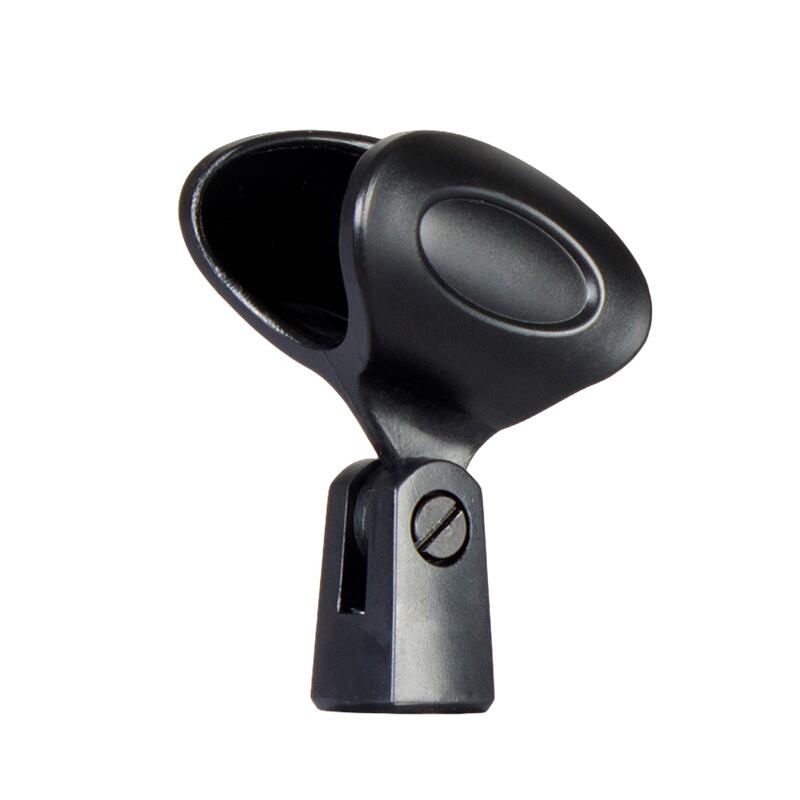
The clip is a mechanism with a thread, a spring and a jaw, and all three have to suit the microphone rather than the stand.
The jaw, and the body it has to grip
Microphones come in body diameters from a thin pencil to a fat studio tube, and a clip sized for one won’t hold the other. Ask what diameter range the jaw covers and whether it has a soft insert. A metal jaw on a painted body leaves a mark the customer sees every session.
The thread, and the adapter nobody stocks
The clip screws onto a stand with a thread, and there are two common sizes in the trade. Ask which thread the clip carries and whether it ships with an adapter. A customer who has to find an adapter locally will buy the clip that came with one.
The spring, and how long it lasts
Ask what the spring is made of and how many cycles the clip is rated for. A cheap spring softens within a year and the clip starts letting the microphone slide. In a school that’s a clip per term, and in a hire kit it’s a complaint.
Plastic or metal, and which market
A plastic clip is light and cheap and it snaps at the hinge. A metal clip survives and it costs more and it can mark a body. Ask which the market buys, and if you stock both, make the difference obvious in the description rather than leaving the customer to guess.
How to vet a clip supplier
Ask for samples across the diameter range rather than one clip. Ask whether the thread is machined or moulded, and ask what the jaw insert is made of. A supplier who sends one sample has one sample, and that’s usually the best one they’ve got.
What to put on the bench before ordering
- Clamp a sample onto a stand and try to twist the microphone in the jaw.
- Screw the thread on and off twenty times and look for wear.
- Check the insert against a painted body for marks.
- Open and close the clip until the spring softens.
- Ask what changes at the volume you’re planning.
Where a clip goes missing
Clips vanish from schools, rehearsal rooms and hire kits, and they vanish quietly. Ask whether they can be ordered in bags of ten and whether the bag price changes at volume. A spare that costs the customer a two week wait gets replaced with tape.
Packing small parts so they arrive usable
A bag of clips arrives with bent jaws if they’re loose together. Ask how they’re packed, whether the jaws are protected, and whether the thread is capped. Small metal parts in a bag find each other on the way across an ocean.
What ships with a clip order
Anyone buying clips is usually kitting out a room. The same order tends to include a Yinyu blue shock mount for the vocal position, a OEM microphone isolation shield where the mic has to be isolated from the floor, and a OEM microphone shock mount for a thinner body.
Audfine headphones travel with most of these orders, because the person fitting clips is the person listening.

Five answers worth having before the order
What body diameters does the jaw cover?
Ask for the range rather than a single figure, and check it against the microphones the customer already owns.
Which thread does it carry?
Ask about the thread and whether an adapter is included. Most complaints in this product start at that joint.
Is the jaw insert soft?
Ask what the insert is made of. A metal jaw marks a painted body and the customer sees the mark every session.
Can the spring be tested?
Ask how many cycles they rate it for, then ask them to open and close a sample until it softens.
Thread wear, and the joint that strips
The thread is where a clip dies. Ask whether it’s machined or moulded, whether it’s brass or plastic, and whether the supplier sells a thread insert separately. A stripped thread turns a clip into waste, and a metal insert turns it into a repair.
What a clip has to survive in a hire kit
A clip in a hire kit is taken off, put back on and dropped into a box every week. Ask how it behaves when it’s loose in a case with stands and metal parts, because that’s the life most of them have. A clip that bends in the box is a clip the customer replaces rather than repairs.
The swivel, and holding an angle
Most clips let the mic tilt, and the tilt has to hold once it’s set. Ask whether the swivel is a ball, a hinge or a thread, and whether it can be tightened. A swivel that won’t hold an angle is worse than no swivel at all.
Clips for a body that isn’t round
Some microphones aren’t circular in section, and a clip made for a round body will hold them badly. Ask whether the factory makes a jaw for a flat sided body and how it’s marked, because a clip that’s wrong for the mic it’s sold with is a return.
The difference between a clip and a shock mount
Buyers mix these up constantly. A clip holds the microphone rigidly and a shock mount isolates it from the floor and the stand. Ask the customer what they’re solving, because selling a clip to somebody with a footfall problem sends them away with the wrong part.
How a school orders these
A school buys clips in tens and loses them in ones. Ask whether the factory can supply a mixed bag with a couple of sizes and whether the bag has a part number a school can reorder from. An order that’s easy to repeat is an order that gets repeated.
Marking, and the part that gets lost
Ask what’s moulded into the clip, because a part with no marking is a part nobody can reorder. A model number on the jaw and a size on the thread is enough, and it costs nothing to add to a tool that’s being cut anyway.
What a reorder tells you about the tool
If a customer reorders the same clip and it arrives slightly different, the tool has been changed or the resin has. Ask how the factory holds the mould and whether they own it or share it. A shared tool is a tool that can change without anybody telling you.
The tool, and the tolerance it holds
A clip is a moulded or cast part running on a tool, and the tool wears. Ask how often the factory replaces it and what happens to a batch made on a worn tool. A jaw that’s a fraction too wide lets the microphone rotate, which the customer reports as a clip that doesn’t fit.
What the jaw is made from
Ask what the jaw body is and what the insert is. A soft insert protects a painted body and wears out, and a hard insert lasts and marks. Neither is wrong, and the customer needs to know which one they’re getting before they put a microphone in it.
A clip for a heavy microphone
A large studio microphone is heavier than a small one and it puts more load on the jaw. Ask what the clip is rated for and whether there’s a heavier version with the same thread. A clip that holds a light microphone and slips under a heavy one is a return waiting to happen.
How clips are counted in a carton
Ask how many go in a carton and whether they’re bagged in tens inside it. A carton of loose clips arrives with half of them marked, and marked stock can’t be sold at full price even when it works perfectly well.
Where a clip sits in a signal room
A clip holds the microphone and nothing else, and it’s the first thing to fail in a room that gets used hard. Ask how the factory would expect a customer to spot a failing clip, because a clip that’s starting to let go produces a noise the customer will blame on the cable.
The two failures a customer reports
Almost every clip complaint is either a jaw that won’t grip or a thread that won’t hold. Ask the factory which of the two they see more often and what they changed as a result. A supplier who’s never had a complaint has never shipped many.
What a sample costs you
A sample costs a factory almost nothing and it costs you the time to test it. Ask for three across the range and test them properly, because a clip judged from one sample is a clip judged from the best one they had on the bench that day.
One question that saves a run
Ask what the standard thread is in your market before the order, not after. It’s a single line in a message, and getting it wrong means a container of clips that every customer has to buy an adapter to use.
Send the microphone and the stand
Tell us the microphone body diameter, the stand thread, and whether the clip has to hold an angle. Those three lines settle the jaw, the thread and the swivel.
Ask for a sample across the range rather than a single clip, because the jaw is the part the customer will complain about.
Clips and holders leave here under the Yinyu name, produced in Zhejiang by Ningbo Lesound Electronics, where the jaw and the thread are checked on every batch.
Post time: Oct-13-2026