


An adjustable dj table with tv is two products on one order, and the screen end carries the risk. The table has to hold a person’s gear and the mast has to hold several kilos above it, which changes what the frame has to do.
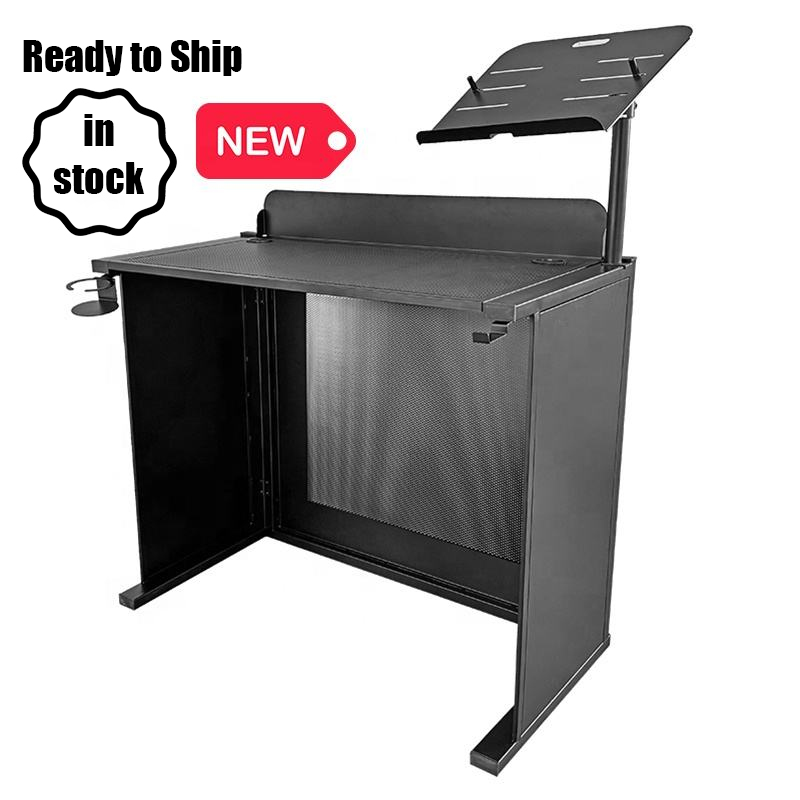

Buyers who treat the screen as an accessory rather than a load usually find that out at the sample stage, which is the cheapest place to find it out.
What the screen adds to the load
A screen on a mast puts weight above the table and offset from the mast, and offset is what tips a frame rather than what crushes it. Ask what screen size and weight the bracket is designed for, and ask where the centre of that weight sits. A table that holds the screen and walks under it’s worse than one that refuses it.
The bracket, and the pattern it has to match
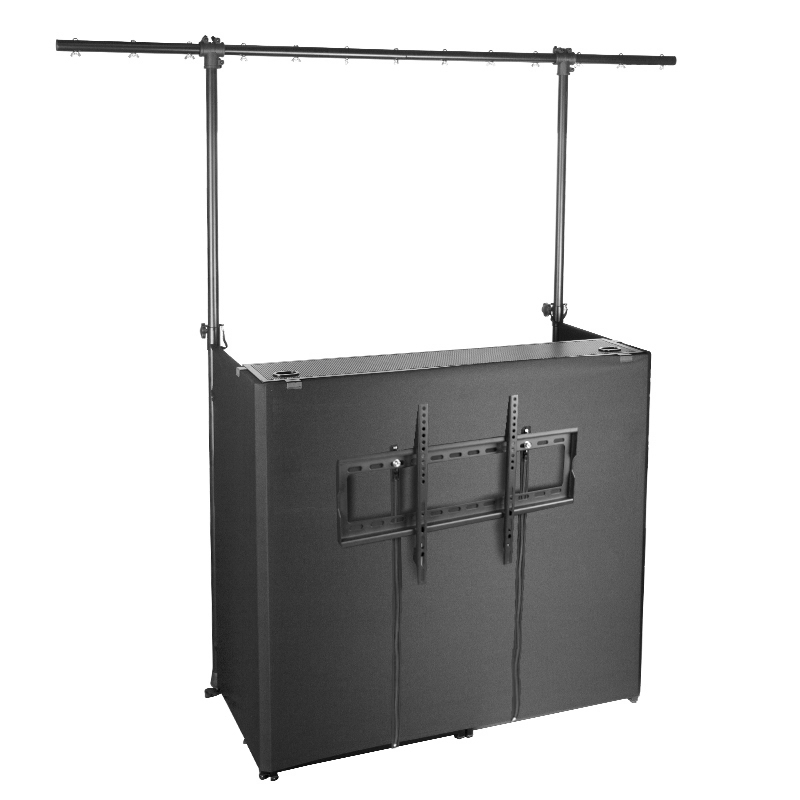
A bracket drilled for one hole pattern is useless on a display from a different family. Ask what hole layout the plate was drilled for, how much sideways travel it allows so the panel can be centred, and whether a replacement plate can be ordered once the market shifts to a larger screen.
The mast, and how it meets the table
The mast is the part that transfers the screen’s load into the table, and the joint is where it happens. Ask whether the mast bolts through the top or clamps to a tube, whether there’s a plate under the top to spread the load, and whether the mast can be set at more than one height. A mast that clamps to a thin top will loosen.
Height, sightlines and the people watching
Ask where the screen has to sit for the people watching it. A screen at chest height works in a booth and fails in a room where the audience is seated. Ask what range the mast covers and whether the customer can change it without unbolting the table.
Routing the screen cable without a mess
A screen needs power and a signal, and both have to get from the floor to the mast without hanging where somebody will catch them. Ask whether the mast has a channel or clips, where the cable leaves near the base, and whether the table has a gap for it to pass through. A cable that hangs off the mast is the first thing to fail.
What to hang on a sample before the container
- Fit a screen at the weight the market uses, not the lightest one.
- Set the mast to the height the room needs and check the sway.
- Route both cables and look for a pinch point.
- Check the plate against a screen the customer owns.
- Take the mast off and refit it to see if the joint keeps its grip.
Spares a screen table needs on the shelf
The parts that go missing are the plate, the bolts and the cable clips. Ask whether they come as a set and whether a customer can order one when a screen changes. A table with a plate for the wrong screen is a table that gets used without one.
Packing a mast so it arrives straight
A mast in a carton with a table will bend if nothing separates them. Ask whether the mast has its own sleeve, whether the plate is bagged with its bolts, and whether the carton has a divider. A bent mast is visible from the first metre of the first setup.
What ships with a table and screen bracket
A venue specifying one of these is usually fitting the whole corner. The same order often carries a Yinyu foldable dj table without the bracket, a OEM adjustable dj table for the floor beside it, and a OEM adjustable dj table where a screen goes on a stand instead of a table.
Audfine headphones travel with a large share of these orders, because a booth that faces a screen is a booth that listens.
Five answers worth having before the frame is cut
What screen weight is the bracket rated for?
Ask for the figure and the offset, because offset is what tips a table rather than weight alone.
Which hole pattern does the plate carry?
Ask, and check it against the screen the customer actually has. Patterns change with screen size.
Does the mast take power and signal?
Ask about routing before the order. A mast without a channel leaves a cable hanging off it.
Can the plate be swapped later?
Ask, because the market moves to larger screens and a fixed plate ends the product’s working life.
Two uses, and how they change the spec
A retail unit wants the screen high where shoppers see it and the table low where staff work. A venue wants the screen at eye level for a seated audience. Both are sold as a table with a screen, and the mast height and the base weight are different for each. Ask which one the customer is selling into.
Screen or LED panel, and what changes
A television is heavy and thin, and an LED panel of the same size is lighter and thicker. The two load the mast differently, so ask which one the customer’s market uses. A bracket rated for a screen can still be wrong for a panel that hangs further from the mast.
The base, and what stops a tall screen tipping
A tall screen on a narrow base is a tipping risk, and the fix is either a wider base or ballast low down. Ask what the base footprint is, whether it can be weighted, and whether the weight is included. A table that needs a bag of sand to stay upright is a table the venue won’t use.
Ask the same question about a person leaning on the table. A screen doubles the load case, and a frame that’s fine on its own may not be fine with a panel on top of it.
Cable management for a shop that moves things
Retail fixtures get moved for a promotion and put back afterwards, so the cable has to survive being handled. Ask whether the mast channel opens without tools and whether the clips are replaceable. A cable route that needs a screwdriver won’t be used.
The height a venue actually needs
Ask what height the screen sits at for the people in the room. In a shop that’s above head height, and in a venue it’s at seated eye level. The two are metres apart, and the mast has to cover both if you want one product for both markets.
What a retail buyer asks first
A retail buyer asks about the screen first and the table second, because the screen is what shows the product. Ask your customer which of the two their buyers lead with, because it decides which part goes in the sample photograph.
A second screen, and the plate that has to change
Screens get bigger between orders, and a plate cut for the last one becomes a problem. Ask whether the plate can be swapped on its own and whether the factory keeps it as a spare. A table that outlives one screen is a table that gets reordered.
What the screen does to the centre of gravity
Every kilogram above the table moves the centre of gravity up and sideways, and the further the screen sits from the mast the worse it gets. Ask the factory where they measure the tipping load, because a figure taken at the table top isn’t the figure that matters.
Where the screen gets its power
A screen needs a socket and a venue rarely has one where the table stands. Ask whether the base has room for a power strip and whether the cable route reaches the floor. A table that needs an extension lead across a walkway will end up used without the screen.
What the table has to do at the same time
The table holds a person’s gear and the mast holds a screen, and both loads arrive at the same place. Ask for the combined rating rather than two separate figures, because two numbers that each pass can still fail together.
Removing the mast when it isn’t wanted
A venue that sometimes wants a screen doesn’t want a mast on the table the rest of the time. Ask whether the mast comes off without tools and whether the table looks finished with it removed. A mast that leaves a plate standing proud is a mast that never comes off.
The screen, and how it’s fastened at the top
Ask whether the screen bolts to the plate or hangs on a hook and is locked. Both are sold under the same words, and a screen that hangs can be lifted off by anybody walking past. Ask which the customer’s market actually needs.
Buying a screen separately from the table
Most customers buy the screen locally and the table from you, and the two arrive at different times. Ask whether the plate can be fitted by the customer and whether the bolts come with it. A table that needs the screen present at assembly creates a delay that turns into a complaint.
What the sample photograph should show
Ask the factory for a sample photograph with a screen fitted, because a catalogue shot of a bare table sells nothing in this category. It costs them nothing and it saves the customer a photo shoot.
Send the screen size and the room
Tell us the screen size and weight, the height it has to sit at, and whether the table is in a shop or a venue. Those three lines settle the plate, the mast and the base.
Ask for the sample with a display bolted on rather than a bare frame, because a mount on its own tells you nothing about whether it holds a panel steady while somebody works at the desk.
Screen tables are badged Yinyu and produced by Ningbo Lesound Electronics in Zhejiang, with the frame, the mast and the plate cut as one job.
Post time: Oct-13-2026