


A snake cable — also sold as a multicore, an audio snake or a stage snake — is the bundle that carries every stage signal to the mixing position in a single run. Instead of laying eight or sixteen separate microphone leads across the floor, you run one jacketed cable with numbered fan-outs at each end and patch the whole stage in one pass. The practical result is a faster load-in, fewer loose leads in a dark room, and a signal path that one person can trace without crawling behind the drum riser.
Snake cables confuse buyers mainly because the vocabulary is loose. A “12-channel snake” might mean twelve sends, or eight sends plus four returns, or twelve lines split unevenly between the two. This article sets out what actually decides the channel count, why the stage box matters more than the number of connectors, and what to check before specifying a snake for a rental fleet, a fixed install or a touring band.
What a Snake Cable Actually Contains
Strip away the packaging and a snake is a bundle of individually insulated cables inside one shared outer jacket. Each inner line keeps its own insulation and its own pair, so a fault on one channel does not migrate into its neighbours. Around the bundle sits a foil or braided screen with a drain wire that carries induced interference to ground.
Three physical details separate a workable snake from a frustrating one:
- The outer jacket. PVC behaves well in dry indoor venues. On outdoor stages and load-ins across wet ground, a rubberised jacket stays flexible at low temperature rather than stiffening and cracking.
- The inner construction. Consistent conductor spacing is what keeps each pair balanced, and a balanced pair is what rejects hum picked up from dimmer racks and mains runs.
- The fan-out. The short tails where the bundle splits into individual plugs take the most mechanical abuse in service. Heat-shrink over the split point and moulded strain relief at each connector are what stop the fan-out becoming the failure point.
Channel Counts: Sends, Returns and Everything Between
The channel count is not one number. A snake is specified by what it has to carry in each direction, and the two directions are not symmetrical. Sends leave the stage — microphones, direct boxes, instrument lines. Returns come back to it — monitor mixes, side fills, and increasingly a network or talkback line.
Sends
Count the sources, not the players. A five-piece band with three vocal microphones, a drum kit on eight channels, two guitar lines, a bass line and two keyboard lines is already at sixteen sends before anyone plugs in a talkback microphone. Wiring a snake for exactly the number of open channels you use tonight is the most common way to run out of capacity on the first night the band adds a guest.
Returns
Returns are usually far fewer than sends, but they are the part buyers forget. Two monitor mixes are two returns; a stereo side-fill pair is two more. When a venue wants wedges, side fills and a drum monitor feed, a snake with four returns runs out quickly. The usual industry split is four or eight returns on a snake of sixteen or twenty-four sends, and the returns are normally carried on the heavier conductor.
Spare Capacity
One or two spare channels are worth having. Spares absorb a failed line without a mid-show repatch, and they cover the microphone that gets added at soundcheck. Bear in mind the next practical size step is usually the cheaper answer: a 16-channel snake with two spares is a 16-channel build either way, while upgrading a 12 to a 16 mid-season is a second purchase.
Stage Boxes: Where the Snake Terminates
The stage box is the panel at the stage end of the snake — a metal or moulded enclosure carrying the female XLR inputs and, on most designs, the return outputs. It does more work than it appears to. The box takes the strain of every cable plugged into it, keeps the fan-out off the floor, and gives the stage a labelled, repeatable patch point instead of a knot of individual leads.
Two details deserve attention when comparing boxes. The first is the mounting flange or the rubber feet: a box that can be screwed to a riser or to a wall plate stays where it was put. The second is the labelling. Numbered sockets with a printed channel map save far more time over a season than any other feature on the box, because they let a visiting engineer patch without asking.

Box on the Stage, or Box on the Reel?
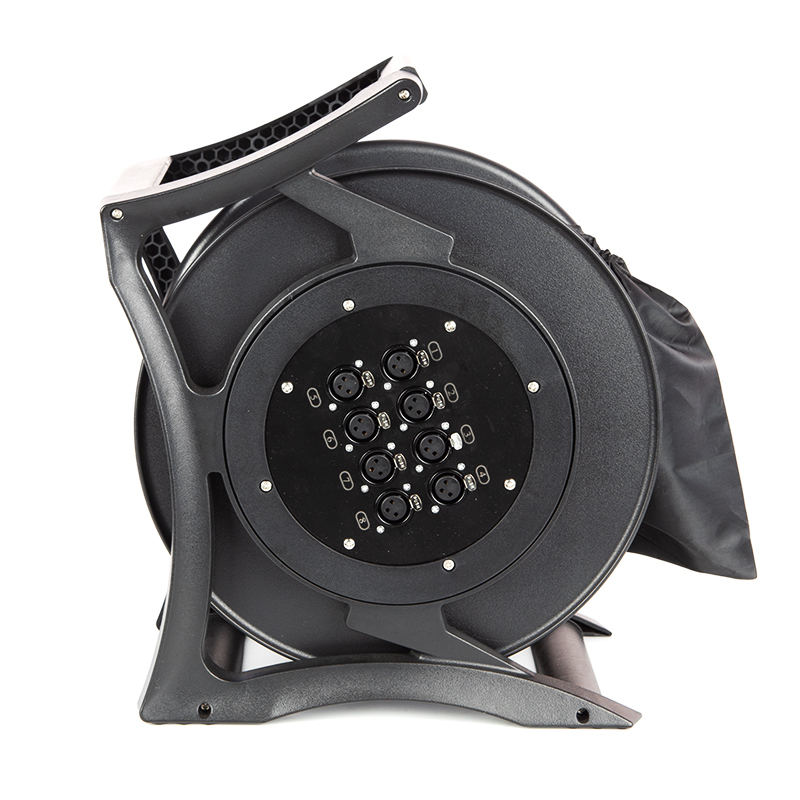
The alternative arrangement puts the connector panel in the centre of a reeling drum. The cable winds back onto the drum after the show, the box travels with it, and there is no separate enclosure to lose in the truck. For rental stock this is often the tidier system, because the coil is the thing that gets damaged and the drum is what protects it. The trade-off is weight: a drummed snake is bulkier and heavier to carry up a stair than a loose coil in a bag.
Connectors at Both Ends
Snakes are usually terminated female XLR at the stage end and male XLR at the mixer end, which is what allows the same box to feed a console directly. Metal shells with a positive latch survive being dragged and stood on; plastic shells save weight but often lose the retention clip that keeps the plug seated.
Other terminations appear where the application calls for them. Jack or TRS connectors suit line-level sends from keyboards and DJ equipment, speakON suits a powered speaker return, and a jacketed fan-out with a single multi-pin connector suits racks that patch once and stay patched. Whatever the mix, number both ends identically. A snake that is numbered on one end only will be repatched wrongly on the first busy night.
Gauge, Length and Signal Loss
Balanced audio line level travels a long way down a well-constructed cable without audible degradation, so length is rarely the limiting factor in analogue audio. Two other considerations bite first. Physical length dictates the coil you have to manage at load-out, and a snake that is far longer than the stage requires becomes a trip hazard that someone has to dress every night. Weight matters too: heavier conductor and a thicker jacket mean a run that takes two people rather than one.
For speaker-level returns carried along the same snake, resistance is the relevant figure, and it rises with length. That is one reason powered speakers fed from the stage have become the default arrangement on smaller rigs — the long cable carries a balanced signal rather than power.
Analogue and Digital Snakes
A digital snake replaces the analogue bundle with a single Cat-class cable and a pair of stage and console interfaces. It wins on weight and channel count; it loses on the fact that one damaged cable takes the entire stage with it. Many rental companies keep an analogue snake as the fallback for exactly that reason. The two approaches are not in competition — they simply fail in different ways.
Coiling, Transport and Service Life
Most snake failures trace back to how the cable was coiled, not to how it was built. Over-under coiling keeps the internal conductors straight and prevents the twist that eventually pulls a fan-out apart. Tying the coil with hook-and-loop strap rather than cable ties avoids crushing the jacket, and a drum or a bag stops the fan-out from being stood on in the back of a van.
Buying a snake with a removable fan-out, or with each channel on its own connector at the box, keeps a single failed line repairable rather than terminal. On a rental fleet the option is worth more than any incremental improvement in the cable itself, because the downtime it prevents is the part of ownership that never appears on a specification sheet.
Common Mistakes When Specifying a Snake
Counting channels instead of directions. Sends and returns are separate budgets. Adding a monitor mix to a snake that was sized only on sends does not work.
Ignoring the run in the store. A snake is stored coiled and moved in whatever vehicle is available. If the drum or bag is an afterthought, the fan-out will be the first casualty.
Numbering one end only. Both ends need the same map, printed and durable.
Assuming every channel is interchangeable. Returns are often carried on heavier conductor and are not always on the same connector type as sends.
FAQ
Is a snake cable the same as a multicore?
In practice, yes. “Multicore” is the more common term in Europe, “snake” in North America. A snake usually implies the finished assembly with a stage box and fan-out, while multicore can refer to the raw cable on its own.
Can phantom power travel down a snake?
Yes. A snake is a passive bundle of conductors, so phantom power on a condenser microphone passes straight through and is blocked only by an active splitter or a digital stage box that filters it.
How many channels does a small band need?
Add the microphones, the direct lines and the returns, then add two spares. A typical five-piece with a four-microphone drum kit lands around sixteen sends with four returns, and that configuration covers a guest vocalist without a repatch.
How Yinyu Builds Snake Cables
Ningbo Lesound Electronics manufactures professional audio and music accessories, and our cable assemblies are produced under the Yinyu brand. The snake cable range sits alongside the microphone cables, instrument cables and the wider cable and connector lines, so a stage package can be assembled from one source: multichannel snakes with or without a drum, patch and signal leads, speaker stands, lighting stands and the DJ booth structures that most mobile rigs are built around.
Because the cable workshop and the stand production share one engineering team and one packing operation, a mixed order of snakes, leads, stands and DJ furniture ships as a single consignment with one artwork sign-off and one packing specification. That matters to brand owners building a private-label range and to dealers who need to restock a specific channel count without committing to a full container of one item.
We build both OEM programmes and small-batch wholesale orders, under the Yinyu brand or under your own label, and we can quote to a specification you send us — channel count, return configuration, length, jacket material and connector type.
Next Step
If you are specifying a snake for a rental fleet, a fixed install or your own brand’s range, send us the stage you are working with: how many sends, how many returns, whether the box should sit on the stage or on a drum, and how the system travels. We will tell you which configuration fits and how it packs for transport.
Post time: Sep-16-2026