


Ask two buyers why their cable orders look different, and the answer often comes down to one detail that never appears on a product page: how the wire is terminated inside the plug. A soldered, assembly-type connector and a factory-molded connector can carry the same signal and look similar from the outside, yet they behave very differently when a cable is coiled, stamped on, shipped across an ocean, or repaired backstage. This guide walks through how each termination style is built, where each one lasts longest, and what to check before you specify connectors on your next cable programme.
What “Soldered” and “Molded” Actually Describe
The two terms are often used loosely, so it is worth pinning down definitions first. They describe the termination method and, to a large degree, the factory process behind it.
Soldered, assembly-type connectors
An assembly-type connector is supplied as a plug and socket in separate parts. The cable is stripped, the conductors are dressed into solder cups or onto terminal tabs, and the joint is made either with a soldering iron or — in higher-volume factories — with a controlled soldering process. The shell is then screwed or snapped closed around the joint. The key property is separability: open the plug and you can see, test, and re-terminate every joint. Our CS-series speakon-type plugs follow this construction, as do most of the 6.35 mm and 3.5 mm plugs in our CP range.
Molded, over-molded connectors
A molded connector is terminated once, at the point of manufacture, and then a boot of PVC or rubber is injection-molded directly over the joint and the rear of the plug. The bond is permanent: the joint, the strain relief, and the housing become one sealed unit. Molded ends dominate retail instrument cables and patch cables because the process is fast, consistent, and produces a tidy, uniform appearance on a store shelf.
Signal Integrity and Consistency
Both methods can deliver a clean signal for years. The difference lies in how much the result depends on who made the joint and how.
With soldered connectors, joint quality tracks workmanship. A well-dressed joint with the right amount of solder wicks into the strand bundle and creates a low-resistance, mechanically stable connection. A rushed joint — too little heat, stranded wires not fully wetted — can become intermittent under vibration. That is why cable factories that ship assembly-type terminations at volume invest in trained staff and inspection checkpoints rather than treating soldering as a casual bench task.
Molded terminations invert that equation. Because the joint is made once, under controlled conditions, every cable leaving the line is nearly identical. There is no variation introduced downstream. The trade-off is that the joint can never be inspected or corrected after molding — the process has to be right the first time, which puts the burden on the factory’s mold design and process control rather than on field staff.
Repairability: Where Assembly Types Earn Their Keep
For touring, rental, and installed-sound buyers, repairability is usually the deciding factor. When a soldered cable fails at the plug, a technician can open the shell, trim back the damaged section, and re-terminate — often in minutes, with the same connector. Nothing is thrown away except a few centimetres of wire.
A molded end offers no such option. The joint is sealed under the boot, so the only remedy is to cut the cable back and fit a new assembly-type plug, or retire the cable entirely. For a retail environment where cables are inexpensive and replaced rather than serviced, that limitation is irrelevant. For a production house with hundreds of speaker and microphone cables in rotation, it directly affects how much spare stock must be held and how long a failed line stays out of service.

Strain Relief: The Detail That Decides Cable Life
Most cable failures do not happen at the solder joint or the mould — they happen a few millimetres away, where the flexible cable meets the rigid plug. How each termination style manages that transition matters more than almost any other construction detail.
On a molded connector, the boot itself is the strain relief. Because it is bonded to the jacket and tapers gradually down to the plug body, bending stress is spread over a longer length of cable. Done well, this is one of the strongest arguments for molded construction on cables that get coiled and uncoiled daily.
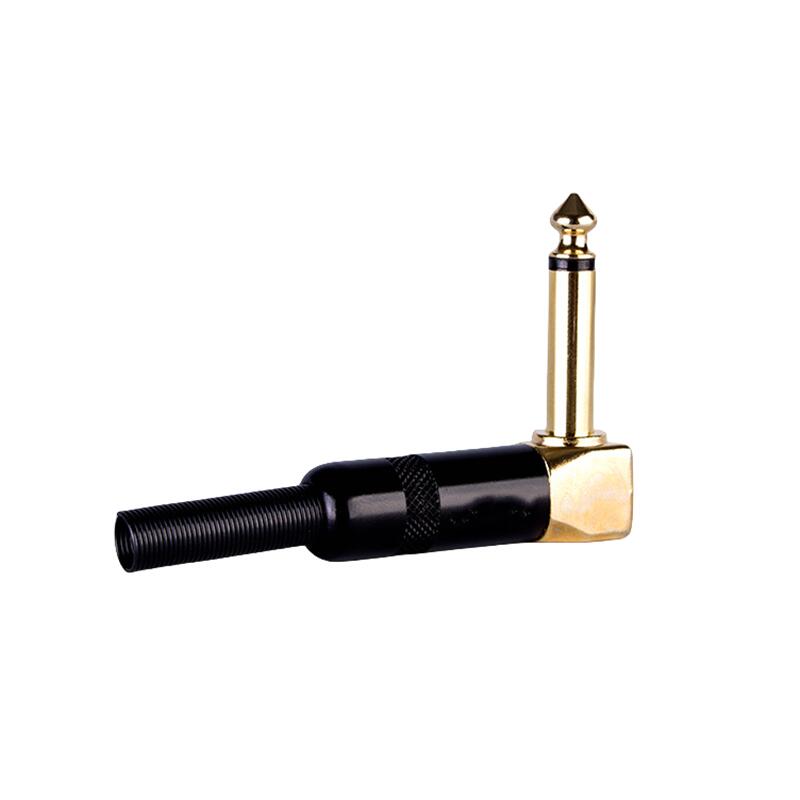
On an assembly-type connector, strain relief is a design feature you must evaluate per model. Look for a threaded or ribbed boot that actually clamps the jacket — not just the inner insulation — and check whether a crimp ring or clamp inside the shell takes the pull force. The CP101 plug shown above, for example, uses a wide threaded collar that grips the jacket over a long span. A plug with a poor boot will fail quickly no matter how good the solder joints are, so when comparing suppliers, ask to see the strain-relief construction rather than only the finished exterior.
Matching Termination Style to the Application
Neither style wins everywhere. The right question is which failure mode matters more in your market.
- Touring and rental stock: assembly-type, soldered terminations, chosen for field repair and the ability to re-terminate with spare plugs on a show day.
- Fixed installation: assembly type for patchbays and rack work where service access matters; molded ends are acceptable on permanently dressed runs that will not be disturbed.
- Instrument and patch cables for retail: molded ends, where consistent appearance, a slim boot, and high-volume production matter more than repairability.
- Pedalboard patch cables: molded right-angle ends are popular because the low-profile boot fits tight switcher spacing — a good example of boot geometry driving the purchase, not the termination method itself.
- Speaker cables: speakon-type plugs are essentially always assembly-type, since the contact block is designed for field termination; see our range of audio cables for typical constructions.
A Sourcing Checklist for Connector Terminations
When you evaluate a cable supplier’s connector work, the following points separate a factory that controls its process from one that does not.
Ask to see opened assemblies
Request photos or samples with the shell removed. You want to see fully wetted solder cups, no stray strands, and heat-shrink or insulating sleeves where conductors could short. A supplier confident in its soldering will show you this without hesitation.
Check the strain-relief grip point
Confirm whether the boot clamps the outer jacket or only the inner insulation. Jacket-clamped designs resist pull force far better. On right-angle plugs such as the CP101, also check the exit angle against your application — a 90-degree exit is ideal for guitar jacks but awkward behind a rack panel.
Clarify who terminates what
Some buyers import loose plugs and terminate locally; others order finished assemblies. If you buy finished cables, the factory’s termination process is part of what you are buying — ask about inspection steps between soldering and molding. If you buy loose connectors, the CP-series 6.35 mm and 3.5 mm plugs in the instrument cable ecosystem, and the CS-series speaker plugs that pair with our audio snake cables, are specified so that installers can terminate them with standard bench tools.
How LESOUND Builds Both Styles
LESOUND manufactures cable and connector products under the Yinyu brand across both termination philosophies. Our CP connector series covers 6.35 mm and 3.5 mm plugs in dozens of housing variants — straight and right-angle, different boot sizes and finishes — which gives product managers room to match boot geometry to the cable and the end use rather than forcing one shape onto every application. The CS series covers speakon-type speaker connectors in two- and four-pole layouts, with metal-shell options in the range for buyers who prefer the stiffness and handling of a metal housing on larger gauges.
Because both connector families and the cable lines that feed them — from microphone cables to audio cable assemblies — are produced in the same factory, termination style can be chosen per product line rather than dictated by what a supplier happens to stock.
The Short Version
Soldered assembly-type connectors buy you repairability and transparency; molded connectors buy you consistency and a slim, permanent strain relief. Spec the termination against how the cable will actually be used — serviced on the road, replaced at retail, or dressed once in an installation — and verify the strain-relief construction before anything else. If you are planning a cable programme and want input on connector selection, the LESOUND team works with buyers on these decisions at the sampling stage, where a change costs nothing but a conversation.
Post time: Oct-16-2026