


Ask two rental companies which frame material they prefer for a DJ facade and you will usually get two confident and opposite answers. Both are correct — for their own load-in pattern. A surround that is folded and refolded five nights a week, carried by one person in an estate car, meets a very different set of forces from one that sits in a fixed venue and is moved twice a year by two people with a trolley.
This article sets out what the two frame materials actually change in a folding DJ facade — mass, stiffness, hinge loads, finish behaviour, repair — and which of those differences matter on a real road schedule. It is written for rental fleets, distributors and OEM buyers specifying DJ furniture in batches, not for a single one-off purchase.
Why the Frame Material Is Only the Start of the Answer
A folding facade is a mechanism before it is a piece of metal: four panels hanging on hinges, standing on feet, folded and unfolded hundreds of times, then stacked against other road cases in transit. The material of the frame sets the boundaries of what is achievable, but the behaviour of the finished product is decided by four things that sit on top of it.
- Section geometry. Stiffness in bending rises steeply with the depth of a tube or extrusion. A deep, narrow profile and a shallow, wide one can deliver similar rigidity from very different amounts of material.
- Joint design. Whether the corners are welded, riveted, bolted or hinged determines where stress concentrates when the unit is knocked or leaned on.
- Panel size and count. Coverage is bought with panel area, and panel area is bought with frame material. A wider surround is always the heavier assembly.
- Finish. A coating system decides how the frame looks after two seasons of van contact far more than the base metal does.
So the useful question is not “which metal lasts longer”, but “which combination of section, joint, panel size and finish suits the way this booth will actually be used”. The material is the starting point of that comparison, not the conclusion.
What an Aluminium Frame Changes in a Folding Facade
Aluminium is roughly one third the density of steel, and that single property explains most of what the material offers a portable surround.
- Handling mass. Coverage that would be a two-person lift in steel can often be carried as one package in aluminium. For operators loading in alone, this is the difference that decides whether a wide four-panel surround is practical.
- Extruded hinge channels. Aluminium is normally supplied as an extrusion, and the profile can be designed with an integral channel for the hinge hardware. Because the hinge is seated inside formed material rather than attached to the outside of a tube, panel rotation can be arranged through a wider arc — enough for the surround to be shaped square, angled back, or folded flat against a wall.
- Stiffness by section rather than thickness. An extruded box section of moderate wall thickness resists flexing and twisting well; the design work goes into profile depth and corner bracing rather than into adding material.
- Finish and surface behaviour. Anodised or powder-coated aluminium does not carry a ferrous substrate, so a deep scratch exposes bare metal rather than starting a corrosion front.
- One planning constraint. Extrusion is a tooling commitment. Panel dimensions and hinge positions follow the die, which makes aluminium particularly well suited to a programme where the panel format is already settled — and less flexible for one-off sizes.
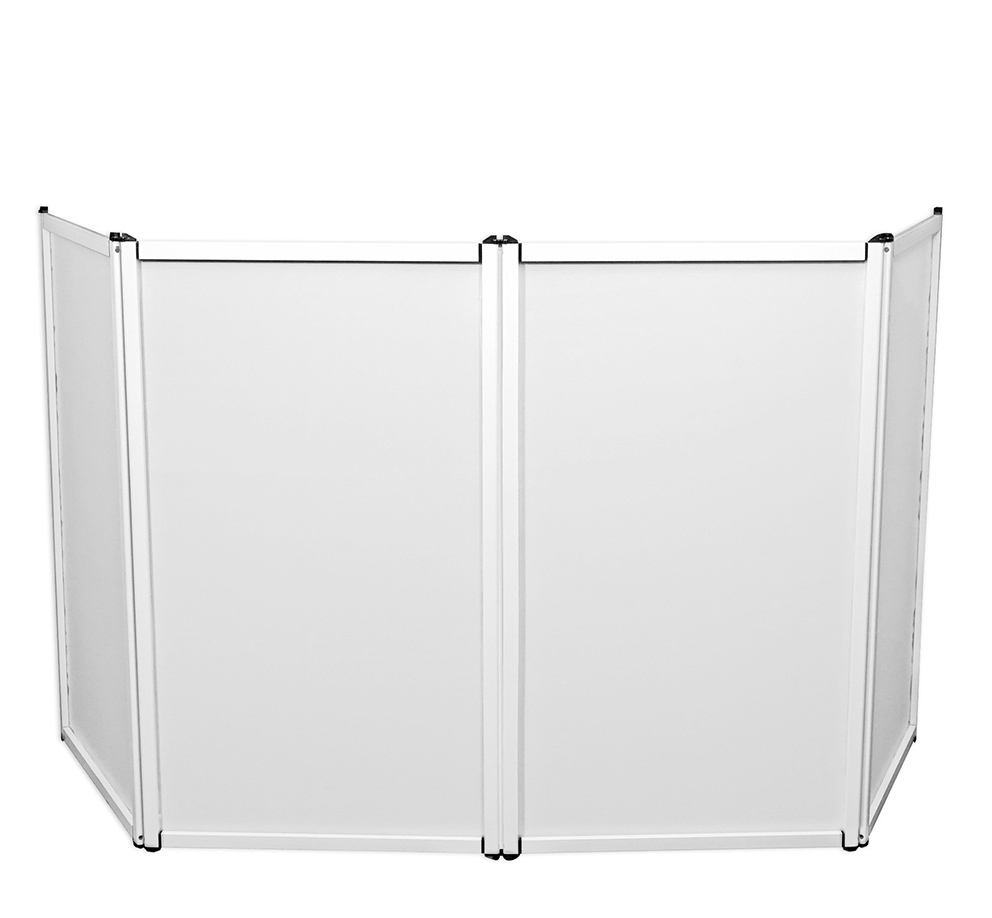
In our own range this construction appears as a four-panel aluminium facade with 70 cm by 120 cm panels, foldable and dismountable, with hinges that allow each panel to turn through a full 360 degrees so the surround can be shaped to the stage. It is the format we recommend first when the load-in is a one-person job and the coverage has to stay wide.
What a Steel Frame Changes
Steel brings a different set of advantages, and they are the reason powder-coated steel remains the standard for DJ tables as well as for many facades.
- Stiffness from thinner walls. Steel’s higher modulus means a thin-walled welded frame can be very rigid without large section depths. The result is a frame that feels solid under a loaded work surface.
- Damage behaviour. Where aluminium tends to distort over a wider area, a steel member usually deforms locally. A bent tube or a closed corner can be brought back into shape by a fabricator, which matters for fleets that repair rather than replace.
- Welded joints. Welding produces a continuous load path at corners and at hinge mounts. On a facade that is repeatedly leaned on at the panel joints, that continuity is a genuine design benefit.
- The trade: mass. A steel surround carried in one piece is a heavier lift, and most practical steel designs answer this by folding flat and splitting into panels, or by using dismountable hinges.
- Natural fit for work surfaces. Where the frame has to carry a table top, equipment and cable loads, steel is the usual specification.

Our steel facade line covers four-panel surrounds with 50 cm by 112 cm panels, and steel-framed facade tables that can be used with the work surface attached or as a traditional surround without it. The most load-bearing version of the format is the full steel folding DJ table: a 112 cm by 53 cm top at 94 cm working height, with a removable flat mesh top and two grommet openings for cables. Net weights sit between 21.5 kg and 27.5 kg across the three models, and every panel folds completely flat into a package measuring 119 cm by 107 cm by 15 cm. See the DJ table range for the formats this applies to.
The Hinge Is Where Both Designs Are Really Decided
Whichever metal is chosen, the hinge is the highest-loaded component in a folding facade, because every panel is a lever acting on it each time the unit is opened, closed, carried or leaned against. Three details separate a hinge assembly that survives a mobile calendar from one that develops play in the first season.
- A positive lock. The hinge should arrive at a defined locked position rather than relying on friction. A friction hinge that is set just tight enough on the first night is a hinge that is set too loose by the twentieth.
- Bearing surface, not pin-in-plate. Load should pass through a bushing or a machined face. A plain pin passing through two thin plates concentrates wear in the plate.
- Enough material around the thread. Any threaded fastener in a folding frame — hinge fixings, feet, panel stops — carries more load in a thin tube wall than in an extrusion with a formed channel around the thread. It is worth asking where the threads are, not only what the frame is made of.
Panel count changes the arithmetic as well: a four-panel surround puts more hinges and joints into the same coverage, so the individual hinge hardware deserves closer inspection on a four-panel design than on a two-panel one.
Weight, Packed Volume and One-Person Handling
Because transport is where DJ furniture earns its reputation, two numbers matter more than any material label: the mass of the heaviest single piece, and the folded volume of the whole assembly.
- Heaviest single piece. Total mass is misleading. What a single operator actually lifts is one folded panel set or one cased assembly, and that is the number to compare between designs.
- Folded thickness. Surrounds that fold to roughly 15 cm travel flat on top of a speaker stack or upright behind a seat. Thicker packages usually have to sit on the load floor.
- Footprint against the vehicle door. A folded package that fits the load space but not the door aperture will be carried at an angle at every load-in.
- Carry hardware. Removable hinges and flat-folding panels reduce handling mass but add assembly steps; the trade is worth making only where the weight saving is real.
Scrim, Finish and the Wear That Shows First
On a working booth, the visible wear rarely begins at the frame. It begins at the surfaces that touch other objects.
- Scrim panels. Translucent woven scrim is the part of a facade that is seen most and handled most. It should be removable with hook-and-loop fixings so a damaged panel can be replaced on its own, and it should be supplied in both white and black where a fleet needs to change the look of the same frame.
- Frame coating. Powder coat over steel and anodised or coated aluminium both tolerate road contact well. What separates them in service is touch-up: a matt black powder coat can be locally repaired with a matching paint, while a scratch in an anodised surface is permanent.
- Edge and corner protection. Most transport damage happens in the vehicle, not on stage, so frames that pack without the metal bearing on a panel face travel with fewer marks.
- Feet. Adjustable feet are a maintenance item on any folding frame, and threaded inserts in metal outlast plastic threads in a frame that is folded weekly.
Facades are normally lit by floor fixtures rather than by anything built into the frame, which also keeps heat and vibration away from the panels. Fleets that supply a booth usually pair it with a T-bar or a pair of lighting stands, and keep a set of balanced cables in the same case so that a booth never goes out without a complete signal path.
Matching the Frame to the Gig Profile
The two materials map onto different working patterns rather than onto different quality levels. The following decision path reflects how the specification usually resolves in practice:
- Three or more load-ins a week, one operator, car or estate. Aluminium, in the widest panel format that still folds into the available space. Handling mass dominates every other consideration at this frequency.
- Fixed venue with occasional moves, or a two-person crew with a van. Steel. The frame can be specified for rigidity and coverage without the handling penalty becoming the constraint.
- Work surface required. Steel, in a folding table format, with a front scrim or panel if the audience side also has to be screened.
- Wide coverage plus a work surface. A steel folding table plus a separate aluminium surround. Two light packages are easier to move than one large hybrid assembly, and each can be serviced or replaced independently.
- Outdoor or uneven ground. Adjustable feet and a frame that can be levelled, with the surround positioned so it cannot be leaned on from the audience side.
Both facade and table formats are specified together often enough that our DJ booth and table ranges are designed to be combined, so a fleet can cover a lighting-driven setup and a laptop-driven setup from the same supplier and the same set of service parts.
Service Components and Fleet Planning
Frame material also decides how a booth is maintained over a fleet life. Before a batch is specified, it is worth confirming that hinges, feet and threaded inserts, panel fixings, scrims and carry bags are all available as individual line items rather than only as complete assemblies. That is the practical argument for buying facades and tables from the same source as the microphone stands and cables that travel with them — the wear items are ordered together, and a single booth can be put back into service without replacing its frame.
FAQ
Is aluminium weaker than steel in a folding facade?
Not in any simple sense. Aluminium achieves stiffness through deeper sections, steel through thinner walls, and the joint design carries most of the load in both cases. The realistic difference is the failure mode: aluminium tends to distort over a wider area, while steel deforms locally and is often repairable by a fabricator. Neither behaviour is automatically preferable — it depends on whether the operator repairs or replaces.
Which material suits a touring rig?
Judge by handling frequency and crew size rather than by the word “touring”. Where the booth is loaded in and out several times a week by one person, the lower mass of an aluminium surround reduces the risk of damage from fatigue handling. Where the booth moves occasionally and is specified for coverage and rigidity, a steel frame with a good locking hinge is the more straightforward specification.
Can aluminium and steel be mixed in the same booth?
They can, and combination rigs are common — an aluminium surround with a steel table, for example. Where the two metals are in direct contact in a damp environment, it is good practice to isolate the interface, which powder coating, plastic bushings and washers all achieve. This is normal metalwork practice rather than a limitation specific to DJ furniture.
Yinyu DJ Facades, DJ Tables and Stage Furniture
LESOUND manufactures professional audio accessories in Ningbo, China, and our DJ furniture is produced under the Yinyu brand. The DJ range covers aluminium-frame folding facades, steel-frame facades and facade tables, and full steel folding DJ tables with removable work surfaces — alongside the lighting, microphone and instrument stands and the audio cables that travel with them. Frames, hinges and hardware are made in the same operation as the rest of the stand and DJ booth ranges, so service components and replacement scrims can be specified as separate line items.
We supply both OEM programmes and small-batch wholesale. Tell us the panel format you need, the coverage the booth has to achieve and the transport profile it will live with, and we will map the requirement against the existing range or build to your drawing, confirming the specification in writing before sampling.
Post time: Sep-22-2026