


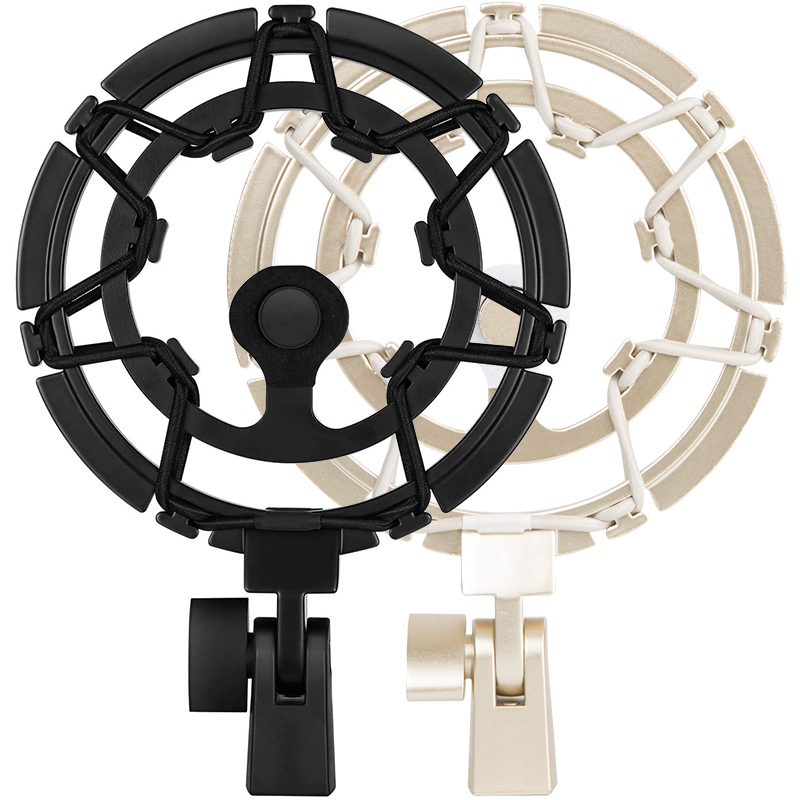
A blue shock mount for mic is a cradle that holds a microphone inside a ring of elastic, so the capsule never touches the stand. That’s the whole idea, and almost everything that goes wrong with one comes from a band that stretched or a cradle that doesn’t fit.


So the questions are about the bands and the cradle rather than about the colour, even though the colour is usually why the customer picked it.
What a shock mount is isolating
It isolates the microphone from vibration in the stand and the floor: footfall, a hand on the stand, a desk being tapped. It doesn’t isolate the microphone from the room, and it doesn’t fix a noisy cable. Ask the customer what they’re trying to stop, because a mount sold for the wrong problem doesn’t fix it.
The bands, and how they age
The elastic is the part that fails. Ask what the band is made of, how it’s fitted, and whether a replacement set is available. A band that has stretched lets the microphone sit lower and eventually touch the cradle, and at that moment the mount stops doing anything at all.
Ask how many bands the mount uses and how they cross. A single band is cheaper and a crossed pair holds the microphone more securely, and the two behave differently when one band is replaced.
The cradle, and the body it has to hold
Ask what range of body diameters the cradle covers and whether the opening is round or scalloped. A cradle that’s too wide lets the microphone rattle and one that’s too tight marks the body. Both faults look the same from a photograph of the empty mount.
The thread, and the adapter
Ask which thread the mount carries and whether an adapter is supplied. The mount screws onto the stand, and a customer without the right adapter will improvise one, and an improvised adapter is usually what’s making the noise they bought the mount to remove.
Colour, and why blue sells
Ask what colours the factory holds and whether a colour change needs a different material. Blue is a strong seller in consumer channels and black is the default in studios, and a supplier who offers both off one tool gives you a range rather than a product.
What to test on a sample mount
- Fit the microphone the customer owns, not a workshop one.
- Tap the stand and listen for anything reaching the capsule.
- Pull the bands and check they return to shape.
- Screw it onto the stand the customer uses and check the thread.
- Ask what the factory sees come back most on this model.
Where a shock mount earns its place
A room with a wooden floor, a desk that gets leaned on, a booth beside a door. Ask where the customer’s microphone sits, because a mount on a solid concrete floor in a quiet room earns nothing and a mount on a suspended floor earns everything.
Shock mount or isolation shield
These two get confused constantly. A mount stops vibration coming up the stand and a shield changes what reflects back into the capsule. Ask which problem the customer has, because selling a mount to somebody with a hard wall sends them away with the wrong part and the same complaint.
Bands as a spare
Ask whether the bands can be bought as a set and whether they’re the same band fitted in production. A spare band from a different supplier has a different tension, and a mount with three old bands and one new one hangs crooked.
What ships with a shock mount
A studio buying mounts usually buys the rest of the mic position at the same time. The same order often includes a Yinyu microphone pop filter where the room is the problem, a OEM mic spit as a second mount, and a OEM microphone metal as a spare for a heavier microphone.
Audfine headphones travel with nearly every order like this, because the person fitting a mount is the person listening for the noise.

Four questions before the order
What body diameters does the cradle take?
Ask for the range and check it against the microphones the customer owns, because the cradle is the part that decides whether it works.
Can the bands be replaced?
Ask whether a spare set is available and whether it’s the same band used in production.
Which thread does it carry?
Ask about the thread and whether an adapter ships with it. An improvised adapter is often the noise the mount was bought to remove.
Which colours can we stock?
Ask whether a colour change needs a different material, because a colour that needs a new tool is a limited run.
When a mount doesn’t fix the noise
If the noise is coming down the cable rather than up the stand, a mount does nothing. Ask how the customer describes the problem before selling anything, because a symptom that follows the microphone when it’s moved is a cable issue rather than a mount issue.
What a heavy microphone does to a band
A large diaphragm microphone weighs more than a handheld, and the elastic carries that weight as a standing tension. Ask what the mount is rated to hold, because a band stretched by a heavy microphone sits low from the first week and the capsule drifts slowly toward the cradle.
Ask whether the factory fits the same band to every size it sells. One band for a light microphone and the same band for a heavy one will sag on the heavy one and grip too hard on the light one, and neither fault shows in a photograph of the empty mount.
Hanging from a boom, or standing on a desk
The same mount behaves differently on a boom and on a desk stand. On a boom it carries the microphone out sideways and on a desk it carries it straight down. Ask which one the customer uses, because a mount that’s steady on a desk can swing on the end of an arm.
Ask whether the mount offers a second thread so it can be turned ninety degrees. A studio that records from above as well as in front will want that, and a mount without it only does half the job.
What a mount does between takes
Between takes the microphone comes off and goes back on, and that cycle is what wears the mount. Ask whether the microphone is held by the body or by a band across the top, because a mount that holds the body wears the finish and a mount with a top band wears the band.
Ask how many fit-and-remove cycles the factory runs before it signs off a tool. A number is a better answer than a description, and a supplier who has run the cycle knows the failure before you do.
A microphone with a switch on the body
Some microphones carry a switch or a pad on the body, and a cradle can cover it. Ask the customer which microphone they use and where its controls sit, because a mount that hides a switch means reaching into the cradle every time the pattern changes.
Ask whether the factory has a mount that leaves the lower body open. Where the controls sit is something the customer notices after the first session rather than before the order.
The screw, the insert, and the third hand
The mount screws onto the stand with a small screw and a thread insert, and the insert is the part that strips when somebody over-tightens it. Ask what it’s made of and whether it can be replaced without taking the whole mount apart.
Ask what tool the customer needs to fit it. A mount that wants a spanner will be fitted by hand anyway, and fitted by hand is how a thread gets crossed.
Blue, black, and what a colour costs
A colour change on a moulded part is cheap and a colour change on a metal part is a finishing step. Ask which parts the colour touches, because a blue cradle over black hardware costs less than a blue cradle over blue hardware.
Ask how many of each colour the factory holds. A dealer who wants two colours on the shelf is asking for twice the stock and half the risk of running out of the one that sells.
Two mounts and a stereo pair
Recording a pair needs two mounts on one bar or two stands, and the two have to hang the microphones at the same height. Ask whether the factory measures the bands rather than just fitting them, because mounts from different batches can sit a few millimetres apart.
Ask whether the mounts can be ordered as a matched pair. A studio buying for stereo will pay a little more to know the two are the same, and a supplier who can’t promise it’s selling singles.
Where a mount is bought by the box
A distributor buys mounts by the box and a studio buys them one at a time, and the two want different packing. Ask how many fit in a carton and whether the cradle and the bands ship apart, because a band that ships stretched arrives stretched and stays that way.
Ask what the carton weighs. A mount is mostly air and the freight is mostly the box around it, so the packing design matters as much as the part.
An adapter in the box, or a phone call
The mount takes a thread that suits the stands the customer already owns, or it doesn’t. Ask whether the adapter ships in the box and whether it’s the same adapter the factory fits in production, because a third-party adapter has a different depth and can bottom out before it grips.
Ask what happens when the customer loses the adapter. A part the factory sells on its own is a small order, and a part that only comes with the mount turns a lost adapter into a replacement mount.
Send the mic and the room
Tell us the microphone, the stand it sits on, and what the customer is trying to stop. Those three lines settle the cradle, the thread and the bands.
Ask for a sample with the customer’s microphone fitted, because the cradle is the part a photograph never shows properly.
Mounts in this range carry the Yinyu badge and are produced by Ningbo Lesound Electronics in Zhejiang, where the cradle, the bands and the thread are checked as one assembly.
Post time: Oct-13-2026