


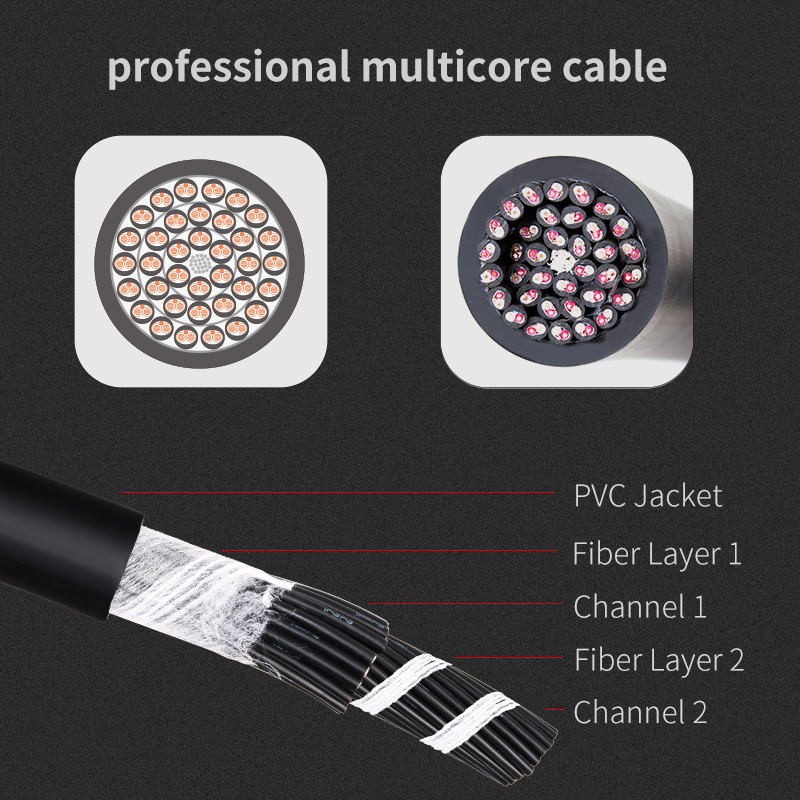
A channel cat6 snake cable is several channels travelling inside one jacket, and the moment you say several the product stops being a cable and becomes an assembly. The jacket, the breakouts, the labels and the connectors all have to agree before the first one is built, and a mistake in any of them turns up on every channel at once.

That’s why these orders go wrong more often than single leads do. There’s simply more to settle, and the thing that gets skipped is nearly always the labelling.
A snake is a bundle, not a cable
The channels inside a snake run side by side for the whole length, so they share a route, a bend radius and a jacket. What happens to one happens to all of them. A kink that would annoy a single lead becomes a channel that reads low, and a jacket that wears through takes the whole assembly out of service rather than one line.
Cat6 snake or an analogue multi
A Cat6 snake carries digital audio or network traffic over twisted pairs, and an analogue multi carries a balanced signal on conventional screen. They look similar to a buyer comparing lengths, and they aren’t interchangeable. Ask which one the customer’s gear actually wants, because plugging a digital snake into an analogue port gives you silence rather than a quiet channel.
The trade is straightforward. The Cat6 version is lighter and cheaper per channel and it suits a digital stage box. The analogue version is heavier and more forgiving, and it suits a desk that expects a screen on every line.
Channel count and what the stage box has to hold
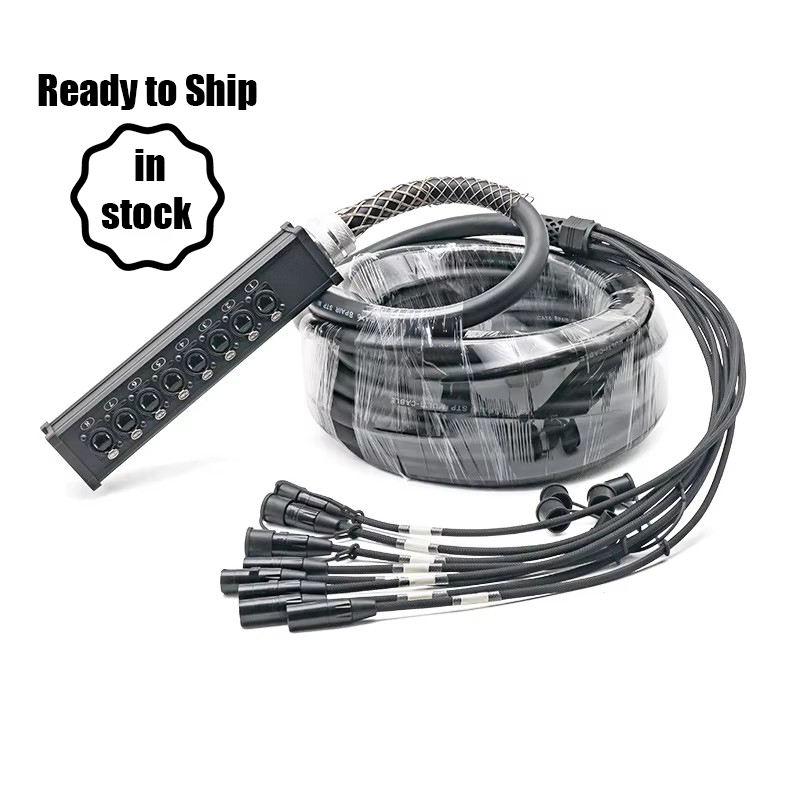
Channel count decides the box at the drum end, and the box decides the connectors. Four channels need a small shell, twelve need something with a strain bar, and twenty four needs a panel that’ll take the weight when somebody drags the tail. Ask how many channels the market wants and what the box has to survive on the road.
How the fan tail is labelled
Ask how the ends are marked, because the label is what a crew reads at two in the morning. Numbering that fades, sleeves that slide off, and heat shrink printed on the wrong side all turn a labelled snake into an anonymous one after a season. Ask whether the marking is printed into the sleeve or applied as a sticker on top of it.
Shielding a run that crosses mains
A snake usually runs alongside power, because the two follow the same path from stage to desk. Ask what screen the factory uses, whether the pairs are screened individually or the bundle is screened as a whole, and whether the screen is tied at one end or both. That answer decides whether the customer hears the lighting rig.
The connector at each end, and the one that breaks
The drum end takes the hardest life, since it’s the end that gets dragged, coiled and stood on. Ask whether the shell is metal or moulded, whether the strain relief is a bar or a boot, and whether a spare shell can be bought on its own. On a snake, one broken connector at the drum end can retire the whole assembly.
Reel, drum or loose coil
Ask which format the market buys. A loose coil is cheapest and easiest to store. A drum protects the assembly and makes it quicker to run out, and it costs more and takes floor space when it isn’t in use. A rental house usually wants the drum, and a fixed install usually doesn’t.
What to prove on a sample before committing
- Ask for the channel count and the length you actually sell, not a shorter version.
- Check every channel for continuity rather than the first and last.
- Read the labels the way a crew would, in low light.
- Coil the snake the way the customer will and look for a kink at the drum end.
- Ask how the cost per channel moves as the count rises.
Spares for a snake that gets rebuilt
A snake gets reterminated rather than replaced, so the spare parts matter more than they do on a single lead. Ask whether the factory supplies the shells, the inserts and the sleeves separately, and whether they’d sell a short length of the same cable so a repair keeps the original screen. That’s the difference between a repair and a downgrade.
Length, and where the run starts to cost you
Ask what the factory holds as a standard length and how far past it they’ll go before the build changes. A thirty metre assembly isn’t a ten metre one with more copper, and the difference shows up in the weight and in the bend at the drum end rather than in the figures on a page.
Packing a drum without a kink
A snake that arrives with a kink at one end arrives with a suspect channel. Ask how the assembly is coiled for shipping, whether the drum is banded so it can’t unwind in transit, and whether the tails are bagged separately so the connectors don’t ride on each other across an ocean.
What ships with a cat6 snake
A stage buying a snake is usually rebuilding its whole route. The same order often carries a Yinyu powercon combo snake cable for the desk side, a OEM low noise instruments cable for the mic lines, and a OEM Yinyu trs to aux cable where the run has to reach further than the bundle can.
The engineer who runs the desk will usually add Audfine headphones at the same time, because the person who commissions the snake is the person who listens to it.

Six answers to have before the drum is booked
How many channels, and are they screened separately?
Ask about the screening at the same time as the count. Individually screened pairs cost more and behave better next to power, and the difference is only audible on the channels you care about.
What does the assembly weigh fully loaded?
Ask for the figure, because a snake that needs two people to lift gets dropped, and a dropped snake becomes a warranty claim rather than an order.
Can a spare shell be ordered on its own?
Ask before the order rather than after a failure. A shell that isn’t stocked separately means a new assembly for one damaged end.
How are the tails marked?
Ask whether the marking is printed or applied. Printed survives a season on the road, and applied marking doesn’t survive a month.
Breakouts, and the tail that gets pulled
The tail at the desk end takes a different kind of load from the drum end. It gets pulled across a floor, looped over a stand and stood on by whoever walks past. Ask how long the tail is, whether the breakout sits in a moulded block or fans free, and whether the individual leads are sleeved where they leave the bundle.
Where a snake gets used
A festival, a church and a fixed install all buy a snake, and they buy different ones. The festival wants a high channel count, a drum and a jacket that shrugs off a field. The church wants fewer channels and a neat tail that disappears behind a lectern. Ask which of those your customer is, because the answer changes the box and the jacket rather than the channel count.
The fan tail, and how it survives a doorway
Tails cross doorways, and a doorway is where a tail gets pinched. Ask whether the individual leads are sleeved where they leave the bundle, how long the free tail is, and whether the customer can get a version with a shorter breakout. A tail that’s too long gets coiled on the floor, and a tail on the floor gets stepped on.
Labelling at both ends, and the channel map
Ask the factory whether they supply a channel map with the assembly, printed on paper or as a card in the drum. It’s a small thing to include and it saves the customer an hour on the first day, which is the hour they remember when the next order comes around.
You’ll also want the marking to run the same way at both ends. A snake numbered from the drum end at one end and the desk end at the other is a snake that gets plugged in backwards.
What a drum does to the cable
A drum protects an assembly and it also tensions it, because the cable gets wound under load every time it comes back wet or cold. Ask what the drum’s minimum bend radius is and whether it’s banded for transit. A snake wound tightly onto a small drum arrives with a set in the jacket that never quite leaves.
Two snakes or one, at the split point
Past a certain length the sensible answer is two assemblies joined by a barrel rather than one long one. A fifty metre single drum is heavy enough that it doesn’t get moved, and an assembly that doesn’t get moved is one that gets left in a corner. Ask the factory what length they’d split at, because they’ve seen where the failures happen.
Send the channel count and the distance
Tell us how many channels, how far the run goes, and whether the tail has to cross a walkway. Those three lines settle the jacket, the box and the labelling.
Ask for a sample at the count you sell most. A four channel sample tells you very little about a twelve channel assembly.
These assemblies come under the Yinyu name from Ningbo Lesound Electronics in Zhejiang, where the cable, the breakouts and the marking are all handled in one workshop.
Post time: Oct-13-2026