


In a recording session a microphone pop filter for recording has one job, which is to keep a puff of air from hitting the capsule on the hard consonants. Everything else about it, the hoop, the arm and the clamp, exists to put the screen in the right place and keep it there.


So a filter is judged by two things: what the screen is made of, and whether it can be positioned. The second one is the part buyers overlook.
What the filter is doing in a session
A plosive is a puff of air rather than a sound, and it hits the capsule as a thump. The screen spreads that puff over a longer moment so the thump becomes part of the word. Ask the factory what material they use and why, because the answer explains how far forward it has to sit.
Distance, and why it decides everything
A screen set too far from the capsule does nothing, because the puff has already reformed by the time it arrives. Ask the customer how far they set it, and compare that with what the factory recommends. The two are often different, and the customer’s version is the one that doesn’t work.
Single layer or double layer
Two layers of screen with a gap between them break a puff up more than one layer does, and they also darken the top end slightly. Ask which the market expects, because a studio tracking brass will want one layer and a studio tracking voice will generally want two.
The arm, and reaching the right spot
The screen has to sit between the mouth and the capsule without the arm getting in the shot or in the singer’s way. Ask how far the arm reaches, whether it swivels, and whether it can be set with one hand. An arm that needs two hands to adjust won’t be adjusted.
Filter and shock mount together
A filter sits in front of the microphone and a shock mount sits under it, and the two have to coexist on one stand. Ask how much room the filter needs below the hoop, because a filter that collides with a mount forces the customer to choose one of the two.
What to test before a take
- Set the screen where the customer would and speak a hard P into it.
- Move the arm with one hand and check it stays where it’s put.
- Check the screen doesn’t touch the shock mount or the stand.
- Wash the screen and check it dries back to shape.
- Ask what the factory would change for a recording room.
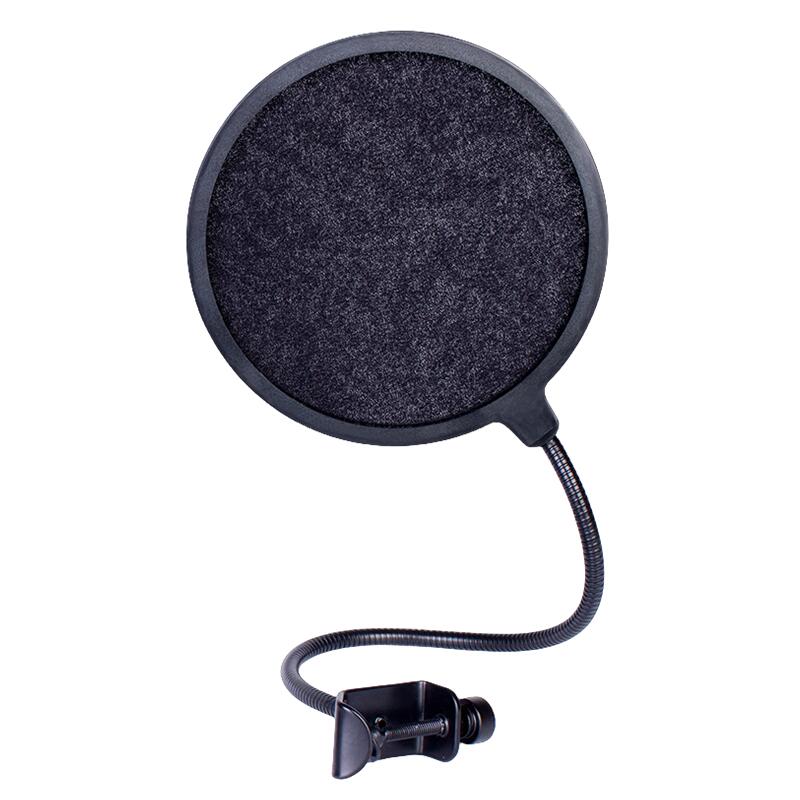
Where a recording setup uses a filter
Voice over, podcast, vocal tracking and narration all use them, and each one has a different working distance. Ask which the customer does, because a narrator working close needs a different screen position from a singer working back from the microphone.
Cleaning, and how often
Ask how the screen is cleaned and whether it can be taken off the hoop. A screen that can’t be removed gets washed in place and never dries properly, and a damp screen does less than a dry one and smells of the last session.
The hoop size and the mic
Ask what diameter the hoop is and how it relates to the microphone. A hoop that’s smaller than the grille sits behind the capsule and catches nothing, and a hoop that’s very large is harder to position between a mouth and a mic.
What ships with a recording filter
A room setting up a tracking position buys the mount and the filter together. The same order often carries a Yinyu wireless microphone to sit under the microphone, a OEM microphone isolation shield where the mount and the screen are one item, and a OEM foldable microphone isolation shield for a thinner microphone body.
Audfine headphones go out with nearly all of these orders, because a filter is bought by somebody who’s about to record a voice.

Four questions worth settling
How far does the screen sit from the capsule?
Ask the factory for the figure they’d recommend and compare it with what the customer does today.
One layer or two?
Ask which the market uses. Two layers control plosives better and take a little off the top end.
Can the screen be removed for cleaning?
Ask, because a screen that can’t come off never dries properly and does less over time.
Does it clear a shock mount?
Ask how much space the arm needs below the hoop, because a filter that collides with a mount forces a choice.
When the filter isn’t the problem
A customer who reports a boomy voice often has the microphone too close rather than a filter that’s too small. Ask what the working distance is before selling anything, because moving the microphone back fixes a problem that no filter will.
What the screen material does to the top end
A woven nylon screen takes a little of the very top off a voice and a punched metal one takes less. Ask which the customer’s market hears as correct, because a singer who has recorded on one for years will notice a change and blame the microphone rather than the screen.
Ask whether the factory can supply both from the same hoop. A supplier with both lets the customer hear the difference without changing anything else in the position.
A filter on a boom the singer grabs
In a vocal booth the singer adjusts the boom and the filter comes with it. Ask how the arm is clamped to the stand, because a clamp that slips when the boom moves leaves the screen aiming at the ceiling and the singer putting it back between takes.
Ask what the clamp is lined with. A bare clamp marks a chrome boom and a lined one doesn’t, and a marked boom is a complaint that arrives with the filter rather than with the stand.
Two hands, one hand, or no hands
How the arm sets is the difference between a filter that gets used and one that gets left at the wrong distance. Ask whether it holds position with one hand, because a two-handed adjustment happens once at setup and never again during a session.
Ask whether the arm can be locked. A filter that locks stays where the engineer put it, and a filter that only grips drifts across a long day of takes.
Shipping a screen without crushing it
A screen is a shape in a box and it arrives either round or oval. Ask how the factory packs the hoop, because a screen pressed against a carton wall takes a set and never sits flat again.
Ask whether the arm and the screen ship together or apart. Apart costs a little more to pack and apart is what keeps the hoop round, and a customer who has received a squashed batch will ask for it by name next time.
A filter for a desk that gets knocked
On a podcast desk the stand gets leaned on and the filter moves with it. Ask whether the arm attaches to the stand or to a separate base, because an arm on its own base survives a knock that takes the microphone with it.
Ask how much desk the base needs. A filter that wants a large footprint won’t fit a small desk, and the customer who finds that out after the order is the customer who sends it back.
When the microphone sits at the edge
A microphone at the edge of a booth has the screen reaching across, and the reach is set by the arm rather than the hoop. Ask how far the arm goes and whether the customer’s microphone sits behind or beside the stand.
Ask whether the factory offers a longer arm on the same clamp. A customer who needs two inches more will buy a different brand unless the supplier has the option.
The number of turns to lock the hoop
The hoop clamps onto the arm with a small screw, and the screw either holds or it doesn’t. Ask how many turns it takes to lock and loosen, because a screw that needs many turns gets left loose and a loose hoop swings away from the mouth.
Ask what the screw threads into. A metal insert in the clamp outlasts a thread cut into plastic, and that’s the part that fails first in a room that resets the position every day.
A spare screen for a long session
A screen picks up moisture from a singer over a session, and a second screen lets one dry while the other works. Ask whether the factory sells the screen on its own, because a customer who can buy only the whole filter throws away a good arm to replace a screen.
Ask whether the spare screen is cut from the same roll. A screen from a different batch has a slightly different openness, and the customer will hear the difference between takes.
What a filter does to the sound of a room
A screen sits between the mouth and the capsule and it changes what the capsule sees, not only what it hears. Ask the factory how much the screen costs in the top end and in the working distance, because a screen that pushes the singer back changes the tone as surely as a different microphone does.
Ask whether the customer has compared the position with and without the screen. Most haven’t, and a buyer who can talk about that comparison is a buyer the customer trusts.
Send the mic and the session
Tell us the microphone, the working distance and whether a shock mount is already in place. Those three lines settle the hoop, the arm and the layers.
Ask for a sample set up on a stand with the customer’s microphone, because the position is the whole product.
Filters in this range carry the Yinyu name and are made by Ningbo Lesound Electronics in Zhejiang, where the hoop, the screen and the clamp are checked on every batch.
Post time: Oct-13-2026