


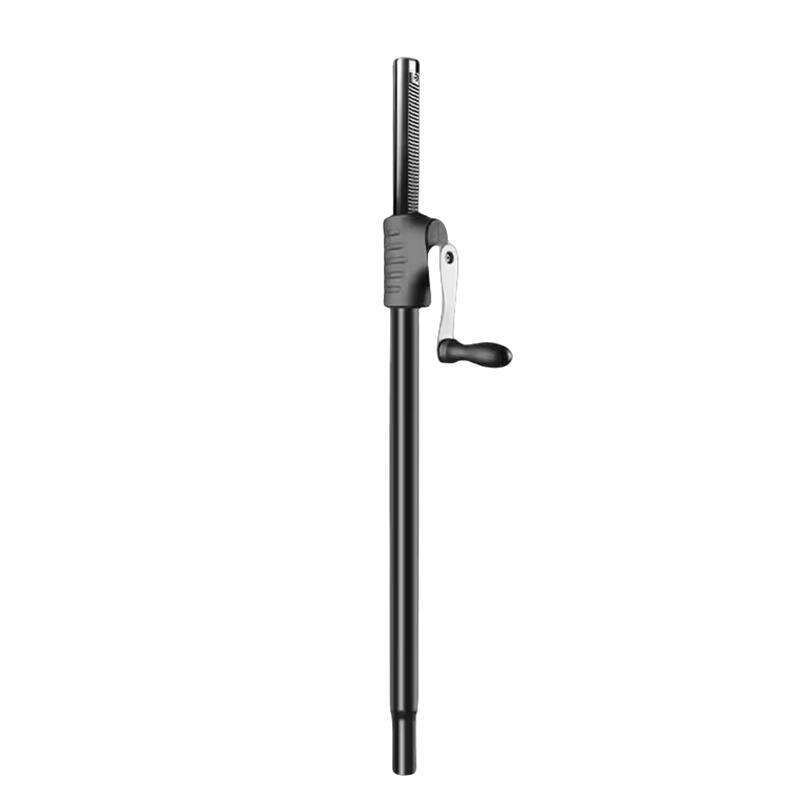
A rental crew in Birmingham rang us in March about a pole. Not a cabinet, not a driver. A pole. They run six full-range boxes with 35 mm sockets moulded into the bottom. On wedding jobs those boxes were sitting so low that the horn was firing into the backs of chairs. What they wanted was one they could raise single handed to 1.4 m and then leave alone for four hours. That’s the piece of a rig nobody prints a brochure for, and it’s the piece that decides whether your top box ends up at ear height or at chest height. The crank-up speaker subwoofer pole we build for that kind of job is the SSA038, and it travels from 0.8 m up to 1.4 m on a geared handle.
A crank gear turns height into something you can fine-tune
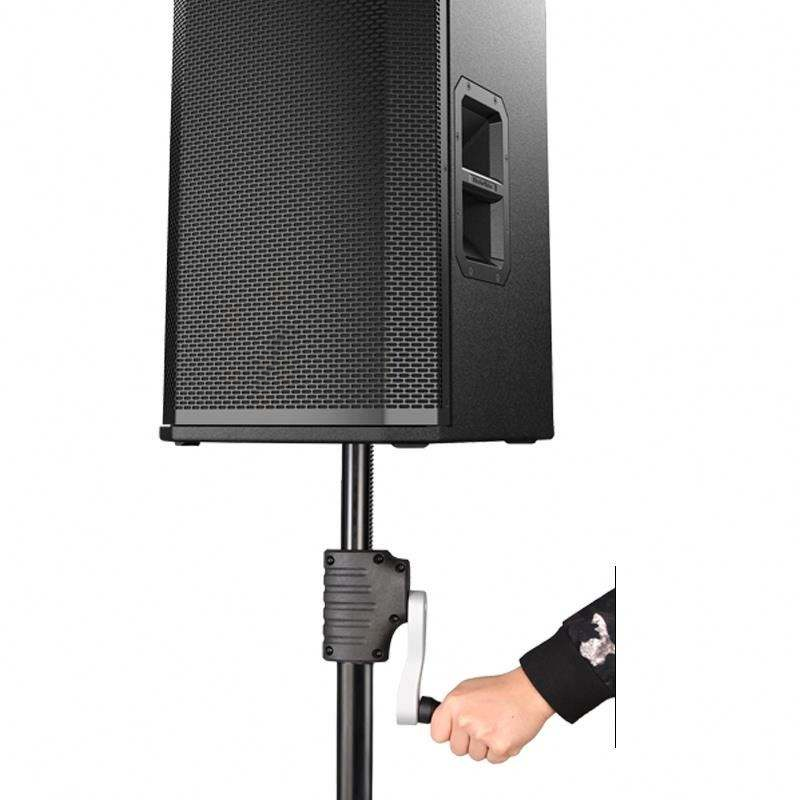
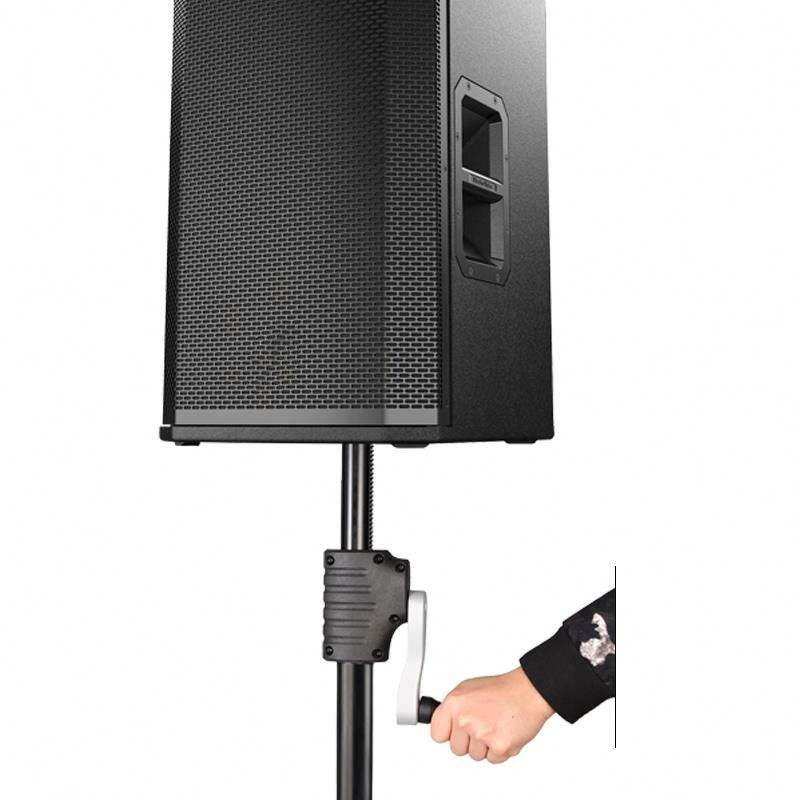
Push a button and you get three holes. That’s how most stands work, and it’s fine if you only ever use them at the same two heights. A crank works differently. There’s a handle on the side of the outer tube, and inside that housing a gear drives the inner one, so the tube stops wherever you stop turning. You get the whole range instead of three fixed points. On a floor that slopes, or under a ceiling that dips, that’s the difference between the box pointing where you want and pointing at the plaster. It also means you can raise a loaded cabinet without lifting it, which at eleven at night with two people left is the thing crews actually care about.
It isn’t free, though.
A pin is a spring and a bit of steel. A crank is a housing, a gear, a handle and a brake, and there are more places in that for grit to get in. The thing holding your cabinet up becomes a mechanism you can’t see. Any crank you buy should hold its height with the load pushing back down on it. There’s a simple way to find out. Load it, leave it overnight, and look at it in the morning. If it’s crept down by even a little, the brake isn’t doing its job. We’ll tell you to do that with ours, because we’d rather you find it in your own warehouse than at a venue forty minutes before doors. The other way of doing the same job is a gas or air assisted tube. If your crew lift and drop boxes twenty times a night you might be better served by one-hand crank up speaker stand than by a gear you have to wind.
From 0.8 m to 1.4 m, and the room height that picks it
Zero point eight metres is the collapsed length and 1.4 m is the top, and which of those you actually use depends on where people’s heads are. At a seated dinner, ears sit somewhere around 1.2 m off the floor, so a box on a 1.4 m pole clears the whole room. At a standing show the same box is fine lower down, because you’re aiming over shoulders rather than over heads. The bottom of the range matters just as much. Plenty of engineers lift a sub a hand’s width off a hollow stage deck to stop the deck booming along with it. That’s an old trick, and it’s why 0.8 m is a useful number instead of just the bottom of a range.
- A cardioid stack puts the rear cabinet on its own pole, and the two heights have to match
- A tilt adapter sits between the tube and the box, and it takes a bite out of the working height
- Under a three metre ceiling you won’t use the last 20 cm, so there’s no point paying for it
35 mm is the whole interface
Every part of a stand that touches a cabinet comes down to one number. The upper shaft on the SSA038 is 35 mm, which is what most moulded pole cups in PA cabinets are cut for. The fit matters more than people expect. A tube that’s loose in its cup will chatter when the cone moves, and a tube that’s tight won’t come back out at the end of the night. The cups themselves are the variable. Some are smooth plastic, some carry a steel sleeve, and some have an M20 thread in the base that wants a bolt rather than a tube. If you’re buying for a fleet, measure one cup on one cabinet before you order a hundred of anything, and send us that number. Every Yinyu stand that leaves for that job is cut to the socket you measured, and we’d rather make to your measurement than have you discover it on a Friday.
Steel tube, and the wall thickness nobody prints
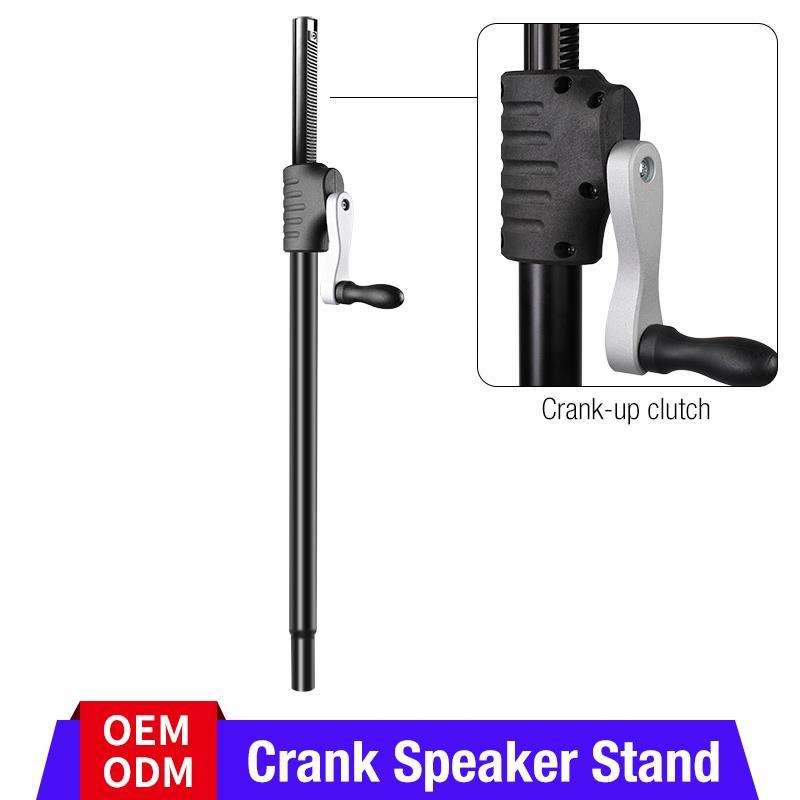
The page says steel and it says black, and it doesn’t say how thick the wall is. That’s not us hiding anything. Wall thickness is the variable we set against whatever you’re putting on top. The right answer for a 12 inch moulded box isn’t the right answer for an 18 inch birch one. Tell us the cabinet and how many, and we’ll tell you what we’d build. Asking the other way round is how people end up with a pole that’s either over-built and a pain to carry, or under-built and moving every time the kick drum goes. The finish has the same story. Powder coat holds up fine until you get to the top of the inner tube, where the socket rubs on every single load-in. If you want something harder up there, say so.
What the pole carries when a cabinet sits on top
People want a load rating before they buy, and we don’t print one. I’d rather explain why than make a number up. A rating is measured with a weight hanging straight down from the middle. That isn’t what happens on a job. On a job there’s a cabinet with its weight off to one side, a loom of cable pulling sideways, and someone brushing past with a flight case. The pole that holds a load straight down isn’t the pole that holds the same load when a guest leans on the box. If you need a figure for a tender document, tell us the cabinet, the rigging and the floor, and we’ll put something in writing for that exact case. That’s a promise we make about Yinyu stands, not a way of talking around the question.
The wobble you feel at full extension
Two sections, and that’s most of the answer. A pole that does 0.8 to 1.4 m across two tubes moves less at the top than a three section one covering the same range. There’s one less joint, and a longer overlap where it counts. That doesn’t mean it won’t move. Anything tall and thin with a weight on the end will move, and you can feel it if you put a hand on the cabinet while the bass is going. What helps is not using the last 10 cm, keeping the base weighted, and running the cable down a leg instead of letting it hang off the top. What doesn’t help is buying a heavier cabinet and hoping for the best.
Five checks before a crank-up pole order
- Wind it up with a cabinet sitting on it, not with the pole in your hands
- Measure one socket on one cabinet, then send us that number
- Stand it on the floor you really work on and push the top
- Turn the handle fifty times and listen for grit in the gears
- Look at the top of the inner tube after a hundred load-ins
Cables and clamps in the same carton
Nobody orders forty poles on their own. The container they go in usually has something else with them, and the more of that which is ours, the fewer invoices and fewer forwarders you’re chasing. Yinyu stands go in the same container as Yinyu cables. A rental house building out a stage end will often take a snake cable stage box in the same shipment. The cable and the poles turn up on the same day. Audfine headphones arrive in those orders too, mostly for the monitor position. The 35 mm tilt adapter is the other item people forget and then reorder in a hurry. Pointing a box down at a seated room is a lot easier than pointing it at the ceiling. Packing is a 5 ply brown box. How many you get in a container is a question for us, not a number I’d guess at.
What we ask when a pole enquiry comes in
An email saying pole, forty units, please quote gets an email back with five questions on it. What cabinet goes on top, and what’s the socket on it. How high you need it, and whether that’s every job or the worst one. What you stand it on. Whether the handle needs to fold, because a handle sticking out in a van gets bent. And whether you want your own name on it, which turns into a separate conversation about printing, cartons and the quantity where that becomes worth doing. None of that is us being difficult. Every one of those answers changes what we make, and it is the same five questions for one carton of Yinyu stands as it is for a mixed container. The paperwork leaving Ningbo Lesound Electronics for your poles can carry your own name on it instead of ours, and that’s the last of the five questions rather than the first.
Answers we send before a pole order
Will a 15 inch cabinet sit on a 35 mm pole?
The 35 mm is the joint, not the size of the thing on top. What decides it is the load and how far off the floor you put it, and those two together tell you which tube we’d build. Tell us the cabinet model and the height you need and we’ll tell you straight.
What weight does the SSA038 hold?
We don’t print a figure, for the reason in the section above. A straight-down number wouldn’t describe what your job does to it. If there’s a line in a tender that needs filling, send us the cabinet and the arrangement and we’ll put a number in writing for that case.
Does the handle fold away for transport?
Handles stick out, and that’s the part that gets bent when poles are stacked loose in a van. We pack them so the handle lies against the tube. If your trucks are tighter than that, tell us and we’ll look at what we can do.
How many go in a container?
It depends on the length you buy and how you want them packed, so ask. We’ll work it out against the actual carton rather than give you a figure that turns out to be wrong when the freight is booked.
Can you put our name on them?
Yes, and the page says OEM or ODM available for that reason. Printing on the tube, printing the carton and changing the colour are three different jobs with three different minimums. Tell us which you want and we’ll tell you what it takes.
Are they on the shelf or made to order?
Tell us the quantity and the date you need them and we’ll tell you honestly which it is. There’s finished product inspection on the way out either way, and if a date can’t be met we’d rather say so at the quoting stage than three weeks later.
If you’re pricing poles for a fleet, the fastest thing you can send is a photo of the socket on your cabinet plus the height you need. We can work the rest out from that. Put the words crank pole height in the subject line so it lands on the right desk, or just start from the contact page on our site.
Post time: Nov-10-2026