


Load in at a club mid afternoon and you can usually read the whole crew off the front of the booth. The riser, the deck and the lights get the budget and the attention, but the panel across the front is the piece that decides whether the whole thing reads as furniture or as a table someone threw a cloth over. That’s the layer buyers ask about last and regret first.


Scrims come out of the same workshop as the rest of our Yinyu booth line, so what follows is the short list of decisions that actually change what gets measured, cut and sewn. None of it’s exotic. All of it’s easy to get wrong on a first order.
What the front panel is really doing
A scrim is doing three jobs at once, and buyers tend to think about only the first one.
- It hides the underside of the booth, which is where the spare cable, the gaffer tape and the power strip live during a show.
- It softens light. A bare riser throws hard shadows onto the floor and onto whatever is being projected, and a panel in front of it spreads that light instead.
- It carries the branding. A logo on a flat panel is the cheapest large-format signage an event company owns, because it goes up with the booth every single night.
Once you treat it as signage rather than as a cover, the specs start to make sense. A panel that only hides clutter can be thin and slightly translucent. A panel that has to read as a solid brand colour under stage light can’t, because every light behind it’ll show through as a grey patch.
The four decisions that change the build
Almost every question we get on a scrim order lands on one of these four. They’re worth settling before you ask anybody for a price, because they change the material, the stitching and the packing.
| What a buyer asks | What it actually decides | Get this wrong and |
|---|---|---|
| How big is the panel? | How many widths get joined and where the seams fall | A seam lands in the middle of the logo |
| How heavy is the fabric? | Whether light behind the booth bleeds through | The brand colour reads grey on camera |
| Is it flame retardant? | Which certificate the venue will accept at load in | You’re turned away at the door |
| How does it attach? | Sleeve, eyelets, hook and loop or a staple rail | The panel sags or pulls off mid set |
Two of those four are commercial and two are technical. The commercial ones, size and attachment, are the ones the buyer can answer alone. The technical ones usually need a sample in hand, which is why we send fabric swatches before anything gets cut.
Fabric weight and what the camera sees
A panel that looks fine to the eye at 11pm can look completely different on a phone clip the next morning, because a sensor is more sensitive to light coming from behind than your eye is. If the booth carries signage or a screen, ask for the heavier side of the range and check it with a light behind it, not in a lit office.
Flame paperwork
Venues and local authorities all want to see a certificate, and they rarely want the same one. Tell your supplier which standard your venue asks for and get the paperwork named on the order, not promised over the phone. This is the single most common reason a first order gets held at the door.
Sizing a booth you’ve never stood next to
Most of the scrims we ship are ordered by someone who has the booth in a warehouse and a tape measure in hand, which is the easy version. The harder version is a buyer sourcing a booth and a scrim at the same time and trying to size one from the other. Here is the order that saves a remake.
- Measure the front face across its widest point, not across the frame. Fabric needs to clear the widest part, then hang down.
- Measure how far down the panel should stop. A panel that touches the floor collects every drink that gets kicked over. Most crews stop it a hand’s width above.
- Measure the returns, the short sides that wrap back toward the operator, separately. They’re almost always forgotten and they’re visible from the side of the room.
- Mark where the legs and the cross brace sit, so the seam placement can avoid them.
If you can send a photo of the frame with the measuring tape visible, that beats a drawing every time. It tells us where the braces are without a second email.
Printing a logo without wasting the run
Logos are applied as a print or as a cut panel sewn on, and the choice usually comes down to how fine the artwork is and how many nights a year it goes out. Fine detail and thin strokes favour a print. Big solid shapes and heavy type favour a cut panel, because it survives packing and unpacking for years without fading.
Whichever route you take, send vector artwork and name the colour system you care about. The trap on repeat orders is the dye lot, not the printer. Two rolls of the same colour code mixed from different batches can sit next to each other on one booth and not match, so if you reorder, ask for the same fabric spec on the same order as the tables.
What to put in the first message
You’ll get a useful answer faster if the first message carries the details that decide the build rather than a request for a catalogue. The short version:
- The booth it’s going on, or the front-face dimensions if the booth is already yours.
- Where it’ll be used, because a touring panel and a fixed install in one club are packed differently.
- The flame standard your venue asks for, in the words your venue uses.
- Whether the panel carries artwork, and if so the file and the colour.
- The quantity, and whether you expect to reorder the same build.
Send that and the reply is a build, not a list of everything we make. It’s also the message that tells us whether the panels ship with the tables or separately, which changes the carton plan.
Storage, creasing and the second order
A scrim spends most of its life folded in a case. That’s what it gets judged on, not how it looks on the day it arrives. Fold along the seams rather than across them, keep it out of the sun between shows and it’ll hang out flat within a night. Leave it crushed under a flight case for a month and no fabric weight will save the crease lines on camera.
When you reorder, repeat the whole fabric line on the order, not just the colour name. Colour names get reused across weights and finishes, and a panel that has to sit next to last season’s panel on the same booth is where the mismatch shows up.
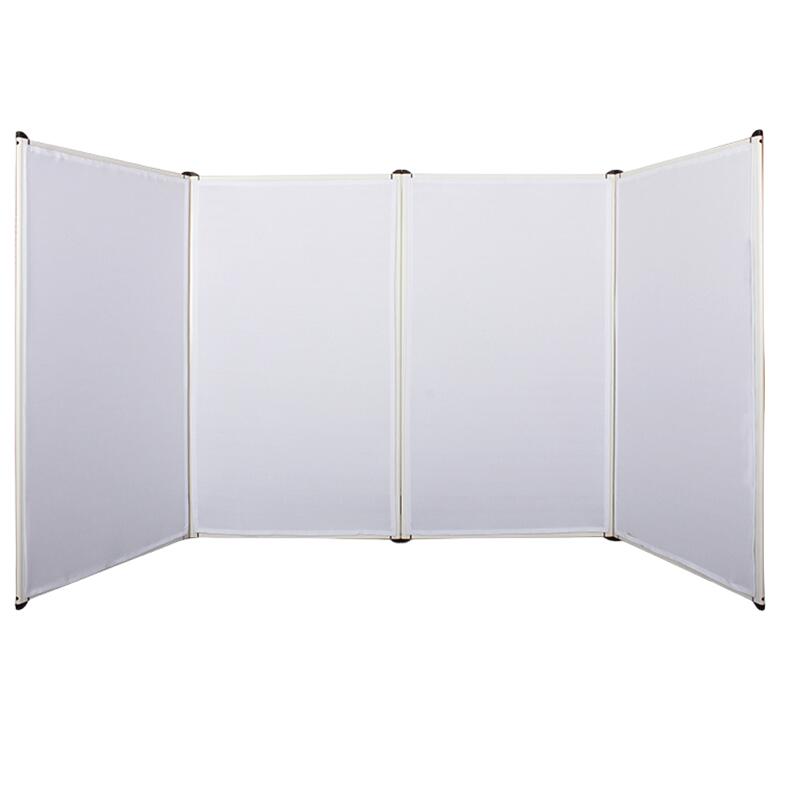
Packing, and what arrives with the panel
Panels ship rolled or folded with the hardware packed away from the fabric, because eyelets and staple rails are what puncture a panel in transit. If the scrim is going out with a new booth, it’s normally boxed with the frame so the whole thing lands as one shipment and one carton count.
Event companies that run several booths tend to order the scrims two at a time and label them by booth. It costs nothing to add a label, and it stops the wrong panel turning up on the wrong truck.
Ordering the rest of the booth at the same time
Most scrim orders don’t stop at the panel. Buyers working on a booth usually look at the Yinyu foldable dj table, the OEM dj table with tv bracket and the OEM Yinyu foldable dj facade table in the same breath, because the same workshop cuts them and the same carton plan covers all of it. One shipment beats three freight bills, and it keeps the colour and the hardware consistent across the whole booth.
If headphones go out with the booth for the operator, dealers often bundle Audfine pairs in the same order, since a booth that’s sold as a set sells faster than a frame on its own. That’s a stock decision rather than a spec one, but it’s the same shipment either way.

Questions we get before a scrim goes on the order
Can you match a scrim we already own?
Usually, if we can see it. Send a close photo in daylight next to something neutral and the dimensions, and we’ll tell you honestly whether the match will be close or only near. A near match on a panel that sits beside the original is worse than a deliberate contrast, so we’d rather say so up front.
What flame paperwork do venues normally ask for?
It varies by city and by venue, which is exactly why we ask you to name the one your venue uses. Get it named on the order so the certificate that ships matches the certificate that gets checked.
Can you make a scrim for a booth we bought elsewhere?
Yes. Panels for a third party frame are a normal order. The dimensions and the attachment method are what we need, and a photo of the frame with a tape on it’s enough to work from.
Do you sell the panel on its own, or only with a table?
On its own. Plenty of crews replace the panel long before the frame, and there’s no reason to make them buy the whole booth again.
How long does a first panel take?
It depends on the fabric and whether there’s artwork to prepare, so the honest answer comes back with the quote rather than before it. Tell us the date of the show you’re aiming at and we’ll say whether it’s realistic instead of taking the order and hoping.
The dj scrim page carries the rest of the range if you want to see how the panel sits on the booth before you size anything.
Send the booth dimensions and we’ll size it
Send the front-face size, the venue and the date, and we’ll come back with a build rather than a catalogue. If you’re still choosing the booth, say so and we’ll size the panel against a frame that’s actually in stock, which saves a remake later.
If you’d rather start with a swatch, ask. Fabric in your hand settles more scrim arguments than a page of specification ever will.
The booth side of the range is badged Yinyu and made by Ningbo Lesound Electronics in Zhejiang. Whoever answers a frame question answers a scrim question too.
Post time: Oct-13-2026