


An instrument cable looks like the simplest piece of gear on stage: two connectors, a jacket, and a length of copper in between. That simplicity is exactly why the internal construction is worth understanding. The two specifications that separate a cable that lasts a touring season from one that crackles within months are the conductor material — specifically whether it is oxygen-free copper, or OFC — and the shielding, where a braided screen behaves differently from foil or spiral wraps. This article explains what each of those terms actually describes, what physically changes inside the cable, and how to read a specification sheet without relying on marketing language.
The context matters as much as the physics. A guitar or bass cable carries an unbalanced, instrument-level signal: high impedance, low voltage, and no common-mode rejection to help it. Whatever noise the cable picks up along its length arrives at the amplifier at nearly full strength. That is why conductor purity and shield construction, which are minor details on a balanced microphone line, become first-order decisions on an instrument cable.
What OFC Actually Means
OFC stands for oxygen-free copper — copper that has been refined to a very low residual oxygen content, typically below a threshold measured in parts per million. The designation is not a marketing invention; it refers to a defined refining process, usually melting and casting under a protective atmosphere so that oxygen does not dissolve into the metal. Standard electrolytic copper, by contrast, carries measurably more oxygen trapped within its grain structure.
Why does oxygen content matter in a cable that carries a guitar signal? The effect is less about conductivity on day one and more about how the conductor ages. Copper with high oxygen content is more vulnerable to intergranular oxidation: over years of exposure to air migrating through jacket pores and connector seams, oxides form along grain boundaries inside the conductor. Each oxide region is a less conductive boundary in the path the signal travels. An OFC conductor oxidises far more slowly through its cross-section, which is why cables built with it keep consistent electrical characteristics through years of storage, coiling and stage use.
There is a second, more immediate benefit. The same refining route that removes oxygen also produces a copper with fewer impurities overall and a more uniform grain structure. For a manufacturer drawing this copper into fine strands, that uniformity translates into fewer drawing defects and more consistent strand-to-strand dimensions — which matters because instrument cable conductors are stranded, not solid, precisely so the cable survives repeated coiling.
Stranding, Purity and Flex Life
An instrument cable lives a mechanical life that fixed-install wiring never sees. It is coiled after every show, stood on, run over by road cases and stuffed into a gig bag. A solid core conductor would work-harden and snap. Fine stranding solves this, and the quality of the copper determines how well the stranding survives it. Many pro-grade cables specify tin-plated OFC strands: the tin layer resists solder wicking during termination and slows surface oxidation on the strand exterior, while the OFC core carries the signal.
When comparing cables, the meaningful question is not only whether the datasheet says OFC, but whether it states the stranding configuration — how many strands, of what diameter. A cable with a high strand count of fine OFC wires flexes more times before fatigue than a cable with a few thick strands, and the difference is visible on any rental fleet after one season.
Braided Shielding: What It Does and Why the Weave Matters
Shielding is the cable’s defence against the environment an instrument signal cannot fight on its own: mains hum from lighting rigs and power supplies, radio-frequency interference from the venue’s own equipment, and digital noise from switching stages. The shield works by intercepting this interference and draining it to ground, ideally before it couples into the centre conductor.
Three shield constructions dominate the market, and they behave differently in service:
- Foil shield. A thin polyester film with deposited metal. It can achieve very high physical coverage and is cheap to apply, but it is mechanically fragile — repeated flexing at the plug creases the foil and creates opens in the screen.
- Spiral shield. Wires wound in a helix around the core. It is flexible and quiet to handle, but the winding opens up when the cable is stretched or bent sharply, reducing effective coverage exactly at the strain points near the connectors.
- Braided shield. Wires woven in an over-under pattern. The weave is self-healing in the sense that flexing does not open gaps the way it does in a spiral, and it provides consistent coverage through the cable’s full bend radius.
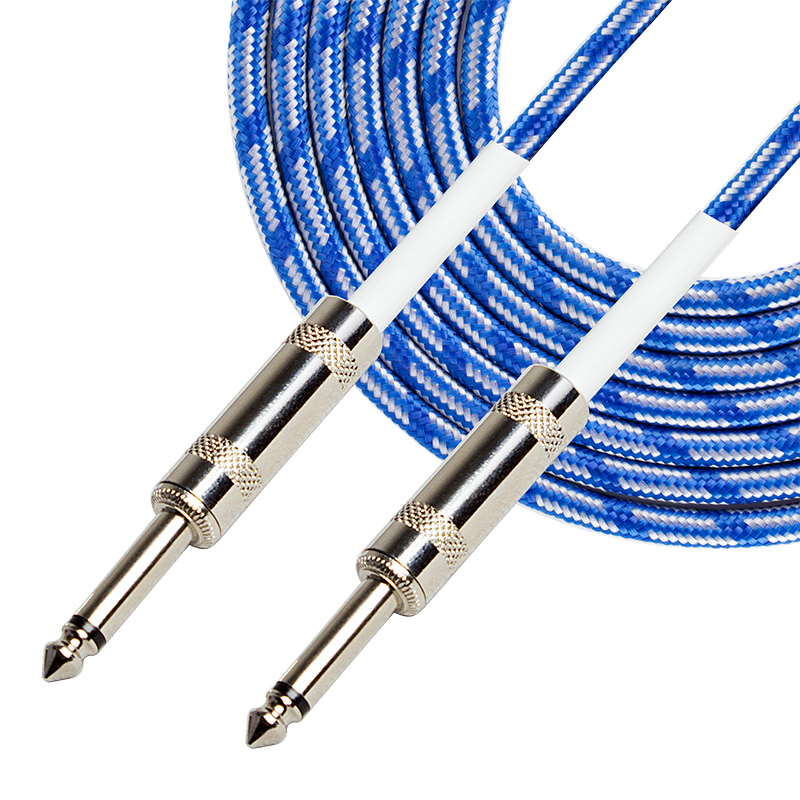
The trade-off most buyers actually notice is not electrical — it is tactile. A braid adds stiffness and manufacturing expense, which is why entry-level cables omit it. But on a stage the braid does two jobs at once. Electrically, it holds its coverage where foil and spiral shields degrade. Mechanically, in cables where the braid sits under the outer jacket, it reinforces the jacket against abrasion; in vintage-style cables where the woven fabric is the outer surface, the weave itself is the jacket and the braided copper shield sits beneath it. Either way, the over-under construction distributes bending stress across many wires instead of concentrating it on one.
Coverage Percentage and Drain Terminations
Shield specifications usually quote a coverage percentage — how much of the conductor’s surface the screen physically envelops. For instrument use, coverage in the mid-nineties from a braided shield is a common design target. The remaining gap matters less than where the shield terminates: the drain connection at the plug is the single most common failure point in any shielded cable, because every flex cycle works the solder joint at the same spot. Well-made instrument cables bond the shield to a dedicated ground path with strain relief, rather than relying on a solder tail twisted against the plug sleeve.
Note that the centre conductor in a good instrument cable usually carries its own inner insulation and sometimes a conductive layer that quiets triboelectric noise — the crackle you hear when a cable is handled, caused by charge building up between layers that rub. A braided shield alone does not solve handling noise; the inner construction does. This is why two cables with identical shields can behave very differently when you flex them during soundcheck.
Where the Difference Shows Up in Real Use
The clearest way to think about OFC and braided shielding is in terms of what fails, and when.
Intermittent crackle after months of use is almost always mechanical: a broken strand at the connector, an opened spiral shield, or a fractured solder joint. Braided shielding and fine OFC stranding attack exactly these failure modes, which is why cables specified this way are the default choice for rental stock and touring where cables are coiled nightly.
Buzz that changes with lighting states or with position in the room is a shielding-coverage problem. In a venue where the cable run passes dimmer racks or sits alongside power distro, a shield that maintains coverage along the whole length — including at the bends — keeps more of that interference out of the signal path before it reaches the amp input.
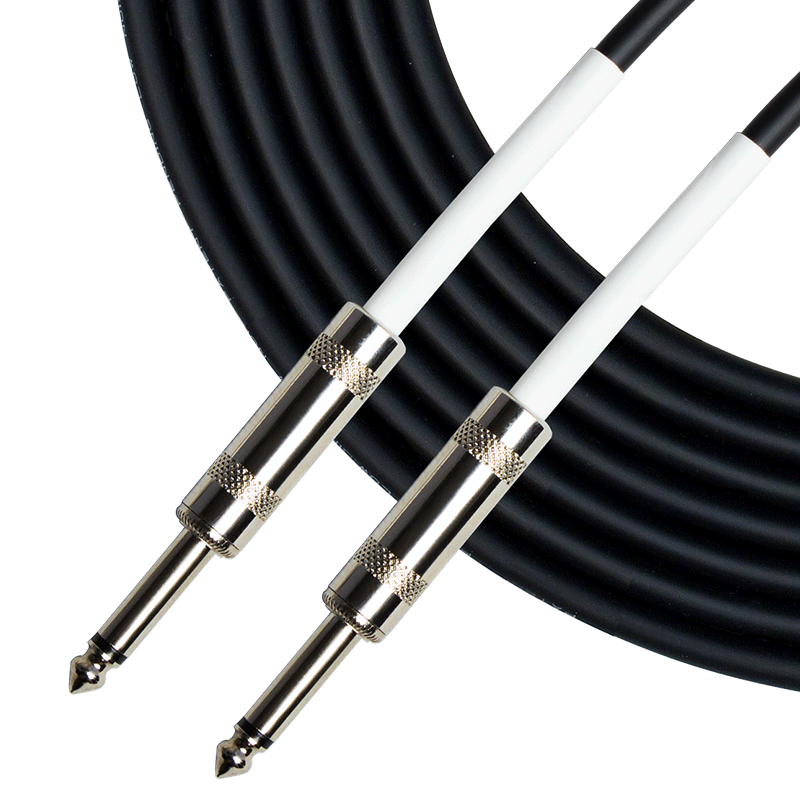
Signal dulling over years relates to conductor aging and connection integrity rather than any dramatic change. A cable whose OFC conductor and plating strategy slow oxidation keeps its capacitance and contact quality stable across a much longer service life — which, for a dealer or rental house, is the difference between a product that generates repeat business and one that generates returns.
Reading an Instrument Cable Specification Sheet
With those principles in place, a spec sheet becomes readable. The items worth locating, in order of practical importance:
- Conductor — OFC, and the strand count. More, finer strands indicate a flex-optimised build.
- Shield type and coverage — braided with stated percentage coverage is the strongest indication of a stage-grade cable.
- Capacitance per metre — this is the figure that shapes how a passive pickup sounds through a long run; lower capacitance preserves high-frequency content. It is a design characteristic, not a quality ranking: some players prefer the warmer response of a higher-capacitance run.
- Jacket material — flexible PVC suits general stage use; rubberised or braided-fabric outer surfaces trade expense for feel and abrasion behaviour.
- Strain relief and plug construction — moulded relief with a supporting sleeve, and plugs that can be re-terminated, extend service life more than any single internal component.
A datasheet that omits the first three items is telling you where the build budget was trimmed. A datasheet that publishes them is giving you the information needed to compare cables on engineering grounds.
Common Buying Mistakes
Judging by jacket appearance alone. A tweed braid looks professional, but the woven fabric layer is cosmetic; the electrical shield and conductor underneath are what the cable is. Ask for the full construction, not the colourway.
Assuming thickness equals quality. Diameter often reflects jacket thickness, which has nothing to do with conductor purity or shield coverage. The spec lines matter; the calipers do not.
Buying on initial measurements alone. Every cable measures well on the bench when fresh. Conductors and shields distinguish themselves over hundreds of flex cycles, which is why stranding detail and braid construction are the most predictive items on the sheet.
Matching cable length carelessly. Because capacitance accumulates with length, the right cable for a two-metre pedalboard patch is not the right cable for a ten-metre stage run. Specify per position rather than ordering one length for everything.
FAQ
Is OFC audible on its own?
On a short, healthy cable the audible difference between conductor grades is subtle and hotly debated. The practical argument for OFC is stability over time: it resists the oxidation that degrades conductors through years of service, and it draws into more uniform strands. Buyers specifying for rental fleets and resale should treat OFC as a longevity specification first.
Braided shield or foil shield — which should I stock?
For cables that will be coiled daily, a braided shield is the standard choice because its coverage survives flexing. Foil-shielded cable remains appropriate for semi-permanent patching inside a rack or a pedalboard, where the cable is bent once and left alone. Matching shield type to duty cycle is more useful than ranking the two constructions.
Does a braided outer jacket mean the cable is shielded by the braid?
No. The visible woven fabric on vintage-style cables is a protective and decorative outer layer. The electrical shield is a separate braided copper screen underneath it. Check the construction diagram on the datasheet rather than inferring from the surface.
How Yinyu Builds Instrument Cables
LESOUND manufactures professional audio and music accessories in Ningbo, China, and our cable range is produced under the Yinyu brand. The instrument cable line covers straight and right-angle configurations, braided-fabric and flexible PVC jackets, and both oxygen-free copper conductor options and standard builds, so a range can be tiered by construction rather than by cosmetic trim.
The instrument line sits within a wider connector and cable programme: microphone cables with balanced OFC construction, audio snake cables for multichannel stage runs, and the full cable and connector catalogue from patch leads to speaker and DMX lines. Because cables are engineered and produced alongside our microphone stands, speaker stands and DJ booth systems, dealers and brand owners can assemble a complete stage package — cables, stands and DJ furniture — from one factory, one artwork sign-off and one consolidated shipment.
We serve both OEM programmes and small-batch wholesale orders. If you are building a private-label cable range, send us the construction you want — conductor specification, shield type, jacket material, length and connector plating — and we will quote against that drawing, or propose a construction from our existing GTC range that meets it.
Next Step
If you are deciding which instrument cable construction fits your market, tell us the duty cycle: how often the cables are coiled, what lengths your customers run, and whether the range needs a vintage braided aesthetic, a workhorse PVC build, or both. We will map those requirements to specific constructions and confirm the specification in writing before sampling.
Post time: Sep-17-2026