


Walk into any backline room and you will find three connector families doing almost all of the analogue work: the three-pin XLR connector, the TRS plug with its two insulating rings, and the plain TS plug with just one. They look similar, they mate with similar jacks, and they are frequently interchangeable in an emergency — which is exactly why so much confusion surrounds them. The connector is not a mechanical afterthought. It declares how the signal inside the cable is wired: balanced or unbalanced, one conductor plus ground or two conductors plus ground. Choosing the wrong one rarely breaks equipment, but it quietly gives up noise rejection, level, or both.
This guide explains what each connector actually carries, where each one belongs in a signal chain, and where the boundaries between them sit — the places where a mixing desk, an instrument and a cable meet and the wiring standard changes.
What the Connector Physically Declares
Every one of these connectors is a way of terminating conductors at the end of a cable. The differences that matter are threefold:
- Pin count and contact arrangement. XLR provides three pins (plus optional shielding variants with more), TRS provides a tip, ring and sleeve, and TS provides only a tip and sleeve.
- Latching mechanism. The XLR’s push-lock catch holds the connection under stage abuse; 6.35mm plugs rely on jack friction alone.
- Balanced or unbalanced wiring standard. This is the electrical consequence of the first two points, and it is the one that determines whether a cable rejects interference on a long run.
A balanced connection sends the same audio signal twice — once in phase and once inverted — and the receiving input amplifies only the difference between the two. Any interference the cable picks up along the way arrives identically on both conductors and is cancelled at the input. An unbalanced connection carries a single signal conductor against a shield, so whatever the cable picks up is added directly to the programme audio. XLR and TRS are wired for the former; TS is wired for the latter.
XLR: The Balanced Standard for Microphones and Line Level
The three-pin XLR is the default connector for microphones and for line-level signals between professional equipment, and the reasons are electrical and mechanical at once. Electrically, pins 2 and 3 carry the balanced pair while pin 1 bonds the shield to chassis ground — the classic configuration that lets a microphone send a tiny signal tens of metres to a preamplifier without picking up the lighting dimmers on the way. Mechanically, the locking catch means a cable pulled across a stage unplugs itself at the connector housing rather than dragging a microphone off its clip.

XLR also carries phantom power: mixing consoles supply a DC voltage down the same balanced pair to power condenser microphones and active DI boxes. The connector’s contact arrangement is designed so that hot-plugging does not route that voltage to the wrong pin audibly. None of this happens on a 6.35mm line.
Where XLR Belongs
- Microphone runs of any length, from a vocal mic on a stand to a drum kit across the stage.
- Line-level interconnect between a console, outboard processors and powered speakers.
- Snake and multicore systems, where many XLR pairs share one loom — see our audio snake cables for how that scales to 8, 12 and 24 channels.
- Any run likely to be stepped on, pulled, or coiled nightly.
TRS: The Balanced 6.35mm Workhorse
A TRS plug — tip, ring, sleeve — carries three contacts, which makes it the 6.35mm world’s equivalent of a three-pin XLR. Wired as a balanced line, tip is hot, ring is cold, sleeve is ground, and a TRS-to-TRS cable between two balanced inputs behaves like an XLR pair: common-mode noise cancels at the receiving input. This is why patchbays, rack processors and many mixer channel inserts use TRS, and why studio monitor inputs frequently offer a balanced 6.35mm jack alongside XLR.
TRS has a second, entirely different job: the stereo unbalanced connection. On headphones and on stereo line links, tip carries left, ring carries right, sleeve is the shared return. The plug geometry is identical; only the wiring standard behind it changes. This dual identity is the single most common source of confusion when technicians read a cable label — a “TRS cable” describes the plug, not what the cable carries. When specifying stock, it pays to describe the application (balanced mono line, stereo headphone feed, insert send/return) rather than the plug alone.
TRS or XLR for a Balanced Run?
Where a device offers both, the choice is largely about latching and environment. A TRS jack depends on the socket’s spring contacts, which is fine in a rack that never moves and adequate on a pedalboard. For floor runs, crossovers between rooms, and anything a crew will trip over, the XLR’s locking catch is the reason it survives professional touring. Distances matter too: balanced TRS is engineered to reject interference over long runs, but the XLR ecosystem — wall plates, stage boxes, looms — is built around it, and a mixed connector plan complicates every future expansion.
TS: Unbalanced Instrument and Patch Duty
The TS plug — tip and sleeve only — carries one signal conductor against its shield. It is the correct connector for an electric guitar, bass or keyboard output, because those instruments have unbalanced, high-impedance outputs designed for exactly this wiring. Put a TS-to-TS cable between a guitar and an amplifier and the cable itself becomes part of the instrument’s tone: its capacitance rolls off high frequencies with length, which is why instrument cables are specified per length rather than sold as one-size-fits-all.
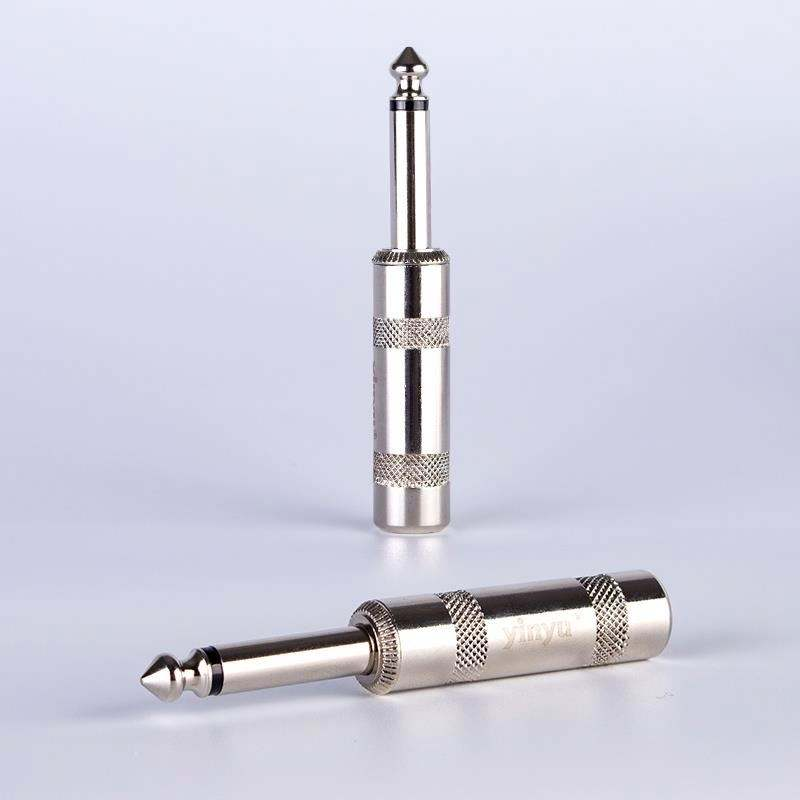
Where TS goes wrong is distance and environment. Because there is no balanced pair to cancel interference, a long TS run picks up mains hum and lighting noise directly. The practical ceiling for unbalanced runs in a live environment is short — pedalboard patches, a guitar to a nearby amp, keyboard-to-DI positions on a small stage. Beyond that, the signal should be balanced (with a DI box converting the instrument output to XLR) before it travels.
The Adapter Question
Adapters between these families exist for good reasons and fail in predictable ones. A TRS-to-XLR cable wired to the balanced standard is a legitimate way to connect balanced gear across connector formats. But a bare TS-to-XLR adapter placed on a guitar cable does not balance anything — it merely changes the plug shape while the signal stays unbalanced, hum and all. The rule worth teaching every tech: an adapter changes contacts, not wiring standards. If the equipment at either end is unbalanced, no plug shape will make the run reject interference.
Matching Connector to Signal Path
Condensed to a checklist that works across almost any venue or install:
- Microphone to preamp. XLR, always. The run may be long, and phantom power expects the pinout.
- Instrument to amp or DI. TS on the instrument side; XLR from the DI box onward.
- Balanced line level, rack to rack. TRS or XLR per the equipment’s sockets — both are balanced.
- Headphones. TRS (or the locked variants on studio models), carrying stereo unbalanced.
- Long floor runs. Balanced XLR regardless of what the source is; convert early, run far.
- Patchbays and insert loops. TRS, matching the console’s insert standard.
For the cable constructions behind these connectors, the broader rules are covered in our guide to audio cable types, and the multichannel version of the same logic — many XLR pairs sharing one jacket — is what a stage snake is for.
Common Buying and Wiring Mistakes
Sourcing a “guitar cable” with TRS plugs. It will pass signal, but the guitar output is unbalanced, so the extra ring contact buys nothing. Worse, some gear treats a ring connection specially and the result is a dead or distorted channel. Match TS plugs to instrument outputs.
Running microphone signals on adapter chains. Every screw-on adapter in a long XLR run adds two contact junctions and one more thing to fail mid-show. Specify the correct terminated cable from the start for anything that goes out on hire.
Assuming connector plating is a tone decision. Contact plating primarily affects long-term contact reliability and corrosion behaviour — a sourcing and service-life consideration, not an audible one on a healthy connection. Dealers are better served by asking about contact materials and spring tension than by chasing plating folklore.
Ignoring the strain relief. In service records across every connector family, the failure point is rarely the contact; it is where the cable enters the boot. Boots with a supporting sleeve and a solder anchor survive nightly coiling far longer than bare moulded plugs.
FAQ
Can I use a TRS cable in place of a TS cable for a guitar?
Electrically it usually passes signal, but there is no benefit — the guitar output is unbalanced, so the ring contact is unused — and a few instruments and pedals misbehave with a ring present. The safe stock decision is TS plugs for instrument cables and TRS plugs for balanced lines and headphones.
Is XLR really necessary for short runs?
For microphones, yes, regardless of length: phantom power, the preamp input standard and the locking connector all assume XLR. For line-level gear a metre apart on a rack shelf, balanced TRS is a perfectly standard choice. Length is where XLR’s latching and ecosystem pay for themselves.
How do I tell TRS and TS plugs apart at a glance?
Count the black insulating bands on the shaft: one band means TS (two contacts), two bands mean TRS (three contacts). It is the same convention as the RCA-to-banana world of multimeters, and it works in a dark backstage box where labels have fallen off.
Yinyu Connector and Cable Programme
LESOUND manufactures professional audio accessories in Ningbo, China, and our connectors and cables are produced under the Yinyu brand. The connector range spans three-pin XLR plugs and chassis sockets, 6.35mm TS and TRS plugs in straight and right-angle form, nickel and gold contact options, and cable-mounted or panel-mounted formats — the full catalogue sits within our cable and connector programme alongside microphone cables, instrument lines and multichannel snakes.
Because connectors are terminated in the same plant as the cable they ride on, cable and plug are specified together rather than sourced apart: strand count, shield type and boot construction are matched to the duty the assembly will see, and every termination is designed for re-soldering in the field rather than disposal at first failure. The same production footprint covers our microphone stands and DJ tables, so a distributor building a stage-goods category can consolidate cables, stands and DJ furniture with one supplier.
We supply both OEM programmes and small-batch wholesale. Tell us the applications your customers run — mic duties, instrument lines, patchbay stock — and we will map them to connector and cable combinations from the existing range, or terminate to your drawing and confirm the specification in writing before sampling.
Post time: Sep-18-2026