


Impedance is the number that appears on every studio headphone specification sheet, and it is also the number that causes the most confusion. A monitoring headphone is offered in 32Ω, 80Ω, and 250Ω versions, and buyers ask a very reasonable question: are these three grades of quality, or three tools for three different jobs? The answer shapes what a distributor stocks, what a rental company fleets, and how an OEM brand configures its headphone range.
This article explains what headphone impedance actually measures, walks through the 32, 80, and 250 ohm variants in practical terms, and shows how one professional model — the DH-1772 in the LESOUND range — uses all three variants to cover different markets from a single design.
What Impedance Actually Measures
Impedance is the opposition a headphone’s voice coil presents to the alternating-current audio signal, measured in ohms (Ω). It is an electrical property of the coil winding, not a measure of sound quality. A 250Ω headphone is not a higher grade of the same product; it is a headphone that has been engineered to be driven differently.
The practical relationship works like this:
- Low-impedance headphones (16–50Ω) draw more current at lower voltage. They play loudly when connected to devices with limited output, such as laptop outputs, portable recorders, and battery-powered interfaces.
- Mid-impedance headphones (60–100Ω) balance current draw and voltage demand. They work comfortably with desktop interfaces and mixing consoles.
- High-impedance headphones (200Ω and above) need more voltage to produce the same loudness, and draw less current. They are designed for sources with a healthy voltage swing — dedicated headphone amplifiers and professional gear with ample output.
There is no single “correct” impedance. There is only the match — or the mismatch — between the headphone and the source it will be plugged into. A perfectly well-built 250Ω monitor plugged into a phone will sound quiet and flat, not because the headphone is weak, but because the source cannot supply the voltage the coil asks for.
The 32 Ohm Version: Monitoring on the Go
The 32Ω variant is the one that behaves well everywhere. Battery-powered audio interfaces, field recorders, and laptops all have modest output stages, and a 32Ω load lets them deliver usable listening levels with the voltage they have.
In practice, the 32Ω version suits:
- Mobile recording rigs and field recording kits
- Home studios built around compact desktop interfaces
- Content creators who move between a laptop, a camera, and a portable recorder
- General-purpose monitoring where the source gear changes from day to day
The trade-off is that a low-impedance load asks more from the source’s output stage. On a weak or noisy output, that can show up as a touch of background hiss at higher listening levels. On a clean interface, the 32Ω version is simply the most convenient tool in the range.
The 80 Ohm Version: The Working Middle Ground
The 80Ω variant sits where a large share of studio work happens. Desktop interfaces, small mixers, and monitoring controllers drive it without strain, and it retains enough headroom to benefit from a dedicated headphone amplifier when one is available.
This is the variant many engineers specify for control-room work and tracking sessions, because the same headphone behaves predictably across the mixed collection of gear a typical studio accumulates. For a distributor building a retail range, 80Ω is also the safest single variant to stock, because it functions acceptably on almost everything a customer might plug it into.
The 250 Ohm Version: Fixed Studios and Professional Sources
The 250Ω variant is engineered for environments where the source has real output capability. Dedicated headphone amplifiers, professional interfaces, and installed monitor systems deliver the voltage swing a high-impedance coil requires, and in return the load draws less current — which many amplifier designs handle with ease over long sessions.
The 250Ω version finds its home in:
- Fixed studio installations with proper amplification
- Post-production rooms and broadcast facilities with professional monitoring chains
- Multiple-headphone setups driven from a central distribution amplifier, where lower current draw per unit is an advantage
The important point for buyers is that the 250Ω version is not a premium upgrade of the 32Ω version. It is a different configuration intended for different source gear. Selling a 250Ω headphone to a customer who will use a phone or a laptop invites a return, not a repeat order.
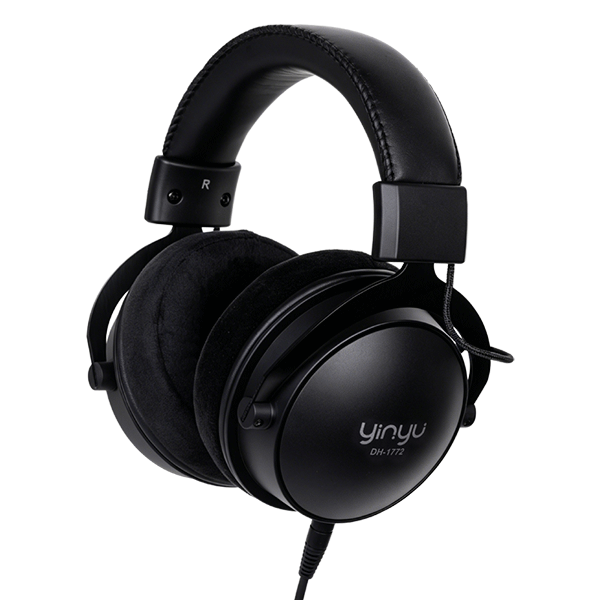
Why One Headphone Model Comes in Three Impedances
Manufacturing three impedance variants of one model is a deliberate engineering decision. The driver family, the acoustic tuning, the earcups, and the headband stay identical across the range; what changes is the voice coil winding. That lets one design cover distinct usage scenarios without fragmenting the product line.
The DH-1772 illustrates the approach. It is a tuned circumaural monitoring headphone built around 50mm neodymium-magnet drivers, with a frequency response of 10Hz–35kHz, sensitivity of 99±3dB, and power handling of 400mW rated and 1800mW maximum. The specification sheet lists all three impedance options — 32Ω, 80Ω, and 250Ω — as native variants of the same design, with the 32Ω version positioned for normal monitoring and the 80Ω and 250Ω versions intended for professional audio devices.
For an OEM buyer, this structure matters commercially. One tooling serves retail, project-studio, and professional-installer channels. The packaging, spare parts, and accessory sets stay common across variants, and a brand can enter a new market segment without commissioning a new headphone.
Sensitivity and Power Handling Belong in the Same Conversation
Impedance alone does not determine how loud a headphone will play. Sensitivity — stated in dB per unit of input — tells you how efficiently electrical input becomes acoustic output. The DH-1772′s 99±3dB sensitivity means modest input power already produces substantial listening levels, which is why the same model works across all three impedance variants in appropriate setups.
Power handling is the third piece. A rating of 400mW with an 1800mW maximum describes how much signal the headphone absorbs safely. For buyers, generous power handling is about headroom and durability during long monitoring sessions, not about playing louder.
When comparing any monitoring headphone range, read the three figures together — impedance against the intended source, sensitivity for efficiency, and power handling for headroom. A supplier who documents all three clearly is also, in practice, a supplier who controls them on the production line.
Matching the Variant to the Market
For distributors, rental companies, and installation contractors, the question is which mix of variants to carry. A useful rule of thumb:
- General retail and content-creator channels — lead with 32Ω, add 80Ω for customers with desktop interfaces.
- Project studios and music retailers — stock 80Ω as the core, with 32Ω for mobile users and 250Ω for customers with dedicated amplification.
- Rental fleets — 80Ω tolerates unpredictable source gear best; label each unit’s impedance clearly so crews grab the right one.
- Fixed installations — specify 250Ω where the monitoring chain includes proper amplification, and keep one consistent variant per room for predictable levels.
Mixing variants inside a fleet without labelling is the most common operational mistake. Two visually identical headphones that behave differently in front of an engineer erode trust quickly, so variant marking belongs on the headband, the yoke, or the packaging — not buried in a serial number.
What OEM Buyers Should Confirm Before Committing
If you are building a monitoring headphone range under your own label, the impedance discussion extends beyond the spec sheet. Before committing to a programme, confirm:
- Which variants are native to the design — engineered coil options, not a single unit re-listed three ways on paper
- Consistent acoustic intent across variants — the tuning target should not shift from 32Ω to 250Ω; only the drive requirement should change
- Variant labelling at the factory — packaging and unit marking that make warehouse mix-ups impossible
- Cable and connector strategy — the DH-1772, for example, uses a detachable 3-metre braided OFC cable with an anti-loss design and ships with a gold-plated 6.35mm (1/4″) to 3.5mm (1/8″) adapter, so one headphone connects to studio gear and portable devices alike
- Accessory and spare-part coverage — carrying cases, soft bags, spare ear-pads, and spare cables ordered alongside the headphone so the range is maintainable in the field
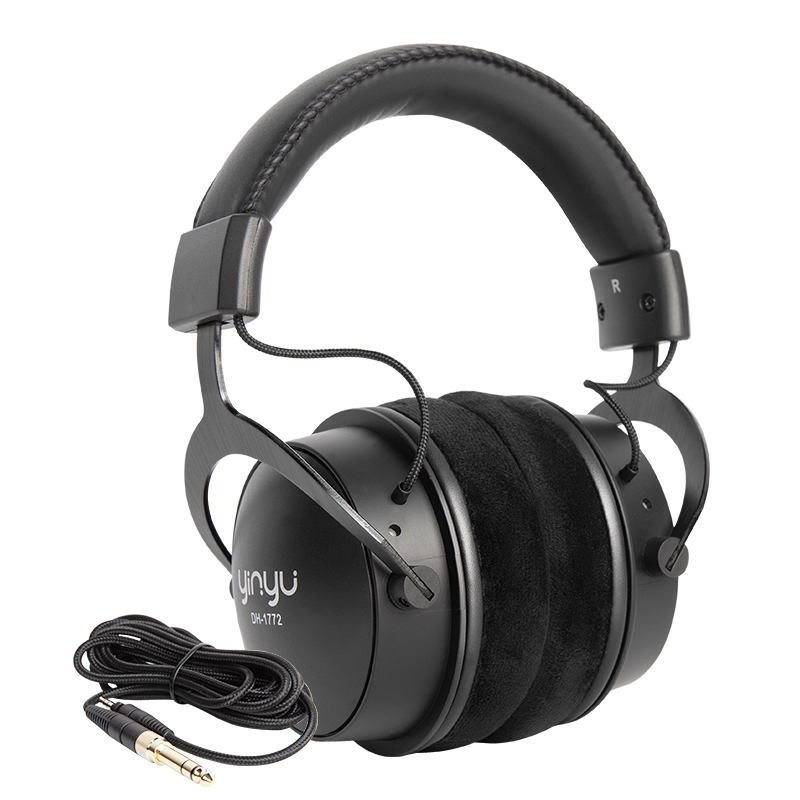
A deeper checklist covering sample evaluation, construction details, and packaging for a headphone programme is available in our earlier article on what OEM buyers check before ordering studio headphones.
The Practical Summary
Impedance is a matching specification, not a quality ranking. Choose 32Ω for mobile and changeable source gear, 80Ω for general studio work, and 250Ω for professional setups with proper amplification. Because the three variants share one acoustic design, a single model range can serve all three scenarios — which is exactly why manufacturers like LESOUND engineer their monitoring headphones with all three options documented on the spec sheet from the start.
LESOUND manufactures professional monitoring headphones in Ningbo, China, supplying them under customer brands and under its own house brands — Yinyu for stands and cables and Audfine for headphones. To review the full monitoring headphone range and the available impedance options, visit the headphones catalogue. For the cable side of the monitoring chain, the audio cables and microphone cables sections cover the wiring that connects sources to monitoring setups, and the cables index lists the complete range.
Post time: Oct-30-2026