


Studio headphones look simple from the outside: two earcups, a headband, a cable. Anyone who has run an OEM programme knows the picture is very different. Driver sourcing, impedance variants, ear-pad materials, cable systems, packaging, and consistency from one production batch to the next all sit behind that simple exterior. When a buyer orders a monitoring headphone range under their own label, every one of those details ends up in front of their customers wearing the buyer’s name.
This checklist walks through what experienced distributors, retail chains, and audio brands actually verify before committing to a studio headphone order — and uses two models from the LESOUND range, the DH-1772 and the DH-7500, to show what a well-documented specification looks like in practice.
1. A Complete, Honest Specification Sheet
The first thing an OEM buyer asks for is the specification sheet, and the first check is whether it is complete. A professional monitoring headphone should document, at minimum:
- Driver diameter and magnet type
- Frequency response range
- Sensitivity and rated/max input power
- Impedance, including any available variants
- Cable type, length, and connector finish
- Ear-pad and headband materials
Vagueness here is a signal. If a supplier cannot state the driver size or the impedance options in writing, the production line behind it is unlikely to hold those parameters steady across batches.
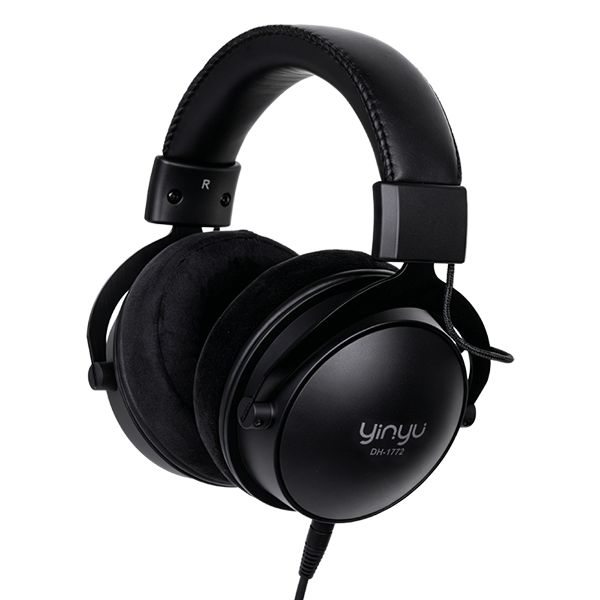
The LESOUND DH-1772 shows what a complete sheet looks like. It is built around 50mm neodymium-magnet drivers with a frequency response of 10Hz–35kHz, sensitivity of 99±3dB, and power handling of 400mW rated and 1800mW maximum. Its circumaural, around-the-ear design isolates in loud environments, and the ear pads use a soft, skin-friendly material with an adjustable headband for long sessions.
Impedance Variants: One Model, Several Markets
One detail separates serious monitoring headphones from commodity stock: impedance options. The DH-1772 is available in 32Ω, 80Ω, and 250Ω versions. The 32Ω version suits portable interfaces and mobile recording rigs, while the 80Ω and 250Ω versions are intended for professional audio devices and fixed studio installations.
For an OEM buyer, this matters commercially. A single tooling with three impedance variants lets one model serve several customer segments without redesign — and it signals that the factory genuinely engineers the range rather than reselling generic stock. When you review any supplier’s sheet, ask which variants are native to the design and which are aspirational.
2. Construction Details That Survive Studio Life
Studio headphones are handled constantly. They are pulled off and on dozens of times a day, tossed into gig bags, and passed between engineers. Buyers therefore check the physical construction, not just the numbers:
- Headband adjustment — metal or reinforced sliders rather than brittle clip-in plastic
- Earcup swivel — the DH-7500, for example, has 90° swiveling earcups for quick one-ear monitoring, a detail DJs and studio engineers rely on daily
- Folding mechanism — the DH-7500 folds up for storage and travel, which matters for mobile rigs and rental fleets
- Ear-pad replaceability — pads are consumables; if they cannot be replaced, the whole headphone becomes disposable
A useful exercise during sample evaluation is to cycle every moving part twenty times. Adjust the headband fully, swivel both cups, unplug and replug the cable. Weak points in the design reveal themselves long before customers find them.
3. The Cable System and Replaceable Parts
Cable design is where OEM buyers often find the biggest gap between a good programme and a disappointing one. Two questions matter most: how the cable attaches, and what happens when it fails.
The DH-1772 uses a detachable braided OFC cable of 3 metres with an anti-loss design, and the DH-7500 uses a detachable coiled OFC cable of 4 metres. Both ship with a gold-plated 6.35mm (1/4″) to 3.5mm (1/8″) adapter, so one headphone covers studio interfaces and mobile devices alike. Detachable, anti-loss connections protect the headphone itself: the cable takes the abuse, and a damaged cable is a replacement part rather than a returned product.
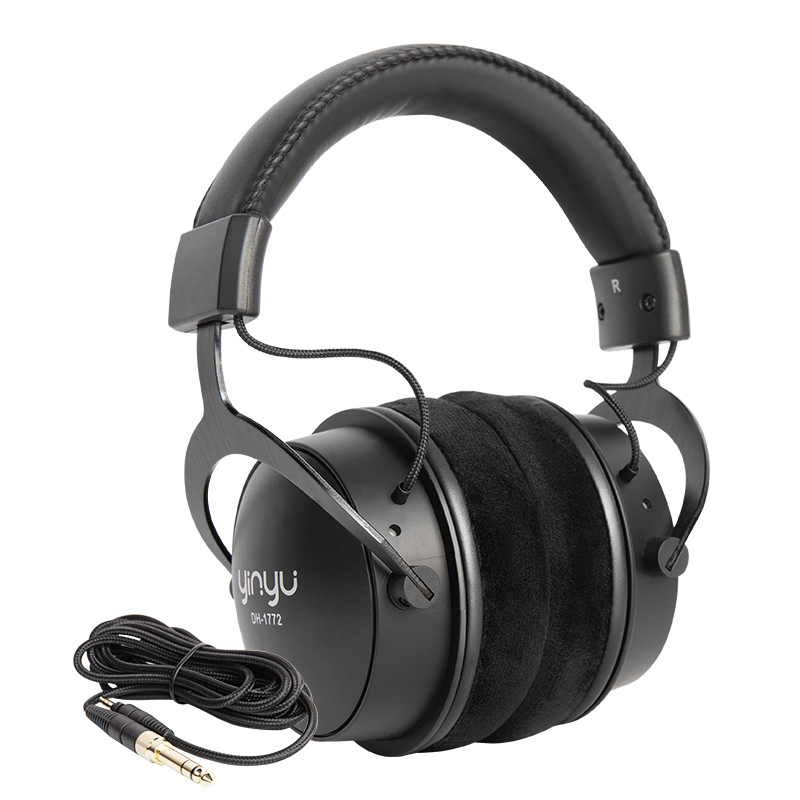
Buyers also look at what else can be ordered alongside the headphone. Both models list a plug-in microphone cable, extra ear-pads, and spare cables as options. That modularity matters to retailers: spare pads and cables turn a one-time sale into a repeat-purchase accessory line. It matters to rental houses even more, because a fleet that can be maintained in the field lasts far longer than one that cannot.
4. Sample Evaluation Before Any Volume Commitment
Experienced buyers never approve a headphone programme from a specification sheet alone. The sample stage is where the checklist gets physical. A disciplined evaluation covers:
- Matched pairs — order two or three samples of the same model and compare them against each other. Unit-to-unit variation in a sample batch predicts variation in a production batch.
- Long-session comfort — clamp force, pad temperature, and headband pressure only reveal themselves after an hour of continuous wear.
- Isolation behaviour — circumaural pads should seal consistently across different head shapes, not just on the one person doing the testing.
- Cable strain relief — flex the cable at the plug and at the cup entry. This is where failures concentrate.
- Packaging fit — check that the solid carrying case or soft bag option actually protects the folded unit, and that a customized box prints cleanly with your branding.
Both the DH-1772 and the DH-7500 offer solid carrying case, soft carrying bag, and customized box options — exactly the structure an OEM buyer needs to configure retail, rental, and touring versions of the same model.
5. Production Consistency and Programme Support
The final checks move from the product to the factory behind it. A monitoring headphone is a repeat-purchase, specification-driven product, so buyers verify that the supplier can hold the specification over time:
- Driver sourcing discipline — whether the 50mm drivers come from a stable supply with incoming inspection, or from whichever lot is cheapest that month.
- Assembly and QC checkpoints — where frequency response, sensitivity, and cable pull tests sit in the line, and whether results are recorded per batch.
- Capacity that scales — headphone output that can grow with a volume programme rather than constraining it; LESOUND states that capacity can be scaled for volume programmes across its categories.
- Communication structure — a named contact who can answer engineering questions, not just forward emails.
These questions overlap with the broader vetting process described in our guide to what an OEM audio accessories factory actually does for your brand. The difference for headphones is tolerance: small shifts in driver placement or pad density are audible to studio customers immediately, so batch-level record-keeping is not optional.
6. Branding, Packaging and Accessories Configuration
The last checkpoint is everything the customer actually sees. LESOUND supplies studio headphones under its own house brands — including Yinyu and Audfine — and under customers’ own brands, with the ownership of both house brands held by the company. For an OEM buyer, the practical checklist is:
- Logo application method — printed or moulded earcup badges, and how each ages
- Customized retail box — artwork formats, insert tooling, and reprint flexibility
- Accessory bundles — which combination of case, bag, spare pads, adapter, and microphone cable ships in the box
- Documentation — user inserts and spec cards that match your market’s language
Getting this layer right early avoids the most common OEM disappointment: a technically sound product that arrives in packaging that looks like an afterthought. Buyers building a broader own-label range often pair the headphone line with other categories; our overview of small-batch wholesale for audio accessories covers how to phase those introductions.
A Compact Version of the Checklist
Before signing a studio headphone order, an OEM buyer should be able to tick every box below:
- Complete specification sheet: driver, response, sensitivity, impedance, power
- Impedance variants that match your target markets
- Swivel, folding, and adjustment hardware that survives daily handling
- Detachable cable system with replaceable pads and spares available
- Multi-unit sample comparison showing consistent units
- Batch-level QC records for the acoustic parameters
- Branding, case, and box options configured before the pilot run
- A factory contact who answers engineering questions directly
Conclusion: Buy the Programme, Not Just the Product
The headphones a studio customer unboxes are only the visible layer of a much larger system: driver sourcing, impedance engineering, cable modularity, packaging tooling, and batch discipline. Buyers who check the full stack — spec sheet, construction, samples, factory, and branding — end up with a range that holds its reputation across seasons. Buyers who check only the sample in their hand usually discover the difference at the worst possible moment: after the goods have landed.
The LESOUND DH-1772 and DH-7500 illustrate the documentation and modularity standards described above — three impedance variants and a braided cable on the 1772, a folding chassis with swiveling cups and a coiled cable on the 7500. To browse the full studio and monitoring range, visit the LESOUND headphones category, or see how headphone programmes connect to the wider accessory range through our audio cables and microphone cables categories.
Planning a studio headphone programme under your own brand? Contact LESOUND with your target markets and configuration, and request samples of the models that match.
Post time: Oct-07-2026